Work-Life Balance in the Time of VUCA: A Secondary Data Analysis
Mir Sharifullah Sadat  and Sunita Sharma*
1Faculty of Management Studies, The Maharaja Sayajirao University of Baroda, India .
Sunita.sharma-mgmt@msubaroda.ac.in
The Volatility, Uncertainty, Complexity, and Ambiguity (VUCA) environment has made it increasingly difficult for employees to maintain a healthy work-life balance (WLB). The aim of this study is to examine the impact of VUCA (Volatility, Uncertainty, Complexity, and Ambiguity) on employees’ work-life balance and to identify the key organizational and individual factors that influence work-life balance and employee well-being in VUCA work environments. This study examines how VUCA conditions influence WLB and employee well-being through an integrative review of existing literature. A total of 33 relevant sources identified through from various journals were reviewed and thematically analyzed. The findings indicate that volatility, uncertainty, complexity, and ambiguity can increase changing workloads, job insecurity, role confusion, work-related stress, and blurred boundaries between work and personal life. At the same time, organizational support, leadership, flexible working arrangements, reasonable working hours, and individual coping abilities can help employees manage these pressures. The study contributes to existing literature by integrating the VUCA and WLB perspectives into a conceptual framework linking VUCA pressures with workplace demands, WLB, employee outcomes, and organizational outcomes. The framework also highlights the role of organizational and individual resources in reducing these pressures. The study suggests that organizations can improve WLB in VUCA environments through supportive leadership, flexible work practices, clear role expectations, and policies that protect boundaries between work and personal life.
Copy the following to cite this article:
Sadat M. S, Sharma S. "Work-Life Balance in the Time of VUCA: A Secondary Data Analysis". Journal of Business Strategy Finance and Management, 8(1).
Copy the following to cite this URL:
Sadat M. S, Sharma S. "Work-Life Balance in the Time of VUCA: A Secondary Data Analysis". Journal of Business Strategy Finance and Management, 8(1). Available here: https://bit.ly/4jOIEpu
Citation Manager Publish History



Introduction
The modern workplace is changing rapidly, and organizations increasingly operate in conditions characterized by Volatility, Uncertainty, Complexity, and Ambiguity (VUCA). These conditions can change workloads, responsibilities, working arrangements, and organizational expectations with little warning. For employees, managing these changes while also meeting personal and family responsibilities has made work-life balance (WLB) an important concern. VUCA conditions can create different pressures for employees. Volatility may result in sudden changes in workload and working schedules, while uncertainty can create concerns about job security and future expectations. Complexity may require employees to manage several interconnected tasks, and ambiguity can make roles and responsibilities unclear. When these pressures continue, employees may experience stress, exhaustion, work-family conflict, and reduced job satisfaction. WLB has been widely examined in relation to workload, work-family conflict, organizational support, flexible working arrangements, job satisfaction, and employee well-being. Similarly, VUCA research has largely focused on organizational change, leadership, adaptability, and performance (Bennett & Lemoine, 2014; Murugan et al., 2020). Although these areas are closely connected, they have not always been considered together.
The research gap addressed by this study is therefore not simply the lack of research on WLB or VUCA separately. Rather, the gap lies in the limited integration of the two perspectives. Existing studies often examine individual workplace factors affecting WLB, while VUCA studies generally discuss broader organizational challenges. This makes it difficult to understand how the four VUCA conditions work together to influence employees' ability to manage work and personal responsibilities. This study addresses this gap through an integrative review of existing literature. It brings together VUCA-related pressures, WLB, employee outcomes, and organizational and individual resources into a single conceptual framework. The study therefore moves beyond describing previous findings and provides a way of understanding why VUCA conditions may make WLB more difficult and what can help employees manage these pressures.
Research Objectives
The objectives of the study are:
To analyze the existing literature on WLB in VUCA environments.
To identify how volatility, uncertainty, complexity, and ambiguity influence WLB.
To examine the implications of WLB for employee well-being and job satisfaction.
Identify organizational and individual factors that can support WLB in VUCA environments.
To develop a conceptual framework linking VUCA conditions, WLB, employee outcomes, and organizational responses.
Materials and Methods
Research Methodology
Research Design
This study uses an integrative conceptual literature review based on secondary sources. The purpose was to bring together existing research on VUCA and WLB, compare recurring findings, and develop a conceptual explanation of their relationship.
The review was conducted in three stages: literature identification, thematic analysis, and conceptual synthesis. The final stage was particularly important because the study did not simply summarize previous studies; it examined how the identified concepts could be connected to explain WLB in VUCA environments.
Literature Search and Selection
The literature search was conducted using Google Scholar. The main search terms were:
- Work-life balance in VUCA time
- Work-life balance
- Work-life balance and VUCA
- VUCA and employee well-being
The titles and abstracts of identified publications were initially reviewed. Full texts were considered where necessary to determine relevance.
Sources were included when they addressed one or more of the following areas:
- Work-life balance
- VUCA
- Work-family conflict
- Employee well-being
- Work-related stress
- Organizational support
- Flexible working arrangements
- Working hours or
- Related employee and organizational outcomes.
Sources that were not directly related to these themes were excluded. A total of 33 relevant sources were ultimately selected and used in the manuscript.
Research Tools
The study uses secondary data gathered through a review of relevant academic literature. Google Scholar was used as the primary search platform to identify relevant scholarly literature using keywords such as work-life balance in VUCA time, work-life balance, work-life balance and VUCA, and VUCA and employee well-being. The literature identified through these searches was carefully reviewed and selected based on its relevance to work-life balance, VUCA, employee well-being, work-related stress, organizational support, flexible work arrangements, and related organizational outcomes. The selected studies were then analyzed using content analysis to identify and organize the major themes emerging from the literature, including VUCA-related challenges, employee well-being, organizational support, flexible work arrangements, and individual coping strategies.
Thematic Analysis and Conceptual Synthesis
The selected literature was examined for recurring concepts and relationships. The analysis focused on four groups of themes:
VUCA pressures: volatility, uncertainty, complexity, and ambiguity;
WLB challenges: workload, job insecurity, role conflict, working hours, and blurred boundaries;
Supporting factors: organizational support, leadership, flexibility, boundary management, and individual coping; and
Outcomes: well-being, job satisfaction, retention, and organizational effectiveness.
The findings from these themes were compared and then integrated into a conceptual framework. The framework was developed by identifying a common pattern across the literature: VUCA conditions create pressures, while organizational and individual resources can influence how strongly these pressures affect WLB and employee outcomes.
This approach is consistent with the purpose of integrative review methods, which emphasize searching, evaluating, analyzing, and synthesizing literature to develop a broader conceptual understanding.
Literature Review
Work-Life Balance
Work-life balance refers to an individual's ability to manage professional and personal responsibilities effectively (Greenhaus & Allen, 2011). It is not simply about dividing time equally between work and personal life. It also involves satisfaction and the ability to meet responsibilities in both areas (Süß & Sayah, 2013; Norfadzilah et al., 2016).
Previous research has linked WLB with job satisfaction, life satisfaction, and mental health (Haar et al., 2014). In contrast, work-family conflict occurs when pressures from work and family roles interfere with one another (Greenhaus & Beutell, 1985; Tan et al., 2024).
This distinction is important in VUCA environments because changing work demands may make it more difficult for employees to control their time and maintain clear boundaries between work and personal life.
VUCA Environment
VUCA describes conditions characterized by Volatility, Uncertainty, Complexity, and Ambiguity (Bennett & Lemoine, 2014).
Volatility refers to rapid and unpredictable change. Employees may face sudden changes in workload, schedules, or organizational priorities (Khan, 2021; Murugan et al., 2020).
Uncertainty refers to difficulty in predicting future events and their consequences. Employees may experience uncertainty about job security, responsibilities, and organizational decisions (Murugan et al., 2020; Pabilonia and Redmond, 2024).
Complexity involves several interconnected issues and demands. Employees may have to manage multiple tasks, stakeholders, and responsibilities at the same time (Raghuramapatruni and Kosuri, 2017; Murugan et al., 2020).
Ambiguity occurs when situations and expectations are unclear and there is no established approach for dealing with them (Khan, 2021).
The COVID-19 pandemic provides a useful example of these conditions occurring together. Organizations experienced rapid operational changes, uncertainty, complex work arrangements, and changing expectations (Murugan et al., 2020; Hjámsdóttir & Bjarnadóttir, 2021).
Impact of VUCA on Work-Life Balance
Volatility
Volatile work conditions require employees to adjust quickly to changes in workload, schedules, and expectations. Sudden increases in work demands can interfere with personal and family commitments. Such changes can make it difficult to maintain a predictable routine and may increase work-family conflict (Bennett & Lemoine, 2014; Greenhaus & Beutell, 1985).
Uncertainty
Uncertainty about employment, responsibilities, and organizational decisions can encourage employees to devote more time to work. Kinman and Jones (2008) found that high job demands can make it difficult for employees to maintain balance and well-being. In an uncertain environment, employees may also feel pressure to remain available outside normal working hours (Pabilonia and Redmond, 2024).
Complexity
Complex work environments involve multiple responsibilities and competing demands. Employees working across teams, locations, or time zones may find it particularly difficult to separate work from personal life. Such conditions can contribute to role overload and work-family conflict (Raghuramapatruni and Kosuri, 2017; Bakker and Demerouti, 2008; Blomme et al., 2010).
Ambiguity
Ambiguity can make it difficult for employees to understand priorities and responsibilities. When expectations are unclear, employees may spend additional time trying to determine what needs to be done. Over time, this can extend working hours and weaken the boundary between work and personal life (Khan, 2021; Lichtenstein et al., 2006).
Although these four dimensions operate differently, the literature suggests that they can reinforce one another. An uncertain organizational situation may create complex responsibilities, while ambiguous expectations can become more difficult to manage when changes occur frequently. This interaction is important because it suggests that WLB problems in VUCA environments are not caused by one factor alone.
Factors Supporting Work-Life Balance
The review identifies several factors that can reduce the negative effects of VUCA conditions.
Organizational Support
Organizational and supervisor support can help employees manage work-family conflict (Kossek et al., 2011). Supportive managers can make it easier for employees to discuss workload and personal responsibilities without feeling that such needs reflect a lack of commitment (Tijani et al., 2022; Koon, 2020).
Flexible Working
Flexible and remote working arrangements can provide employees with greater control over when and where work is completed. However, flexibility can also create problems when employees remain continuously connected to work (Felstead & Henseke, 2017; Bellmann & Hübler, 2020; Buonomo et al., 2024)
Working Hours and Boundaries
Long and unpredictable working hours can negatively affect WLB. Clear boundaries between work and personal life are therefore important, particularly when employees work remotely or use digital technologies outside normal working hours (Kreiner, 2006; Kamboj & Anthonysamy, 2025; Hashimi, 2021; Vyas, 2022; Ayar et al., 2021; Ola et al., 2019; Rawal, 2023; Alqahtani., 2020).
Individual Factors
Individual characteristics such as resilience, emotional intelligence, time management, and experience may help employees cope with changing demands (Kossek et al., 2011; Panojan et al., 2022). However, individual coping should complement rather than replace organizational responsibility.
Results
The results of the literature analysis are discussed in relation to the aim of the study, which is to examine the impact of VUCA on employees’ work-life balance and to identify the key organizational and individual factors that influence work-life balance and employee well-being. The analysis of the selected literature indicates that the four dimensions of VUCA (volatility, uncertainty, complexity, and ambiguity) create different but interconnected challenges for employees in maintaining a healthy balance between work and personal life.
The review produced four main findings.
VUCA Creates Multiple Pressures on WLB
The literature consistently indicates that VUCA conditions can make WLB more difficult. However, the four dimensions do not operate in exactly the same way. Volatility mainly affects predictability, uncertainty affects employees' sense of security, complexity increases competing demands, and ambiguity affects clarity of roles and expectations.
This distinction is important because treating VUCA as one general condition may hide the different ways in which employees experience workplace pressure.
WLB Influences Employee Outcomes
Poor WLB is associated with stress, exhaustion, reduced well-being, and lower job satisfaction (Guest, 2002; Sonnentag, 2018). Other research indicates that better WLB is associated with positive job and life outcomes (Haar et al., 2014). In VUCA environments, these relationships may become more important because employees are already dealing with changing and uncertain conditions.
Organizational Support Can Reduce VUCA-Related Pressure
The literature suggests that supportive leadership, flexible working arrangements, reasonable working hours, and clear organizational policies can help employees manage changing demands of VUCA world (Kossek et al., 2011; Buonomo et al., 2024). However, the review also indicates that flexibility alone is not sufficient. If flexible work results in employees being expected to respond continuously, it may actually increase boundary problems. Therefore, flexibility needs to be accompanied by clear expectations and supportive management.
WLB is a Shared Responsibility
A further insight from the review is that WLB should not be viewed only as an individual's ability to cope with pressure. Employees' personal resources matter, but organizational conditions also determine the level of pressure they experience (Buonomo et al., 2024).
This leads to the central argument of this study: WLB in VUCA environments depends on the relationship between workplace pressures and the resources available to manage those pressures.
Discussion
The findings highlight the challenges employees face in maintaining work-life balance (WLB) in changing and uncertain work environments. Each dimension of VUCA creates different pressures, making it important for organizations to understand and address these challenges. Poor WLB is associated with reduced well-being, exhaustion, and lower job satisfaction (Guest, 2002; Sonnentag, 2018; Haar et al., 2014). Organizational support, including flexible working arrangements, supportive leadership, reasonable workloads, and respect for personal time, can help employees manage their professional and personal responsibilities. However, flexibility may be less effective when employees are expected to remain constantly available for work.
The findings also suggest that WLB is a shared responsibility between employees and organizations. Although individual coping strategies are important, organizational culture, workload, and management practices also influence employees' ability to maintain balance. The main contribution of this study is its emphasis on the relationship between workplace pressures and the individual and organizational resources available to manage them in VUCA environments. Therefore, organizations should not only help employees cope with changing work demands but also create supportive working conditions that promote employee well-being and a healthier work-life balance.
Proposed Conceptual Framework
Based on the synthesis of the literature, this study proposes the following framework:
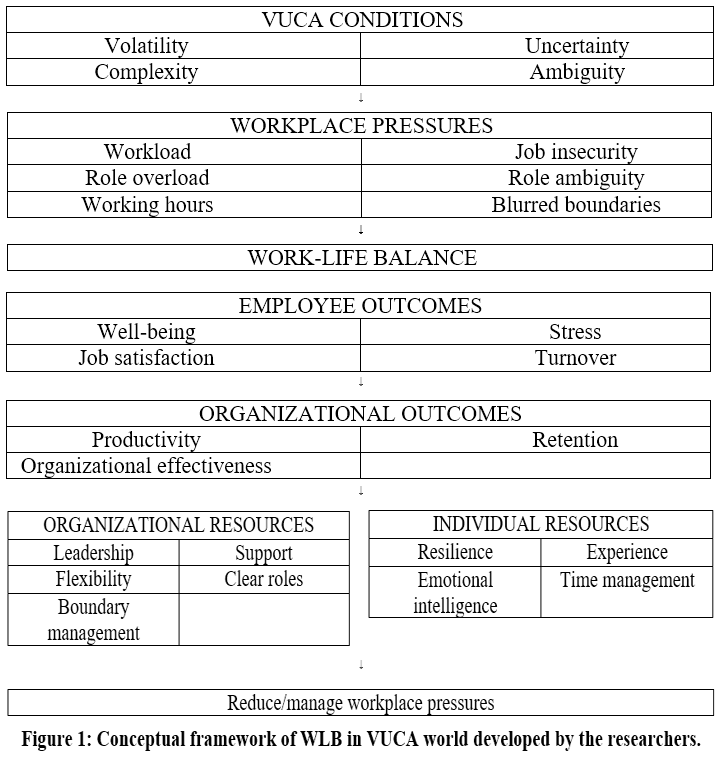 | Figure 1: Conceptual framework of WLB in VUCA world developed by the researchers.
|
At the same time, organizational support, leadership, flexible working arrangements, clear roles, boundary management, and individual coping abilities can reduce the effect of VUCA pressures on WLB.
Conceptual Contribution
The framework contributes to existing literature by bringing together factors that have often been examined separately. Rather than viewing WLB simply as the outcome of workload or work-family conflict, the framework suggests that WLB in VUCA environments develops through the interaction of external pressures + organizational resources + individual resources.
This provides a broader way of understanding why employees working under similar VUCA conditions may experience different levels of WLB.
Theoretical Propositions
Based on the framework, the study proposes:
P1: VUCA conditions are likely to increase workplace pressures and make WLB more difficult to maintain.
P2: Higher workplace pressures are likely to be associated with poorer employee well-being and job satisfaction leading to stress and turnover. The negative employee outcome further affects organizational outcomes such as productivity, overall effectiveness and retention.
P3: Organizational resources such as support, leadership, flexible working arrangements, and clear role and boundary management are likely to reduce the negative effect of VUCA pressures on WLB.
P4: Individual resources such as resilience, emotional intelligence, time management, and experience can support employees in managing VUCA-related pressures.
P5: WLB is likely to be stronger when organizational and individual resources work together to manage VUCA-related pressures.
These propositions provide a basis for future empirical research to test the relationships identified in this conceptual review.
Practical Implications
The findings suggest that organizations should not treat WLB as an issue that employees must solve individually. Managers can support employees by providing reasonable working hours, flexible work arrangements, clear responsibilities, and supportive leadership.
Organizations should also establish clear expectations regarding availability outside normal working hours. This is particularly important in remote and digitally connected workplaces, where flexibility can otherwise result in the extension of work into personal time.
For employees, developing resilience, time-management skills, and healthy boundaries may help manage changing work demands. However, individual strategies are likely to be more effective when supported by an organizational culture that values employee well-being.
Conclusion
This study reviewed existing literature to examine the relationship between VUCA conditions and work-life balance. The review shows that volatility, uncertainty, complexity, and ambiguity can create different but interconnected pressures for employees. These pressures may increase workload, job insecurity, role confusion, stress, and difficulties in separating work from personal life.
At the same time, the literature shows that the negative effects of VUCA are not unavoidable. Organizational support, leadership, flexible working arrangements, reasonable working hours, clear responsibilities, and boundary management can help employees manage changing demands. Individual characteristics such as resilience, experience, and time-management skills can provide additional support.
The main contribution of this study is the integration of VUCA pressures, WLB, organizational resources, individual resources, and employee outcomes into one conceptual framework. The framework suggests that WLB in VUCA environments is not simply an individual matter. It is shaped by the interaction between the pressures created by the work environment and the resources available to employees.
Therefore, organizations seeking to maintain productivity and employee retention in VUCA environments should consider WLB as part of their broader organizational strategy. Future empirical studies can test the proposed relationships and examine whether the framework applies across different industries, occupations, and employee groups.
Acknowledgement
The first author gratefully acknowledges The Maharaja Sayajirao University of Baroda for providing the opportunity to pursue the Ph.D. research work and also expresses sincere appreciation to Dr. Sunita Sharma, research supervisor and co-author of this research paper, for her invaluable guidance, academic insights, and continued encouragement throughout the research process. The authors further acknowledge the contributions and support of all individuals who directly or indirectly assisted in the completion of this research work.
Funding Sources
The author(s) received no financial support for the research, authorship, and/or publication of this article.
Conflict of Interest
The authors do not have any conflict of interest.
Data Availability Statement
This statement does not apply to this article.
Ethics Statement
This research did not involve human participants, animal subjects, or any material that requires ethical approval.
Informed Consent Statement
This study did not involve human participants, and therefore, informed consent was not required.
Clinical Trial Registration
This research does not involve any clinical trials.
Permission to reproduce material from other sources
Not Applicable
Author Contributions
- Mir Sharifullah Sadat: Conceptualization, Methodology, Literature Review, Data Analysis, Writing Original Draft, and Writing - Review & Editing.
- Sunita Sharma: Supervision, Validation, Conceptual Guidance, and Writing - Review & Editing.
References
- Felstead, A., & Henseke, G. (2017). Assessing the growth of remote working and its consequences for effort, well-being and work-life balance. New Technology, Work and Employment, 32(3), 195–212. https://doi.org/10.1111/ntwe.12097
CrossRef - Greenhaus, J. H., & Allen, T. D. (2011). Work-family balance: A review and extension of the literature. In J. C. Quick & L. E. Tetrick (Eds.), Handbook of occupational health psychology (2nd ed., pp. 165–183). American Psychological Association.
CrossRef - Bennett, N., & Lemoine, G. J. (2014). What a difference a word makes: Understanding threats to performance in a VUCA world. Business Horizons, 57(3), 311–317.
CrossRef - Bakker, A. B., & Demerouti, E. (2008). Towards a model of work engagement. Career Development International, 13(3), 209–223. https://doi.org/10.1108/13620430810870476
CrossRef - Kossek, E. E., Pichler, S., Bodner, T., & Hammer, L. B. (2011). Workplace social support and work-family conflict: A meta-analysis clarifying the influence of general and work-family-specific supervisor and organizational support. Personnel Psychology, 64(2), 289–313. https://doi.org/10.1111/j.1744-6570.2011.01211.x
CrossRef - Kreiner, G. E. (2006). Consequences of work-home segmentation or integration: A person-environment fit perspective. Journal of Organizational Behavior, 27(4), 485–507. https://doi.org/10.1002/job.386
CrossRef - Raghuramapatruni, R., & Kosuri, S. (2017). The straits of success in a VUCA world. IOSR Journal of Business and Management, 16–22.
- Panojan, P., Perera, B. A. K. S., & Dilakshan, R. (2022). Work-life balance of professional quantity surveyors engaged in the construction industry. International Journal of Construction Management, 22(5), 751–768.
CrossRef - Hashimi, S. S. (2021). Factors impacting work-life balance of female employees in private higher education institutions in Afghanistan. Kardan Journal of Economics and Management Sciences, 4(3), 84–99.
CrossRef - Kinman, G., & Jones, F. (2008). A life beyond work? Job demands, work-life balance and wellbeing in UK academics. Journal of Human Behavior in the Social Environment, 17(1–2), 41–60. https://doi.org/10.1080/10911350802165478
CrossRef - Lichtenstein, B. B., Uhl-Bien, M., Marion, R., Seers, A., Orton, J. D., & Schreiber, C. (2006). Complexity leadership theory: An interactive perspective on leading in complex adaptive systems. Emergence: Complexity & Organization, 8(4), 2–12.
- Süß, S., & Sayah, S. (2013). Balance between work and life: A qualitative study of German contract workers. European Management Journal, 31(3), 250–262. https://doi.org/10.1016/j.emj.2012.12.003
CrossRef - Norfadzilah, A., Hairunnisa, M., & Narehan, H. (2016). Measuring reliability and validity instruments of work environment towards quality work life. Procedia Economics and Finance, 37, 520–528.
CrossRef - Haar, J. M., Russo, M., Suñe, A., & Ollier-Malaterre, A. (2014). Outcomes of work-life balance on job satisfaction, life satisfaction and mental health: A study across seven cultures. Journal of Vocational Behavior, 85(3), 361–373. https://doi.org/10.1016/j.jvb.2014.08.010
CrossRef - Murugan, S., Rajavel, S., Aggarwal, A. K., & Singh, A. (2020). Volatility, uncertainty, complexity and ambiguity (VUCA) in context of the COVID-19 pandemic: Challenges and way forward. International Journal of Health Systems and Implementation Research, 4(2), 10–16.
- Khan, A. (2021). VUCA and well-being: The challenges and prospects in the new pandemic era. Arthavaan, 4(1), 97–107.
CrossRef - Tijani, B., Osei-Kyei, R., & Feng, Y. (2022). A review of work-life balance in the construction industry. International Journal of Construction Management, 22(14), 2671–2686. https://doi.org/10.1080/15623599.2020.1819582
CrossRef - Vyas, L. (2022). “New normal” at work in a post-COVID world: Work-life balance and labor markets. Policy and Society, 41(1), 155–167. https://doi.org/10.1093/polsoc/puab011
CrossRef - Ayar, D., Karaman, M. A., & Karaman, R. (2021). Work-life balance and mental health needs of health professionals during COVID-19 pandemic in Turkey. International Journal of Mental Health and Addiction, 20, 639–655.
CrossRef - Ola, O. O., John, W. O., Simeon, O. A., & Mutiu, O. A. (2019). Impact of work-life balance on the social life of workers living in Lagos metropolitan borders. Annals of Contemporary Developments in Management & HR (ACDMHR), 1(2), 50–59.
CrossRef - Rawal, D. M. (2023). Work-life balance among female school teachers [K–12] delivering online curriculum in Noida [India] during COVID: Empirical study. Management in Education, 37(1), 37–45.
CrossRef - Greenhaus, J. H., & Beutell, N. J. (1985). Sources of conflict between work and family roles. Academy of Management Review, 10(1), 76–88. https://doi.org/10.2307/258214
CrossRef - Sonnentag, S. (2018). The recovery paradox: Portraying the complex interplay between job stressors, lack of recovery, and poor well-being. Research in Organizational Behavior, 38, 169–185
CrossRef - Guest, D. E. (2002). Perspectives on the study of work-life balance. Social Science Information, 41(2), 255–279.
CrossRef - Blomme, R. J., Rheede, A., & Tromp, D. M. (2010). Work-family conflict as a cause for turnover intentions in the hospitality industry. Tourism and Hospitality Research, 10(4), 269–285
CrossRef - Pabilonia, S. W., & Redmond, J. J. (2024). The rise in remote work since the pandemic and its impact on productivity. Beyond the Numbers, 13(8). U.S. Bureau of Labor Statistics
- Koon, V. Y. (2020). A multilevel analysis of work-life balance practices. Asia Pacific Journal of Human Resources, 60(2), 429–450.
CrossRef - Bellmann, L., & Hübler, O. (2020). Working from home, job satisfaction and work-life balance—Robust or heterogeneous links? International Journal of Manpower, 42(3), 424–441
CrossRef - Hjámsdóttir, A., & Bjarnadóttir, V. S. (2021). “I have turned into a foreman here at home”: Families and work-life balance in times of COVID-19 in a gender equality paradise. Gender, Work & Organization, 28, 268–283
CrossRef - Alqahtani, T. H. (2020). Work-life balance of women employees. Granite Journal, 4, 37–42
- Buonomo, I., De Vincenzi, C., Pansini, M., D’Anna, F., & Benevene, P. (2024). Feeling supported as a remote worker: The role of support from leaders and colleagues and job satisfaction in promoting employees’ work–life balance. International Journal of Environmental Research and Public Health, 21(6), 770
CrossRef - Tan, J., Lim-Soh, J., & Tan, P. L. (2024). The impact of teleworking on women’s work–life balance and life satisfaction: A longitudinal study from Singapore. Applied Research in Quality of Life, 19, 2595–2615
CrossRef - S., & Anthonysamy, L. (2025). Modelling the relationship between work-family boundaries, work-life balance, workload and employees’ turnover intentions: Moderated mediation analysis. International Journal of Productivity and Performance Management, 74(10), 3347–3373
CrossRef

This work is licensed under a Creative Commons Attribution 4.0 International License.