The Influence of Dynamic Capability on the Sustainability of Non-Governmental Organizations in Nairobi County, Kenya
Alphonce Ochieng Okoth1*  , Zachary Bolo Awino , Moses Machuki Otieno and Mary Kinoti
1Department of Business Administration, Faculty of Business and Management Sciences, University of Nairobi, Nairobi, Kenya .
2Faculty of Business and Management Sciences, University of Nairobi, Nairobi, Kenya .
Non?governmental organizations (NGOs) in Nairobi operate amid shifting donor agendas, regulatory scrutiny, and evolving community needs—conditions that put long?term viability at risk. This study investigates how dynamic capability—sensing, seizing, and reconfiguring—shapes NGO sustainability and how organizational learning and organizational resilience strengthen that effect. Anchored in dynamic capability scholarship and related strategy perspectives, the research applies a quantitative, explanatory design to a sample of registered NGOs in Nairobi County. The study utilized a sample of 200 NGOs from Nairobi County, selected using random sampling to ensure diverse representation and cross-sectional survey was used for diversity. Multivariate analyses show that dynamic capability has a strong, positive association with sustainability, and that learning and resilience materially reinforce this relationship. The article contributes an integrated view of capability–sustainability linkages relevant to NGOs facing turbulence and resource constraints, and it outlines practical levers managers and policymakers can use to support durable, high?impact operations.
Copy the following to cite this article:
Okoth A. O, Awino Z. B, Otieno M. M, Kinoti M. "The Influence of Dynamic Capability on the Sustainability of Non-Governmental Organizations in Nairobi County, Kenya." Journal of Business Strategy Finance and Management, 8(1).
Copy the following to cite this URL:
Okoth A. O, Awino Z. B, Otieno M. M, Kinoti M. "The Influence of Dynamic Capability on the Sustainability of Non-Governmental Organizations in Nairobi County, Kenya." Journal of Business Strategy Finance and Management, 8(1). Available here:https://bit.ly/4blJDaL
Citation Manager Publish History



Introduction
Background of the Study
Organizational sustainability has become an increasingly central issue for institutions operating in contexts defined by rapid social, economic, and environmental disruption. Organizations across sectors face intensifying expectations to demonstrate not only short-term efficiency but also the ability to remain viable, relevant, and impactful over extended periods. While sustainability in the corporate world is commonly judged through financial indicators such as profitability, market performance, and shareholder value, the same concept takes on a different meaning within non-governmental organizations (NGOs). For NGOs, sustainability is reflected in the ongoing delivery of programs, the strength of institutional systems, stakeholder trust, and the capacity to produce long-term social benefits (Dubey et al., 2022). Because NGOs exist primarily to generate social value rather than financial returns, their continued operations depend heavily on external funding relationships, collaborations, and community legitimacy. These dependencies make NGOs especially vulnerable to shifts in donor agendas, policy changes, and evolving community needs.
Globally, NGOs have encountered growing pressures that complicate their long-term continuity. Funding models have tightened, donors increasingly demand measurable short-term outcomes, and the sector faces stronger scrutiny from regulators, beneficiaries, and the public (Somers, 2009). Donor transitions toward short-cycle and results-oriented grants often leave limited room for building internal capacity or investing in long-term institutional development. Simultaneously, the needs of communities have grown more complex due to widening economic disparities, accelerated urbanization, climate-related disruptions, and public health emergencies. These realities require NGOs to be more adaptive and agile, yet many lack sufficiently robust internal systems to respond effectively.
The sustainability challenge becomes even more pronounced in developing countries, where NGOs frequently operate amid political instability, economic volatility, and insufficient government service delivery. In these settings, NGOs often fill critical gaps in areas such as healthcare, education, environmental management, and livelihoods support. However, the same environmental pressures that create this demand also limit NGOs’ capacity to operate sustainably. Securing the continuity of programs after initial funding phases remains a persistent concern and has prompted increasing attention toward the internal characteristics that allow NGOs to endure in uncertain conditions.
In Kenya, NGOs are central actors in addressing diverse development challenges, particularly where government capacity is limited. Nairobi County hosts the largest concentration of NGOs in the country, with organizations engaging in sectors such as health, education, environmental conservation, women’s empowerment, and socio-economic development. Their ability to remain close to communities enables them to respond quickly to emerging issues and to tailor their programs to local contexts (Banks & Hulme, 2012). Despite these strengths, many Nairobi-based NGOs experience significant sustainability constraints. According to the NGO Coordination Board (2020), a substantial number struggle to maintain operations beyond their early stages. Heavy reliance on short-term grants undermines financial stability and limits strategic planning, while dependence on external donors heightens exposure to changing funding priorities.
Regulatory requirements further intensify these obstacles. The NGO Coordination Act of 1992 outlines stringent compliance standards intended to promote transparency, but meeting these obligations can be especially burdensome for smaller organizations with limited administrative capacity (Banks & Hulme, 2012). Time and resources allocated to compliance may detract from program implementation and innovation. Moreover, sustainability is also shaped by the quality of relationships NGOs build with their stakeholders. Effective engagement, transparency, and responsiveness can strengthen legitimacy and long-term support, whereas poor relationship management—particularly in diverse urban environments like Nairobi—can erode trust and weaken program outcomes.
Research Problem
Although organizational sustainability has received increasing scholarly attention, evidence explaining what drives long-term viability among NGOs in developing economies is still limited. In Nairobi County, these challenges remain acute despite the sector’s vital contribution to social and economic development. Reports show that only about 60% of NGOs remain active beyond three years, reflecting persistent weaknesses in funding stability, institutional capacity, and adaptability (NGO Coordination Board, 2020). Much of the existing literature prioritizes insights from commercial organizations or NGOs in developed settings, offering limited applicability to Kenya’s context. Studies focusing on local NGOs often emphasize financial dependence or project continuity while overlooking the internal organizational processes that support enduring performance. Research such as Rono (2018) highlights overreliance on external funding and underuse of internal resources but does not explore how capabilities interact to shape sustainability (Makoba, 2002). Consequently, policymakers and NGO leaders lack sufficient empirical guidance for strengthening internal systems to support long-term resilience.
Research Objective
To determine the influence of dynamic capability on the sustainability of NGOs in Nairobi County, and to assess how organizational learning and organizational resilience condition that relationship.
Literature Review
Introduction
Research on organizational sustainability has expanded, yet much of the existing evidence comes from developed economies and corporate settings, offering limited relevance for NGOs in resource-strained environments. NGOs in developing regions operate under shifting donor expectations, regulatory uncertainty, and complex community needs, highlighting the importance of internal capabilities that support long-term survival. Although concepts such as dynamic capability, organizational learning, and resilience are increasingly discussed in management studies, their application to NGOs remains uneven, and interpretations of these constructs vary widely. Methodological constraints such as reliance on case studies and localized samples further restrict the usefulness of current findings for Nairobi-based NGOs. These gaps underscore the need for deeper empirical understanding of how internal capacities shape sustainability within Kenyan NGOs.
Dynamic Capability
Dynamic capability has become a cornerstone construct in explaining organizational survival and competitiveness in environments characterized by constant change. In broad terms, dynamic capability refers to an organization’s ability to sense environmental changes, seize emerging opportunities, and reconfigure internal resources to maintain effectiveness over time (Teece, 2007; Barreto, 2020). It extends beyond operational capabilities by emphasizing adaptability, innovation, and the renewal of routines.
Studies conducted across varied regions—including Asia, Latin America, and Europe—show that organizations capable of redeploying resources and adjusting internal processes in response to environmental shocks experience fewer disruptions and higher survival rates (Cao et al., 2014; Chiappetta, 2018). In the NGO context, dynamic capability becomes particularly important because NGOs rely heavily on external funding and face shifting donor priorities and evolving community needs (Kurtz & Varvakis, 2016).
Technological advancements have become key enablers of dynamic capability. Research on humanitarian supply chains and development organizations demonstrates that digital tools enhance information flow, improve coordination across stakeholders, and support faster decision?making during crises—thereby strengthening sustainability outcomes (Dubey et al., 2022). Evidence from financial risk management similarly shows that organizations with strong environmental sensing mechanisms are better able to anticipate funding changes and take appropriate measures (Bagire et al., 2012).
African studies from Kenya, Uganda, and Ghana indicate that NGOs adopting proactive resource reallocation strategies during financial shortfalls are more capable of maintaining uninterrupted service delivery (Sarfo et al., 2017). However, much of the existing research treats dynamic capability as a direct predictor of performance without scrutinizing how internal processes translate adaptability into sustainable long-term outcomes. Thus, while a positive link between dynamic capability and organizational performance is well documented, the mechanisms connecting adaptability with sustainability require deeper exploration.
Organizational Learning
Organizational learning encompasses the processes through which organizations gather, interpret, share, and apply knowledge to enhance decision-making and performance (Chiappetta, 2018). For NGOs operating in uncertain and resource-constrained environments, learning becomes essential for navigating shifting conditions and responding effectively to evolving community needs. Learning-oriented NGOs are better positioned to integrate insights from past experiences, monitoring and evaluation systems, and stakeholder feedback into strategic adjustments (Senge, 1992).
Empirical studies across Europe, Africa, and Asia consistently show that learning enhances innovation, responsiveness, and program quality. Research involving NGOs in Romania and Spain demonstrates that organizations equipped with structured learning mechanisms—such as knowledge-sharing platforms, reflective reviews, and M&E systems—exhibit stronger resilience and continuity in the face of crises (Argyris & Schön, 2016; Senge, 1992). African studies similarly link adaptive learning strategies to improved organizational performance and program outcomes (Bejinaru, 2017).
Learning also strengthens collaboration and social capital (Ehin, 2000). Inter-organizational learning research highlights that NGOs participating in knowledge networks become more innovative and resilient (Bueno et al., 2019). In densely populated urban settings such as Nairobi, where NGOs operate within dynamic stakeholder ecosystems, collaborative learning enhances program relevance, legitimacy, and stakeholder support (Marita, 2012).
Despite substantial evidence on the value of learning, literature still exhibits notable gaps. Most studies examine learning as an independent attribute rather than exploring how it interacts with dynamic capability or resilience to influence sustainability. Few empirical studies investigate learning as a moderating variable, particularly within Kenyan NGOs—a notable conceptual and contextual gap this study seeks to address
Organizational Resilience
Organizational resilience refers to an organization’s capacity to withstand shocks, recover from disruptions, and maintain functionality during adverse conditions (Gathungu & Mwangi, 2012). For NGOs, resilience is essential given persistent exposure to funding instability, regulatory changes, and socio-economic volatility.
Comparative studies from the UK, Brazil, and Australia show that NGOs with strong anticipation, response, and recovery systems experience fewer disruptions and maintain program continuity during crises (Inkpen & Tsang, 2005; Bhamra & Tsinopoulos, 2018). Effective resilience mechanisms include early warning systems, contingency planning, flexible structures, and coordinated leadership responses.
African research adds that resilience is closely aligned with adaptability. NGOs that anticipate funding fluctuations or diversify delivery models are more capable of sustaining operations (Gathungu & Mwangi, 2012; Rono, 2018). In Kenya, resilience strategies significantly improve project continuity in contexts marked by donor dependency and regulatory pressures (Limnios et al., 2014).
However, resilience is often modeled as a direct determinant of performance, neglecting its potential role as a mediating mechanism linking adaptive capabilities to sustainability (Lopez et al., 2020). Moreover, most resilience studies rely heavily on qualitative case designs, limiting their generalizability and applicability to broader NGO populations. These limitations highlight the need for empirical models that integrate resilience into broader sustainability frameworks.
Organizational Sustainability
Organizational sustainability for NGOs encompasses more than financial viability. It involves strong governance structures, institutional capacity, stakeholder engagement, adaptive programs, and the ability to generate long-term social impact (USAID, 2012). Sustainable NGOs typically diversify their funding sources, maintain transparent governance, and cultivate trust among key stakeholders.
Evidence from global development agencies indicates that organizations with diversified revenue streams are better shielded from donor withdrawal and better positioned to plan long-term interventions (Khurana et al., 2022). In Africa and Asia, transparent governance practices and efficient resource use enhance NGO credibility, which in turn supports sustainability.
Stakeholder engagement, particularly involving beneficiaries, donors, and government partners, also plays a critical role. Research shows that inclusive decision-making processes, clear communication, and accountability mechanisms strengthen legitimacy and resilience (Epstein & Buhovac, 2014; Freeman, 2010).
Despite these insights, sustainability is conceptualized inconsistently across studies. Some emphasize financial stability, while others focus on governance, social impact, or program continuity. Few models integrate adaptability, learning, and resilience as interconnected drivers of sustainability, creating a gap this study addresses.
Interrelationships Among Dynamic Capability, Learning, Resilience, and Sustainability
Scholars increasingly emphasize that sustainability is influenced not by isolated capabilities but by the interplay of multiple organizational attributes. Dynamic capability enhances sustainability most effectively when organizations embed learning systems and resilience mechanisms (Ortiz de Mandojana & Bansal, 2016).
Learning enhances adaptive capability by improving sensing accuracy, decision-making, and strategic alignment (Monteiro et al., 2019). Resilience amplifies this effect by enabling organizations to recover from disruptions without compromising long-term goals.
However, few studies empirically test the combined influence of dynamic capability, learning, and resilience, especially within resource-constrained NGOs in developing countries. Most studies focus on bilateral relationships, leaving an important conceptual and methodological gap this study seeks to fill.
Summary of Empirical Studies and Knowledge Gaps
The reviewed literature reveals several critical gaps. Conceptually, many studies examine dynamic capability, learning, or resilience in isolation, without integrating them into a comprehensive sustainability framework. Contextually, most of the empirical evidence originates from developed economies, limiting applicability to Kenyan NGOs. Methodologically, reliance on qualitative designs and non-probability sampling restricts generalizability. Notably, few studies have empirically examined the combined influence of dynamic capability, organizational learning, and organizational resilience on organizational sustainability within the NGO sector. This gap is particularly pronounced in Nairobi County, where NGOs operate under unique socio-economic and regulatory conditions.
Hypotheses
Based on the reviewed literature, organizational sustainability is conceptualized as the outcome variable influenced by dynamic capability, with organizational learning and organizational resilience acting as interacting mechanisms. Accordingly, the study tests the following hypotheses:
H01: There is no significant influence of dynamic capability on organizational sustainability among local NGOs in Nairobi County.
H02: Organizational learning does not significantly moderate the relationship between dynamic capability and organizational sustainability among local NGOs in Nairobi County.
H03: Organizational resilience does not significantly mediate the relationship between dynamic capability and organizational sustainability among local NGOs in Nairobi County.
H04: There is no significant combined effect of dynamic capability, organizational learning, and organizational resilience on organizational sustainability among local NGOs in Nairobi County.
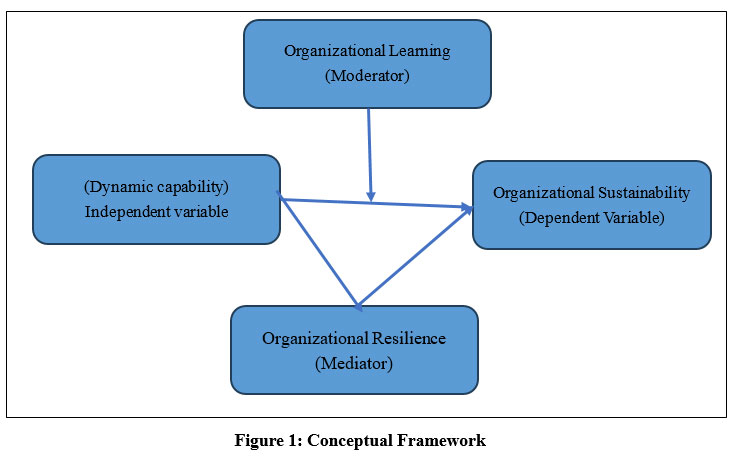 | Figure 1: Conceptual Framework
|
Materials and Methods
Introduction
This is anchored in a positivist view of knowledge: organizational realities are observable, measurable, and amenable to statistical testing. A positivist stance is well suited to the study’s purpose—testing hypothesized relationships among dynamic capability, organizational learning, organizational resilience, and organizational sustainability—because it privileges standardized measures, replicable procedures, and inferential analysis over interpretivist sense-making. Consequently, we adopt a quantitative, explanatory survey design to estimate the magnitude, direction, and statistical significance of pre-specified effects while minimizing researcher subjectivity through structured instruments and uniform administration procedures (Khurana et al., 2022).The design is cross-sectional: data are collected once from many NGOs to capture prevailing organizational conditions and intervariable associations without manipulating the environment. The approach balances description (profiling the sector) and explanation (testing effects) to produce evidence that is both contextually informative and generalizable within Nairobi County’s NGO ecosystem.
Population and Sampling
The empirical setting is Nairobi County, Kenya, the country’s administrative and operational hub for NGO activity. The target population includes all NGOs formally registered and active in the county at the time of study (N = 547), spanning development and humanitarian missions across health, education, environmental protection, women’s empowerment, livelihoods, and related areas.
Given the common regulatory frameworks and operating norms that Nairobi-based NGOs share, simple random sampling is adopted to give each eligible unit an equal chance of selection and to reduce selection bias. The sampling frame prioritizes senior leaders—Deputy Chiefs of Party, Program Directors, and Program Managers, whose roles provide a panoramic view of capabilities, systems, and sustainability practices. Using Nassiuma’s formula with a 10% coefficient of variation and 1% error margin yields a sample size of 85 respondents, balancing statistical precision with feasibility. This configuration enhances external validity by allowing findings to be generalized to the broader NGO population within the county while ensuring the survey burden remains manageable for participating organizations.
Data Collection Procedures
Primary data are gathered using a structured questionnaire designed to measure all focal constructs with multi-item scales drawn from established literature and adapted to the local context. The instrument contains sections on respondent demographics and the four study variables. Items are rated on a five-point Likert scale, enabling consistent quantification of perceptions and practices and supporting parametric analysis of composite indices. Administration targets senior management to align measurement with strategic decision layers where capability formation and sustainability choices are most visible.
To maximize inclusivity and response rates, a mixed-mode strategy is used: secure online distribution complemented by in-person administration for organizations with limited digital access or a preference for face-to-face engagement. All participants receive an information sheet and provide informed consent; participation is voluntary and confidential. A pilot test with ten NGOs precedes the main rollout, focusing on clarity, relevance, and cultural/sectoral fit of items. Feedback informs wording refinements, sequencing, and layout improvements; pilot data are excluded from analysis to prevent contamination. This staged approach strengthens instrument usability, protects data quality, and reduces missingness and satisficing behaviors.
Operationalization of Constructs
In this study, four latent constructions were examined using multi-item indicators that were combined into composite scores to capture their multidimensional character. Dynamic capability was measured through items reflecting an organization’s capacity to sense environmental changes, identify emerging opportunities, and reconfigure its internal resources in response to those shifts (Teece, 2007). Higher values on this construct suggest stronger adaptability and strategic responsiveness. Organizational learning captured the systems and practices through which NGOs acquire, distribute, and apply knowledge. This included aspects such as social capital, work routines, organizational policies, and learning embedded in project cycles, including monitoring, evaluation, and reflective review processes.
Organizational resilience was evaluated through indicators that reflect an NGO’s preparedness for disruption, its ability to recover from shocks, and the extent to which it improves processes following adversity. These measures recognize that resilience is not solely about survival but also about adaptive growth. Lastly, organizational sustainability was conceptualized as a holistic outcome encompassing strategic clarity, stakeholder involvement, institutional adaptability, communication processes, and monitoring and evaluation systems. This broader framing acknowledges that sustainability for NGOs extends beyond financial continuity to include governance strength and the capacity to deliver long-term social value. The multi-indicator measurement approach minimizes single-item bias and supports robust reliability and validity testing through internal consistency checks and factor-analytic procedures.
Diagnostics, Reliability, and Validity
Data quality was upheld through multiple safeguards implemented before and after data collection. Pre-data-collection measures focused on ensuring conceptual clarity and contextual appropriateness. Questionnaire items were adapted from established literature and refined to fit the operational realities of NGOs in Nairobi, strengthening both content and ecological validity. A pilot exercise involving a small subset of organizations was conducted to evaluate clarity, cultural alignment, and overall usability of the instrument. Feedback informed revisions that enhanced precision and reduced respondent burden.
Post-data-collection procedures addressed the statistical soundness of the measures and models. Reliability was assessed using Cronbach’s alpha, with coefficients of 0.70 or higher deemed acceptable for internal consistency. Construct validity was examined using exploratory factor analysis to confirm dimensional structures and ensure that items loaded appropriately on their intended factors without cross-construct contamination.
To confirm the appropriateness of subsequent regression analysis, the study evaluated the underlying statistical assumptions through the following diagnostic checks:
Multicollinearity was inspected using VIF and tolerance values, applying thresholds of VIF < 10 and tolerance > 0.10.
Homoscedasticity was evaluated through residual-fit plots and Levene’s test to confirm the consistency of residual variability.
Independence of errors was assessed using the Durbin–Watson statistic.
Normality of residuals was examined through histogram distributions and Q–Q plots.
Linearity was verified using partial regression plots and residual diagnostics.
Together, these procedures ensured that regression outputs were not affected by violations of assumptions or measurement inconsistencies, thereby enhancing the credibility and interpretability of the study’s findings.
Analytical Strategy, Significance Level, and Ethics
Data processing involved systematic editing, coding, and analysis using SPSS (version 25). The analytical sequence began with descriptive statistics to summarize respondent characteristics and provide an overview of organizational profiles. Bivariate correlations were then used to assess preliminary relationships among variables and to identify any early signs of multicollinearity.
The core of the analysis employed multiple regression models aligned with the study’s hypotheses. The first set of models estimated the direct effect of dynamic capability on organizational sustainability. To assess moderation, an interaction term between dynamic capability and organizational learning was incorporated after mean-centering to reduce inflation of multicollinearity. Mediation by organizational resilience was tested using a hierarchical regression strategy, supported by bootstrap confidence intervals to confirm the significance of indirect effects. A final combined model was used to examine the joint explanatory contribution of all three predictors, reflected through R² and adjusted R² values, and to determine the individual weight of each capability in explaining sustainability outcomes.
All hypothesis tests adhered to a single significance threshold of a = 0.05 (two-tailed), consistent with journal expectations. Beyond p-values, effect sizes and confidence intervals were reported to enhance interpretation of practical significance.
Ethical procedures were rigorously observed throughout the study. Participation was entirely voluntary, and informed consent was obtained from all respondents. Confidentiality was ensured by removing or masking any identifying information about individuals or specific NGOs. Data were stored securely and used solely for research purposes. The study adhered to accepted social science ethical standards and reflected sensitivity to the operational environment of NGOs in Nairobi County.
Results
Multiple Regression Model
The combined model testing the concurrent influence of DC, OL, and OR on OS demonstrates strong explanatory power. The model achieves R² = 0.905 (adjusted R² = 0.900), indicating that just over 90% of the variance in sustainability outcomes across sampled NGOs can be explained by the three internal capabilities considered together. The overall F-statistic = 209.086 (p < .001) confirms that the predictors jointly improve model fit relative to an intercept-only specification. These values underscore that capability architectures—rather than external context alone—account for most observed sustainability differences.
Table 1: summarizes model fit, and Table 2 condenses the omnibus test evidence.
Table 1: Multiple Regression Model Summary
Model Component | Coefficient | Standard Error | t-value | P-value |
Intercept | 1.773 | 0.336 | 5.276 | 0.0 |
Dynamic Capability (DC) | 1.541 | 0.066 | 23.189 | 0.0 |
The coefficient estimates further clarify the size and precision of the DC effect. The intercept = 1.773 (SE = 0.336, t = 5.276, p < .001) and the DC slope = 1.541 (SE = 0.066, t = 23.189, p < .001), indicating that a one-unit increase in dynamic capability is associated with a substantial increase in the sustainability index. In operational terms, NGOs that track environmental signals early, mobilize timely responses, and realign structures and processes outperform those that do not—an effect large enough to be consequential for day-to-day continuity and longer-term mission delivery.
Table 2: Simple Regression Model
Statistic | Value |
R-squared | 0.905 |
Adjusted R-squared | 0.900 |
F-statistic | 209.086 |
p-value (overall) | < .001 |
To convey the precision of these estimates, Figure 2 plots the coefficients and 95% confidence intervals for the simple model. The DC confidence band is narrow relative to the effect size, reinforcing statistical robustness.
Table 3: Simple Regression Coefficients with 95% Confidence Interval
Term | Coefficient | Std. Error | t-value | p-value |
Intercept | 1.773 | 0.336 | 5.276 | < .001 |
Dynamic Capability | 1.541 | 0.066 | 23.189 | < .001 |
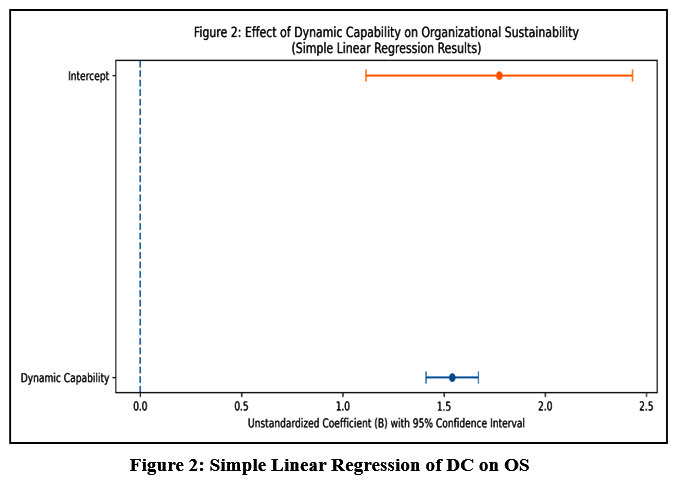 | Figure 2: Simple Linear Regression of DC on OS
|
The simple model demonstrates a large main effect of dynamic capability, suggesting that sensing–seizing–reconfiguring behaviors are central to sustaining operations amid resource constraints and policy changes. The multiple models shows that learning and resilience add explanatory power when modeled alongside DC, elevating the explained variance to over 90% and confirming that capabilities work in concert rather than isolation.
Organizational learning helps convert adaptive intent into better decisions and execution, for example, by using monitoring and evaluation insights to refine programs and by sharing lessons across teams and partners (Cezarino et al., 2019). Organizational resilience ensures that, when disruptions occur such as donor retrenchment or regulatory shifts, NGOs can absorb shocks, recover quickly, and protect core services. The evidence therefore supports a systemic capability view: DC remains the principal driver of OS, while OL and OR amplify and stabilize its impact in turbulent conditions.
Two additional observations are noteworthy. First, the low residual variation across models indicates that the chosen constructs capture the major drivers of sustainability within the sampled NGOs; residual factors—while not negligible—play a secondary role. Second, the ordering of predictors (DC > OR > OL) aligns with the notion that fast, repeated reconfiguration is the linchpin of sustained performance; learning and resilience are most powerful when they enable or protect that reconfiguration capability.
Practical Implications for NGO Leaders and Policymakers
For managers, the findings argue for deliberate investment in systems that institutionalize adaptive behaviors: horizon scanning, data-enabled decision routines, and flexible resource deployment. Learning mechanisms (after-action reviews, M&E cycles, knowledge repositories) should be embedded so that evidence regularly feeds strategy and program design. Resilience planning—early-warning indicators, contingency playbooks, and structural flexibility—ought to be rehearsed and resourced, not improvised during crises.
For policymakers and development partners, enabling environments that support capability building will have durable returns: e.g., funding that permits capacity strengthening, reasonable reporting cycles that protect organizational learning, and regulatory clarity that reduces operational uncertainty. Such measures reinforce the capability system identified here and help NGOs maintain continuity of impact in Nairobi’s demanding context.
Discussion
Summary of the Study Findings
The study’s results underscore the central importance of dynamic capability in determining the sustainability of NGOs in Nairobi. Organizations that demonstrated strong abilities to sense shifts in their external environment, identify emerging opportunities, and reconfigure their internal resources consistently exhibited higher levels of sustainability. This aligns with earlier evidence showing that dynamic capability equips organizations to remain functional in unstable contexts by promoting timely adaptation and innovation.
The findings also show that organizational learning plays an essential reinforcing role. NGOs that institutionalize learning through structured knowledge-sharing, continuous skills development, systematic reflection, and evidence-based decision-making tend to harness dynamic capability more effectively (Khurana et al., 2022). Learning enables organizations to interpret environmental cues accurately, evaluate past strategies, reduce errors, and refine their interventions. As a result, learning enhances the responsiveness and adaptability needed to operate sustainably in conditions of uncertainty.
Organizational resilience emerged as another significant contributor to sustained performance. Resilience allows NGOs to withstand unexpected disruptions, ranging from funding shocks to policy changes or community crises. Organizations that adopt resilience mechanisms such as contingency planning, flexible structures, and proactive risk management experienced less operational interruption and were better able to maintain continuity in service delivery. The evidence reveals that resilience does not operate independently; rather, it complements both learning and dynamic capability by safeguarding organizational functioning during adversity (Gathungu & Mwangi, 2012).
The findings highlight a synergistic interplay between dynamic capability, learning, and resilience. The research confirms that these three capabilities mutually reinforce one another, ultimately enabling NGOs to remain stable, relevant, and impactful despite environmental turbulence. The results also emphasize that adaptation alone is insufficient; NGOs must simultaneously cultivate learning systems and resilience strategies to ensure that adaptive efforts translate into durable organizational outcomes.
Implications and Recommendations
The study carries several implications for scholars, practitioners, and policymakers. Theoretically, it reinforces the argument that organizational capabilities are interdependent and should be examined holistically rather than in isolation. This calls for more integrated models in sustainability research, especially within non-profit contexts.
From a managerial perspective, the findings suggest that NGO leaders should invest in building dynamic capabilities while simultaneously nurturing learning systems and resilience structures. This includes leadership development initiatives, continuous professional training, fostering information-sharing cultures, and strengthening crisis-management frameworks.
For policymakers and development partners, the results indicate the need for supportive environments that enable NGOs to cultivate these capabilities. Policies that encourage innovation, provide flexible funding, and support capacity-building can significantly enhance the sustainability of NGOs. Future research should explore these relationships using longitudinal designs to capture how capabilities evolve over time and expand to different regions for broader generalizability.
Conclusion
This study examined the influence of dynamic capability on the sustainability of non-governmental organizations operating in Nairobi County, Kenya, with particular attention to the conditioning roles of organizational learning and organizational resilience. The findings demonstrate that dynamic capability is a central driver of NGO sustainability, enabling organizations to sense environmental changes, seize emerging opportunities, and reconfigure resources in response to uncertainty. NGOs that actively cultivate adaptive capabilities are better positioned to maintain operational continuity and long-term social impact in volatile environments.
The results further confirm that organizational learning strengthens the effect of dynamic capability by enhancing decision-making, knowledge utilization, and strategic alignment. Learning-oriented NGOs are more effective in translating adaptive intent into sustained performance through evidence-based program refinement and continuous improvement. Additionally, organizational resilience was found to mediate the relationship between dynamic capability and sustainability, underscoring its role in buffering organizations against shocks such as funding volatility and regulatory changes.
Collectively, the study concludes that sustainability in NGOs is best understood as the outcome of an integrated capability system rather than isolated organizational attributes. By simultaneously investing in dynamic capability, learning mechanisms, and resilience structures, NGOs can enhance their ability to remain relevant, effective, and impactful over time. These findings contribute to the growing body of sustainability literature by extending dynamic capability theory into the non-profit context and offering practical insights for NGO leaders and policymakers operating in developing economies.
Acknowledgement
We would like to express our sincere gratitude to the individuals and organizations that supported this research. We thank the Non-Governmental Organizations Co-ordination Board for providing us with data on the NGOs in Nairobi County. Our heartfelt thanks go to the management teams of the 85 Non-Governmental Organizations in Nairobi County that participated in this study. We also acknowledge the valuable insights provided by the senior management officials, including the Deputy Chiefs of Party, Program Directors, and Program Managers, who contributed to the research data.
We are grateful to the academic supervisors at the University of Nairobi, whose guidance and support throughout the research process were invaluable. Their expertise and constructive feedback helped shape this study into its final form.
Lastly, we extend our appreciation to the University of Nairobi for providing the necessary resources and facilities for this research.
Funding Sources
The author(s) received no financial support for the research, authorship, and/or publication of this article.
Conflict of Interest
The authors do not have any conflict of interest.
Data Availability Statement
The manuscript incorporates all datasets produced or examined throughout this research study.
Ethics Statement
This research did not involve human participants, animal subjects, or any material that requires ethical approval.
Informed Consent Statement
This study did not involve human participants, and therefore, informed consent was not required.
Clinical Trial Registration
Not Applicable.
Permission to reproduce material from other sources
Not Applicable.
Author Contributions
Alphonce Ochieng Okoth: Conceptualization, Methodology, Data Collection, Data Analysis, Writing – Original Draft
Zachary Bolo Awino: Supervision, Methodological Review, Writing – Review & Editing
Moses Machuki Otieno: Review & Editing
Mary Kinoti: Review & Editing
References
- Dubey, R., Bryde, D. J., Dwivedi, Y. K., Graham, G., & Foropon, C. (2022). Impact of artificial intelligence-driven big data analytics culture on agility and resilience in humanitarian supply chains. International Journal of Production Economics, 250, 108618.
CrossRef - Somers, S. (2009). Measuring resilience potential: An adaptive strategy for organizational crisis planning. Journal of Contingencies and Crisis Management, 17(1), 12–23.
CrossRef - Banks, N., & Hulme, D. (2012). The role of NGOs and civil society in development and poverty reduction. Brooks World Poverty Institute Working Paper, (171).
CrossRef - NGO Coordination Board. (2020). National validation survey of NGOs. Government of Kenya.
- Makoba, J. W. (2002). Nongovernmental organizations (NGOs) and third world development: An alternative approach to development. Journal of Third World Studies, 19(1), 53–63.
- Rono, N. C. A. (2018). Factors affecting the sustainability of development projects of non-governmental organizations in Kenya: A case of NGOs in Nairobi (Doctoral dissertation). Kenyatta University.
- Teece, D. J. (2007). Explicating dynamic capabilities: The nature and microfoundations of sustainable enterprise performance. Strategic Management Journal, 28(13), 1319–1350.
CrossRef - Barreto, I. (2020). Dynamic capabilities: A review of past research and an agenda for the future. Journal of Management, 36(1), 256–280.
CrossRef - Cao, D., Berkeley, N., & Finlay, D. (2014). Measuring sustained competitive advantage from the resource-based view: Survey of the Chinese clothing industry. Journal of Sustainable Development, 7(2), 1–10.
CrossRef - Chiappetta, J. (2018). Sustainability as a dynamic organizational capability: A systematic review and future research agenda (Doctoral dissertation). São Paulo State University.
- Kurtz, D. J., & Varvakis, G. (2016). Dynamic capabilities and organizational resilience in turbulent environments. In Competitive strategies for small and medium enterprises (pp. 19–37). Springer.
CrossRef - Bagire, V., Aosa, E., & Awino, Z. (2012). The interaction of personal factors, structure, and performance in non-governmental organizations. DBA Africa Management Review, 2(3), 25–41.
- Sarfo, F. S., Adamu, S., Awuah, D., Sarfo-Kantanka, O., & Ovbiagele, B. (2017). Potential role of tele-rehabilitation to address barriers to physical therapy in West Africa. Journal of the Neurological Sciences, 381, 203–208.
CrossRef - Argyris, C., & Schön, D. A. (2016). Organizational learning II: Theory, method, and practice. Addison-Wesley.
- Senge, P. M. (1992). The fifth discipline: The art and practice of the learning organization. Doubleday.
- Bejinaru, R. (2017). Dynamic capabilities of universities in the knowledge economy. Management Dynamics in the Knowledge Economy, 5(4), 577–595.
CrossRef - Bueno, E., Salmador, M. P., & Rodriguez, O. (2019). Organizational learning and knowledge management: A new perspective. Journal of Knowledge Management, 23(5), 965–985.
- Marita, N. (2012). Sustainable development and organizational learning: Mutually supportive concepts. International Journal of Business and Management Studies, 4(1), 523–540.
- Gathungu, J. M., & Mwangi, K. (2012). Dynamic capabilities, talent development, and firm performance. DBA Africa Management Review, 2(3), 83–100.
- Inkpen, A. C., & Tsang, E. W. K. (2005). Social capital, networks, and knowledge transfer. Academy of Management Review, 30(1), 146–165.
CrossRef - Ehin, C. (2000). Unleashing intellectual capital. Butterworth-Heinemann.
- Bhamra, R., & Tsinopoulos, C. (2018). Building organizational resilience: Four configurations. IEEE Transactions on Engineering Management, 65(3), 351–362.
CrossRef - Limnios, E. A. M., Worthington, I., Handscombe, R., & Sullivan Mort, G. (2014). The dynamics of sustainability: A systems-based approach. Journal of Cleaner Production, 84, 59–69.
- USAID. (2012). Organizational sustainability index methodology. United States Agency for International Development.
- Khurana, I., Dutta, D. K., & Ghura, A. S. (2022). SMEs and digital transformation during a crisis: The emergence of resilience as a second-order dynamic capability. Journal of Business Research, 150, 623–641.
CrossRef - Epstein, M. J., & Buhovac, A. R. (2014). Making sustainability work: Best practices in managing and measuring corporate social, environmental, and economic impacts. Berrett-Koehler.
- Freeman, R. E. (2010). Strategic management: A stakeholder approach. Cambridge University Press.
CrossRef - Ortiz de Mandojana, N., & Bansal, P. (2016). The long-term benefits of organizational resilience. Strategic Management Journal, 37(8), 1615–1631.
CrossRef - Lopez Cabarcos, M. A., Srinivasan, S., Vazquez Rodriguez, P., & Lopez Perez, M. L. (2020). The role of organizational learning in organizational resilience. Journal of Knowledge Management, 24(8), 1977–1999.
- Cezarino, L. O., Alves, M. F. R., Caldana, A. C. F., & Liboni, L. B. (2019). Dynamic capabilities for sustainability: Revealing the systemic key factors. Systemic Practice and Action Research, 32(1), 93–112.
CrossRef - Monteiro, A. P., Soares, A. M., & Rua, O. L. (2019). Linking intangible resources and organizational resilience. Journal of Business Research, 103, 1–10.
AbbreviationsList
DC – Dynamic Capability
NGO – Non-Governmental Organization
OL – Organizational Learning
OR – Organizational Resilience
OS – Organizational Sustainability

This work is licensed under a Creative Commons Attribution 4.0 International License.