The Influence of Social Responsibility on Patient Loyalty: A Case Study of an Phuoc General Hospital, Vietnam
Ho Dinh Phi1  , Vien Nguyen Xuan2 , Anh Le Van2 , Dat Phan Hoang Man2 and Minh Bui Quang3*
1University of Phan Thiet, Vietnam .
2An Phuoc General Hospital, Vietnam .
3Department of Industry and Trade, Binh Phuoc Province, Vietnam .
http://dx.doi.org/10.12944/JBSFM.07.02.04
This study evaluates a theoretical model exploring the relationships among four key constructs: social responsibility, reputation, loyalty, and operational performance. Using a sample of 370 patients at an Phuoc General Hospital in Phan Thiet City, Binh Thuan Province, Vietnam. The data was processed and analyzed using Partial Least Squares-Structural Equation Modeling (PLS-SEM) with Bootstrap analysis to test the reliability of the model. The findings highlight the mediating roles of reputation and loyalty in linking social responsibility to hospital performance.
Copy the following to cite this article:
Phi H. D, Xuan V. N, Van A. L, Man D. P. H, Quang M. B. "The Influence of Social Responsibility on Patient Loyalty: A Case Study of an Phuoc General Hospital, Vietnam". Journal of Business Strategy Finance and Management, 7(2).
DOI:http://dx.doi.org/10.12944/JBSFM.07.02.04Copy the following to cite this URL:
Phi H. D, Xuan V. N, Van A. L, Man D. P. H, Quang M. B. "The Influence of Social Responsibility on Patient Loyalty: A Case Study of an Phuoc General Hospital, Vietnam". Journal of Business Strategy Finance and Management, 7(2).Avialable here:https://bit.ly/4mezUGy
Download article (pdf) Citation Manager Publish History



Introduction
Most hospitals face challenges in retaining customers and expanding their market share. Customer satisfaction remains a critical outcome of marketing efforts to attract patients for examinations and treatments. However, maintaining a sustainable market share requires building a loyal customer base and fostering patient engagement with the hospital. Additionally, hospitals must focus on improving their operational performance. While many recent studies have explored the relationship between satisfaction and service quality, less attention has been given to the roles of hospital social responsibility and operational performance in the evolving context of social development and increasing customer demands. Specifically, the mediating roles of hospital reputation and patient loyalty have not been adequately examined. This presents a significant challenge for researchers and hospital managers, especially as Vietnam integrates further into the global healthcare landscape.
This study focuses on two key objectives:
Identifying the relationship between social responsibility and hospital performance.
Applying an econometric model to investigate this relationship.
The research utilizes data collected from 370 patient observations at An Phuoc General Hospital, a well-known hospital in Vietnam’s central coastal region. With a dedicated team comprising 907 staff members, including 651 women, the hospital provided over 110,000 medical examinations and admitted more than 23,000 inpatients during the first six months of 2023. The estimated average bed occupancy rate during this period was 664 beds per day (Binh Thuan Province Electronic Information Portal, 2023).
Materials and Methods
Literature review
Foundation theory
Corporate reputation is determined by a collection of attributes that influence buyers’ perceptions of a company’s identity and trustworthiness—whether it is recognized, viewed positively or negatively, or deemed reputable (Levitt, 1965). Reputation is shaped by public sentiment, which is influenced by the information or misinformation available regarding the company’s operations, workplace culture, historical performance, and future outlook (Fombrun et al., 2000).
Theory of Social Responsibility
Corporate Social Responsibility (CSR) pertains to the ethical conduct of businesses.
It emphasizes that enterprises are accountable not only to shareholders but to all stakeholders (Kinzey, 2013). Transparency and openness form the foundation of CSR, ensuring businesses meet stakeholder expectations while promoting social sustainability. In sectors like hospitality, CSR goals often include operational capacity and the social responsibility of destinations (Marchiori et al., 2010).
Customer Loyalty Theory
Customer satisfaction occurs when buyers feel their expectations are met and do not regret their purchases. However, satisfaction alone does not guarantee loyalty. Loyal customers are consistently satisfied and remain dedicated to a company’s products or services (Sysoev and Neiman, 2004). While satisfaction is a critical first step toward loyalty, it is distinct from the act of repurchase. Customer satisfaction represents an individual’s evaluation of a service based on personal perceptions and expectations, which may be positive or negative. Positive evaluations strengthen repurchase intentions, thereby increasing the likelihood of loyalty (Gerpott, 2001).
Theory of Satisfaction
Boshoff and Gray (2004) argued that satisfaction is not an intrinsic characteristic of a product or service but is instead shaped by an individual’s perception of its qualities. This implies that different consumers may experience varying levels of satisfaction with the same offering (Ueltschy et al., 2007). In marketing, customer satisfaction is regarded as a crucial component of corporate strategy (Fombrun et al., 2000) and a key driver of long-term profitability and market value (Oh et al., 2013).
Relevance to This Study
These theories provide a foundation for understanding the key constructs in this research: social responsibility, corporate reputation, satisfaction, and customer loyalty. They are essential for explaining how these factors interact and influence hospital performance.
The Relationship Among Social Responsibility, Reputation, and Loyalty
According to Carroll (1991), social responsibility comprises four interconnected aspects that companies should aim to achieve: pursuing profitability, complying with legal requirements, adhering to ethical principles, and fostering a humanistic approach to business. Wu (2011), in a study on private hospitals in Taiwan, identified four dimensions of social responsibility: Economic Social Responsibility (ERES), Legal Social Responsibility (LRES), Ethical Social Responsibility (ETRES), and Philanthropic Social Responsibility (PRES).
Building on these findings, this study hypothesizes that the key components of Hospital Social Responsibility (HSR) align with the broader dimensions of the CSR: Economic Responsibility focusing on profitability and financial stability; Legal Responsibility ensuring adherence to laws and regulations; Ethical Responsibility upholding moral principles in business practices; and Philanthropic Responsibility engaging in charitable activities and contributing to societal well-being.
Hospital Reputation
Herbig and Milewicz (1993) defined corporate reputation as the trust and belief customers place in a company’s ability to fulfill its promises. Similarly, Lievens (2017) noted that organizational reputation reflects stakeholders’ beliefs and evaluations, forming the public’s overall perception of the organization. This reputation must be cultivated, continuously improved, and preserved, as it serves as a measure of past performance and an organization’s ability to deliver value (Bromley, 2002; Chun, 2005). Corporate reputation is a critical intangible asset that provides a sustainable competitive advantage (Boyd et al., 2010). Sandu (2015) identified key dimensions of reputation, including Emotional Appeal driving customers while making decisions; Social responsibility and Ethics Commitment to social responsibility and ethical conduct in doing business; Leadership Capabilities; Attention to Patriotism; and Value Creation for Customers.
In the healthcare sector, reputation is especially vital for maintaining market share, securing customer loyalty, and attracting qualified employees (Hibbard et al., 2005; Pilny and Mennicken, 2014). Since healthcare organizations directly serve human beings, their reputation heavily relies on patients’ perceptions and experiences (Satir, 2006; Erbay and Esato?lu, 2017). A strong reputation serves as a strategic asset, providing a competitive advantage that is difficult to replicate.
Developing a positive reputation requires significant investment in time, financial resources, and human capital. For healthcare organizations—whether private or public—prioritizing reputation management is essential to mitigate negative perceptions and build trust. As Ak?n and Demirel (2011) emphasized, a well-managed image enhances public trust, promotes customer loyalty, and strengthens market positioning.
Patient Loyalty
Loyalty is a critical concept in service management, offering substantial benefits such as increased market share, reduced marketing costs, and higher profits (Chang et al., 2013). In marketing, loyalty reflects a consumer’s positive attitude, repurchase behavior, and long-term commitment to a specific product, service, or provider (Keller, 2016). Ellynia and Widjaja (2020) described loyal consumers as those who consistently use a product or service, make repeat purchases, and refrain from switching to competitors. In the healthcare sector, patient loyalty refers to patients’ ongoing commitment to a hospital or medical service due to satisfaction with the care provided. Tosyal et al. (2019) highlighted that loyal patients not only continue to use a hospital’s services but also act as effective advocates, recommending the hospital to their friends, family, and colleagues. These loyal patients are invaluable assets as they contribute to the hospital’s economic stability through repeat visits and positive word-of-mouth. Key characteristics of loyal patients include Repurchase Behavior continued use of the hospital’s services; Cross-Service Utilization willingness to use additional products and services provided by the hospital; Advocacy recommending the hospital to others; and Resistance to Competitors be low likelihood of switching to alternative providers.
Patient Satisfaction
Satisfaction represents the degree of contentment or disappointment experienced when comparing a product’s perceived performance against initial expectations (Oliver, 2014). If the product or service meets or exceeds expectations, the consumer is satisfied; conversely, unmet expectations lead to dissatisfaction (Juhana et al., 2015). In the healthcare context, patient satisfaction is determined by the extent to which patients perceive their needs have been met. Afthanorhan et al. (2018) emphasized that satisfied patients are more likely to develop loyalty, whereas dissatisfaction prevents long-term commitment. Kulsum and Syah (2017) added that when patients’ expectations are not fulfilled, they may feel disappointment or frustration, hindering their trust and future loyalty to the hospital.
Corporate Social Responsibility (CSR), Reputation, and Satisfaction in Hospitals
In the hospital context, the CSR activities often include medical staff training, health seminars, and charitable programs aimed at improving public health. The CSR enhances a hospital’s reputation as its CSR efforts increase. Several studies confirm this relationship:
Susanto (2012) and Gazzola (2014) established a strong connection between CSR and corporate reputation, whereas Inleh et al. (2011) proposed that companies adopt CSR initiatives to safeguard their public image.
Similarly, McWilliams (2000) and other studies (Morsing & Schultz, 2006; Kotler & Lee, 2008; Lai et al., 2010; Singh & Misra, 2021) affirmed that the CSR enhances a company’s reputation.
In the healthcare sector, Clarke and Gibson-Sweet (1999) noted that hospitals under significant public scrutiny often use annual reports to bolster their reputation. Given these findings, the following hypotheses are proposed:
H1: Economic social responsibility (ERES) has a positive impact on hospital reputation.
H2: Legal social responsibility (LRES) has a positive impact on hospital reputation.
H3: Ethical social responsibility (ETRES) has a positive impact on hospital reputation.
H4: Philanthropic social responsibility (PRES) has a positive impact on hospital reputation.
Research also demonstrates a positive link between the CSR and customer satisfaction across various sectors. Cuesta-Valiño et al. (2019) observed this effect in Spanish supermarkets, while Chung et al. (2015) found similar results regarding environmental strategies in China. Studies in Pakistan (Khokhar, 2009), China (Shi, 2020), and Vietnam (Ngoc Tu Tran, 2022) corroborate this relationship. Similarly, Islam et al. (2021) showed that the CSR positively influences both satisfaction and reputation. In the healthcare industry, Lubis (2018) in Indonesia, Leclercq-Machado et al. (2022) in Peru, Naguib et al. (2023) in Egypt, and Hossain et al. (2019) in Bangladesh found that the CSR significantly improves patient satisfaction. Based on these insights, the following hypotheses are proposed:
H5: Economic social responsibility (ERES) has a positive impact on patient satisfaction.
H6: Legal social responsibility (LRES) has a positive impact on patient satisfaction.
H7: Ethical social responsibility (ETRES) has a positive impact on patient satisfaction.
H8: Philanthropic social responsibility (PRES) has a positive impact on patient satisfaction.
Reputation and Patient Loyalty
Reputation plays a critical role in determining patient loyalty, particularly in complex service industries like healthcare. According to Yuliani (2019), a strong brand image drives hospital loyalty, while Emari et al. (2012) emphasized that a poor image reduces market share. Conversely, a positive reputation enhances patient loyalty and future hospital choice (Hwang & Sim, 2016). Research supports the positive relationship between reputation and loyalty (Sciulli & Missien, 2015; Ramli, 2019; Veloso et al., 2018; Ishaq et al., 2014; Dada, 2021). Sciulli and Missien (2015) argued that in complex service industries, brand image is a key factor driving brand loyalty. This claim is supported by Ramli (2019), Veloso et al. (2018), and Ishaq et al. (2014), who all demonstrated a positive relationship between corporate reputation and customer loyalty. In the healthcare sector, a hospital’s image plays a critical role in its success, as a negative image can result in a reduced market share (Emari et al., 2012). Conversely, a positive image enhances patient loyalty and increases the likelihood of patients returning to or recommending the hospital in the future (Hwang & Sim, 2016). In Jordan, Turay et al. (2017) found that hospital reputation significantly impacts patient loyalty. Accordingly, the following hypothesis is proposed:
H9: Hospital reputation has a positive effect on patient loyalty at An Phuoc General Hospital.
Hospital Reputation and Patient Satisfaction
A strong reputation is closely tied to customer satisfaction. Wu (2011), Prayag and Ryan (2012), and Chen and Phou (2013) highlighted the role of brand image in enhancing satisfaction, while Kim and Holland (2013) emphasized that a positive brand image fosters better on-site experiences. Further studies show that favorable destination image significantly influences satisfaction (Wang & Hsu, 2010; Assaker et al., 2011; Mohamad et al., 2011). In healthcare, Turay et al. (2017) found that reputation positively affects both satisfaction and loyalty in Jordan. Based on these findings, the following hypothesis is proposed:
H10: Hospital reputation has a positive effect on patient satisfaction at An Phuoc General Hospital.
Patient Satisfaction and Patient Loyalty
Satisfaction is a critical driver of customer loyalty. Satisfied customers are more likely to repurchase, spread positive word-of-mouth, and remain committed to a provider (Estalami et al., 2007; Mohsan et al., 2011; Lovelock & Wirtz, 2015; Ganiyu, 2017). Numerous studies confirmed the significant link between satisfaction and loyalty (Dagger & O'Brien, 2010; Kassim & Abdullah, 2010; Chang et al., 2013; Abozar et al., 2013; Bisimwa et al., 2019).
In the healthcare sector, studies by Ahmed (2017) in Bangladesh and Turay et al. (2017) in Jordan found that patient satisfaction directly contributes to patient loyalty. Based on these findings, the following hypothesis is proposed:
H11: Patient satisfaction positively influences patient loyalty at An Phuoc General Hospital.
Research model
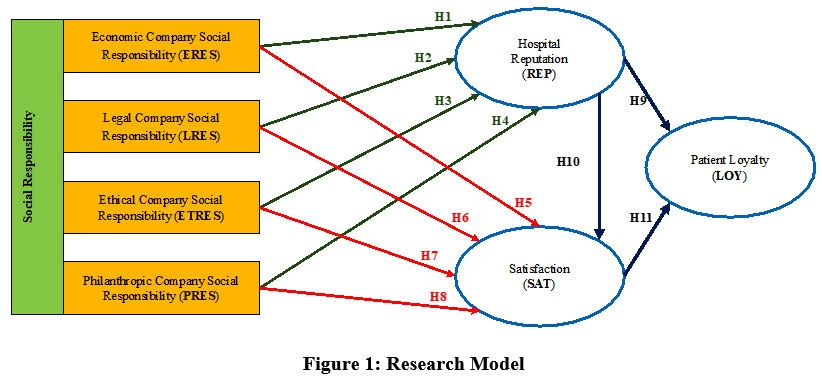 | Figure 1: Research Model.
|
A thorough theoretical review and empirical research are crucial for enhancing current knowledge, expanding theoretical frameworks, and providing additional empirical evidence and managerial insights on social responsibility, reputation, customer loyalty, and satisfaction. While previous studies have examined these relationships using various quantitative methods—such as Exploratory Factor Analysis or separate regression models—they often lack a comprehensive analytical framework for performance evaluation. To address this gap, this study builds on prior research by integrating and analyzing these relationships within a Structural Equation Modeling (SEM) framework. Based on the literature review, a research model has been developed to achieve the study’s objectives, as summarized in Figure 1.
Research Methodology
Measurement
The scales used in this study are adapted from previous research, with modifications made to suit the healthcare context in Vietnam. The survey was conducted in three phases.
First, the expert review method was applied, involving discussions with 10 healthcare professionals, each with a minimum of five years of experience in hospitals in Phan Thiet City, Vietnam. These experts provided valuable insights and recommended adjustments to enhance the questionnaire’s relevance and applicability to the Vietnamese healthcare sector.
Second, a pilot survey was conducted with 20 hospital patients to ensure the questionnaire was error-free, clearly worded, and contextually suitable. Participants were selected based on their willingness to take part in the study.
Third, the final survey was distributed to patients who had been hospitalized for at least three days, resulting in the collection of 390 valid responses.
A five-point Likert scale, ranging from “strongly disagree” to “strongly agree,” was used to assess all observed variables. The scale for social responsibility was primarily adapted from Lubis (2018), who conducted research in hospitals in Medan, Indonesia. To ensure relevance to the Vietnamese context, modifications were made, and additional variables were developed through expert discussions. Some of these additions include:
In the ERES scale: “The hospital has a competitive advantage over other hospitals due to its location.”
In the LRES scale: “The hospital’s electrical, water, drainage, and lighting systems meet international standards.”
In the ETRES scale: “Hospital staff and management demonstrate honesty and responsiveness to customer suggestions.” and “The hospital does not exploit any events to alter service prices or quality.”
In the PRES scale: “The hospital participates in volunteer activities to support the poor, orphans, and families of wounded soldiers and martyrs.” and “The hospital allocates a stable annual budget to programs focused on hunger eradication, poverty reduction, environmental protection, and traffic safety.”
The social responsibility scale includes a total of 16 observed variables.
The hospital reputation scale comprises 3 observed variables, while the patient loyalty scale includes 4 observed variables. The latter scales are based on Ahmed et al. (2017) and were further refined through expert feedback.
Additional observed variables include: “I generally do not consider the price when using hospital services.” and “I will speak positively about the hospital's treatment to my relatives.” A comprehensive measurement table outlining the scales and their corresponding observed variables can be found in Appendix A.
Data Collection and Processing
The questionnaire survey was conducted at An Phuoc General Hospital in Phan Thiet City, targeting patients who were staying at the hospital. A total of 390 survey questionnaires were distributed during the data collection period from October to December 2024. After careful data processing, 370 valid responses were retained for analysis.
Data Analysis Methodology
This study employed the Partial Least Squares-Structural Equation Modeling (PLS-SEM) approach, supported by SPSS and AMOS 22.0 software, to validate the proposed research hypotheses. The PLS-SEM is particularly suitable for analyzing complex models involving multiple constructs and simultaneous relationships (Anderson & Gerbing, 1988).
This study utilized the Partial Least Squares-Structural Equation Modeling (PLS-SEM) approach, supported by SPSS and AMOS 22.0 software, to validate the proposed research hypotheses. PLS-SEM is particularly well-suited for analyzing complex models with multiple constructs and interdependent relationships (Anderson & Gerbing, 1988).
The PLS-SEM analysis followed four key steps
Scale Quality Testing, Exploratory Factor Analysis (EFA), Confirmatory Factor Analysis (CFA), and Structural Equation Modeling (SEM). This structured approach ensures a rigorous evaluation of the measurement model and structural relationships, as recommended by Hair et al. (2006) and Kline (2011).
Results
Information about Survey Respondents
Table 1: Characteristics of Survey Respondents (n = 370).
Category | Frequency | % | Category | Frequency | % |
Gender | Educational Level | ||||
Female | 132 | 36 | Higher education | 126 | 34 |
Male | 238 | 64 | Secondary and High School | 141 | 38 |
Total | 370 | 100 | Elementary | 103 | 28 |
Age Group | Total | 370 | 100 | ||
<30 | 76 | 20 | Income (Million VND/month) | ||
31–45 | 196 | 53 | <8 | 68 | 18 |
46–55 | 32 | 9 | 8–15 | 139 | 38 |
>55 | 66 | 18 | 16–25 | 113 | 31 |
Total | 370 | 100 | >25 | 50 | 14 |
Total | 370 | 100 | |||
Occupation | |||||
Government employees | 143 | 39 | |||
Businesspeople | 96 | 26 | |||
Others | 131 | 35 | |||
Total | 370 | 100 | |||
Source: Extracted from SPSS
Table 1 displays the demographic profile of the 370 survey respondents.
In terms of gender, 64% of the participants were male, while 36% were female. The age distribution was divided into four groups: those under 30 years (20%), between 31–45 years (53%), 46–55 years (9%), and over 55 years (18%). Regarding occupation, the respondents included 39% government employees, 26% businesspeople and 35% others. For educational qualifications, 34% had completed higher education, 38% had attended secondary and highschool, and 28% had attained elementary. In terms of monthly income, the participants were grouped into four income brackets: less than 8 million VND/month (18%), 8–15 million VND/month (38%), 16–25 million VND/month (31%), and over 25 million VND/month (14%).
Scale Reliability Analysis
Table 2: Reliability of the Scale and Excluded Observed Variables
No. | Scale | Observed Variables Excluded | Cronbach’s Alpha Coefficient | Result |
1 | ERES | None | 0.805 | Good quality |
2 | LRES | None | 0.835 | Good quality |
3 | PRES | None | 0.844 | Good quality |
4 | ETRES | None | 0.831 | Good quality |
5 | REP | None | 0.851 | Good quality |
6 | SAT | None | 0.860 | Good quality |
7 | LOY | None | 0.853 | Good quality |
Source: Extracted from SPSS
The results in Table 2 show that all scales meet the reliability criteria, with Cronbach’s Alpha values exceeding 0.6 and corrected item-total correlations above 0.3, in line with the recommendations of Nunnally and Bernstein (1994).
Exploratory Factor Analysis (EFA)
Table 3: Pattern Matrix
Component | |||||||
1 | 2 | 3 | 4 | 5 | 6 | 7 | |
PRES3 | 0.856 | ||||||
PRES4 | 0.852 | ||||||
PRES2 | 0.804 | ||||||
PRES1 | 0.783 | ||||||
LRES3 | 0.831 | ||||||
LRES2 | 0.829 | ||||||
LRES1 | 0.806 | ||||||
LRES4 | 0.792 | ||||||
ETRES3 | 0.830 | ||||||
ETRES4 | 0.817 | ||||||
ETRES2 | 0.816 | ||||||
ETRES1 | 0.790 | ||||||
ERES4 | 0.827 | ||||||
ERES2 | 0.812 | ||||||
ERES3 | 0.783 | ||||||
ERES1 | 0.746 | ||||||
REP3 | 0.874 | ||||||
REP1 | 0.866 | ||||||
REP2 | 0.804 | ||||||
REP4 | 0.782 | ||||||
SAT3 | 0.868 | ||||||
SAT4 | 0.839 | ||||||
SAT2 | 0.836 | ||||||
SAT1 | 0.815 | ||||||
LOY2 | 0.904 | ||||||
LOY1 | 0.870 | ||||||
LOY3 | 0.863 | ||||||
Kaiser-Meyer-Olkin Measure | 0.837 | 0.811 | 0.818 | 0.721 | |||
Bartlett test (Sig.) | 0.000 | 0.000 | 0.000 | 0.000 | |||
Eigenvalues | 2.319 | ||||||
% of Variance | 66.658 | 69.317 | 70.529 | 77.293 | |||
Source: Extracted from SPSS
Note: The Kaiser-Meyer-Olkin (KMO) value falls between 0.5 and 1; Bartlett’s test is significant at a level below 0.05; factor loadings of observed variables exceed 0.3; extracted variance is greater than 50%; and Eigenvalues are above 1 (Hair et al., 2006).
The results in Table 3 indicate the following:
The Exploratory Factor Analysis (EFA) of the Social Responsibility scale identified three factors aligning with the theoretical model’s measured variables, with a total variance extracted of 66.658% and an Eigenvalue of 1.818.
The EFA of the Reputation scale resulted in four observed variables, with a total variance extracted of 69.317% and an Eigenvalue of 2.773.
The EFA of the Loyalty (LOY) scale identified three observed variables, with a total variance extracted of 77.293% and an Eigenvalue of 2.319.
The EFA of the Satisfaction (SAT) scale extracted four observed variables, with a total variance of 70.529% and an Eigenvalue of 2.821.
The Exploratory Factor Analysis (EFA) was conducted using the Promax rotation method.
Confirmatory Factor Analysis (CFA)
 | Figure 2: CFA Analysis Results
|
Source: Extracted from AMOS
The measurement model aligns with the actual data if it meets five key fit indices: (i) Cmin/df, (ii) TLI, (iii) CFI, (iv) NFI, and (v) RMSEA (Gefen et al., 2011). As shown in Figure 2, the results of the Confirmatory Factor Analysis (CFA) are summarized in Table 4.
Table 4: Fit Indices of the CFA
No. | Measure | Standard Value | Model Value | Result |
1 | Chi-squared | Cmin/df ?3 | 2.042 | Good |
2 | Tucker-Lewis Index (TLI) | TLI >0.90 indicates | 0.943 | Good |
3 | Comparative Fit Index (CFI) | CFI >0.90; the | 0.951 | Good |
4 | Normal Fit Index (NFI) | NFI >0.90 is acceptable; | 0.909 | Good |
5 | Root Mean | RMSEA <0.05 indicates | 0.047 | Good |
Source: Extracted from AMOS
The results in Table 4 confirm that the measurement model aligns with the actual data.
Analysis of Structural Equation Modeling
 | Figure 3: Results of the Linear Structural Analysis
|
Source: Extracted from AMOS
The results presented in Figure 3 indicate the following model fit indices: Cmin/df = 2.522; TLI = 0.917; CFI = 0.926; NFI = 0.884; RMSEA = 0.057. These values demonstrate that the integrated model achieves an acceptable fit with the actual data.
Using Bootstrap to Assess the Reliability of PLS-SEM Results
Structural function analysis methods typically require large sample sizes (Anderson & Gerbing, 1988), whereas academic research often encounters sample size limitations. In such cases, the Bootstrap technique serves as an effective alternative (Schumacker & Lomax, 2010). Bootstrap is a resampling method that treats the original sample as the population. It generates random samples from the original data, often using 1,000 resamples. The estimated results from these samples are averaged, and this average tends to approximate the population estimate. The smaller the difference between the average Bootstrap regression coefficients and the original model estimates, the greater the reliability of the model estimates.
Table 5: Bootstrap Implementation Results
Regression Weights: (Group number 1 - Default model) | ||||||||
Parameter | SE | SE-SE | Mean | Bias | SE-Bias | *CR | ||
REP | <--- | PRES | 0.052 | 0.001 | 0.355 | 0.001 | 0.002 | 0.5 |
REP | <--- | LRES | 0.049 | 0.001 | 0.451 | 0.001 | 0.002 | 0.5 |
REP | <--- | ETRES | 0.054 | 0.001 | 0.344 | 0.000 | 0.002 | 0.0 |
REP | <--- | ERES | 0.057 | 0.001 | 0.367 | 0.000 | 0.002 | 0.0 |
SAT | <--- | REP | 0.094 | 0.002 | 0.401 | 0.001 | 0.003 | 0.3 |
SAT | <--- | PRES | 0.069 | 0.002 | 0.222 | 0.001 | 0.002 | 0.5 |
SAT | <--- | LRES | 0.074 | 0.002 | 0.188 | 0.002 | 0.002 | 1.0 |
SAT | <--- | ETRES | 0.061 | 0.001 | 0.177 | 0.003 | 0.002 | 1.5 |
SAT | <--- | ERES | 0.066 | 0.001 | 0.152 | -0.001 | 0.002 | -0.5 |
LOY | <--- | REP | 0.080 | 0.002 | 0.816 | 0.007 | 0.003 | 2.3 |
LOY | <--- | SAT | 0.068 | 0.002 | 0.174 | -0.002 | 0.002 | -1.0 |
Source: Extracted from AMOS
* CR (Critical Ratios) = (Bias) / (SE-Bias)
The estimated coefficients are statistically significant. However, the absolute value of CR is quite small compared to 2, which is considered very good according to Hair et al. (2006) for a 95% confidence level or higher. On the other hand, for a 90% confidence level or higher, a CR value of ?2.5 is considered acceptable according to Greene (1991). The regression coefficient results before Bootstrap were reliable, as shown in Table 7. In Table 5, all hypotheses have an absolute value of CR ?2.5.
Table 6: Hypothetical Results
Hypothesis | Impact | Estimate | S.E. | C.R. | P | Decision | ||
H4 | REP | <--- | PRES | 0.354 | 0.047 | 7.545 | *** | Accepted |
H2 | REP | <--- | LRES | 0.450 | 0.048 | 9.429 | *** | Accepted |
H3 | REP | <--- | ETRES | 0.344 | 0.047 | 7.311 | *** | Accepted |
H1 | REP | <--- | ERES | 0.366 | 0.050 | 7.380 | *** | Accepted |
H10 | SAT | <--- | REP | 0.400 | 0.087 | 4.598 | *** | Accepted |
H8 | SAT | <--- | PRES | 0.221 | 0.058 | 3.839 | *** | Accepted |
H6 | SAT | <--- | LRES | 0.186 | 0.062 | 3.005 | 0.003 | Accepted |
H7 | SAT | <--- | ETRES | 0.175 | 0.057 | 3.067 | 0.002 | Accepted |
H5 | SAT | <--- | ERES | 0.152 | 0.06 | 2.544 | 0.011 | Accepted |
H9 | LOY | <--- | REP | 0.809 | 0.076 | 10.612 | *** | Accepted |
H11 | LOY | <--- | SAT | 0.176 | 0.065 | 2.718 | 0.007 | Accepted |
Source: Extracted from AMOS
Note: *** (Sig. = 0.000).
Table 6 shows that all paths are statistically significant at p < 0.05. Consequently, all hypotheses are supported with a confidence level of 95% or higher.
Table 7: Magnitude of the Impact
Impact | Regression coefficient | % | Position | ||
Impact on SAT | |||||
REP = f(LRES, PRES, ETRES, ERES) | |||||
REP | <--- | PRES | 0.35 | 23.4 | 3 |
REP | <--- | LRES | 0.45 | 29.8 | 1 |
REP | <--- | ETRES | 0.34 | 22.8 | 4 |
REP | <--- | ERES | 0.37 | 24.2 | 2 |
Total | 1.51 | 100 | |||
Impact on REP | |||||
SAT = f(REP, PRES, LRES, ETRES, ERES) | |||||
SAT | <--- | REP | 0.40 | 35.4 | 1 |
SAT | <--- | PRES | 0.22 | 19.6 | 2 |
SAT | <--- | LRES | 0.19 | 16.5 | 3 |
SAT | <--- | ETRES | 0.18 | 15.5 | 4 |
SAT | <--- | ERES | 0.15 | 13.5 | 5 |
Total | 1.13 | 100 | |||
Impact on LOY | |||||
LOY = f(REP,SAT) | |||||
LOY | <--- | REP | 0.809 | 82.1 | 1 |
LOY | <--- | SAT | 0.176 | 17.9 | 2 |
Total | 0.985 | 100 | |||
Source: Extracted from AMOS
The factors influencing “Hospital Reputation,” ranked from highest to lowest impact, are LRES, ERES, PRES, and ETRES. The factors affecting “SAT,” in descending order of influence, are REP, PRES, LRES, ETRES, and ERES. The factors impacting “LOY,” ranked by significance, are REP and SAT.
Discussion
The study defines social responsibility through four key dimensions: Economic Social Responsibility (ERES), Legal Social Responsibility (LRES), Ethical Social Responsibility (ETRES), and Philanthropic Social Responsibility (PRES). These findings align with Ahmed et al. (2017) in the context of healthcare in Bangladesh and Pakistan while incorporating new variables, including:
ERES: “The hospital has a competitive advantage over other hospitals due to its location.”
LRES: “The hospital’s electrical, water, drainage, and lighting systems meet international standards.”
ETRES: “Hospital staff and management demonstrate honesty and responsiveness to customer suggestions” and “The hospital does not exploit any events to alter service prices or quality.”
PRES: “The hospital participates in volunteer activities to support the poor, orphans, and families of wounded soldiers and martyrs.” and “The hospital allocates a stable annual budget to programs focused on hunger eradication, poverty reduction, environmental protection, and traffic safety.”
Additionally, constructs related to customer loyalty include variables such as: “I generally do not consider the price when using hospital services” and “I will speak positively about the hospital’s treatment to my relatives.”
The study confirms that social responsibility (economic, legal, ethical, and philanthropic) positively affects reputation, consistent with findings by Lubis (2018) in Indonesian hospitals. Similarly, it influences loyalty, as shown in research by Hossain et al. (2019) in Bangladesh. Furthermore, both satisfaction and reputation significantly impact patient loyalty, supporting findings from Turay et al. (2017) on hospitals in Jordan.
The results underscore the importance of enhancing satisfaction and reputation to optimize hospital performance and management success.
Conclusion
This study enhances the theoretical framework by providing empirical evidence on the relationships between social responsibility, reputation, patient loyalty, and hospital performance, using data from a general hospital in Phan Thiet City, Binh Thuan Province, Vietnam. The findings highlight the crucial mediating roles of reputation and satisfaction in linking social responsibility to loyalty. Furthermore, structural equation analysis offers deeper insights into the interconnections among these factors.
Limitations of the study
Despite its contributions, the study has certain limitations. The sample is limited to a single hospital in Phan Thiet City, which may restrict the generalizability of the results. Future research should expand to multiple hospitals to allow for comparative analysis and broader applicability. Additionally, while this study focuses on social responsibility and loyalty, future studies could explore other factors influencing loyalty to provide a more comprehensive understanding of performance determinants in Vietnam’s healthcare sector.
Acknowledgment
The authors acknowledge the research team and An Phuoc General Hospital, Vietnam, for their support during this study.
Funding Sources
The authors received no financial support for the research, authorship, or publication of this article.
Conflict of Interest
The authors declare no conflicts of interest.
Data Availability Statement
This statement does not apply to this article.
Ethics Statement
This research did not involve human participants, animal subjects, or any material that requires ethical approval.
Informed Consent Statement
This study did not involve human participants, and therefore, informed consent was not required.
Permission to reproduce material from other sources
The authors have secured the necessary permissions and licenses for the reproduction of all figures,tables, and excerpts from external sources.
Author Contributions
Ho Dinh Phi: Conceptualization, Methodology, Validation, Writing – Original Draft, Supervision, Project Administration, Final Approval of the Version to be Published.
Dat Phan Hoang Man: Investigation, Formal Analysis, Data Curation, Writing – Original Draft
Minh Bui Quang: Writing – Review & Editing and Visualization.
Vien Nguyen Xuan: Investigation, Data collection, Resources, Data Curation.
Anh Le Van: Investigation, Data collection, Resources, and Data Curation.
References
- Abozar, T., Poor, T.H., & Soltanmoradi, M. (2013). Influence of customer satisfaction and customer loyalty on firm performance in Iran. Journal of Basic and Applied Scientific Research, 3(2), 1234–1239.
- Afthanorhan, A., Awang, Z., Salleh, F., Ghazali, P., & Rashid, N.J.M.S.L. (2018). The effect of product quality, medical price, and staff skills on patient loyalty via cultural impact in medical tourism. Management Science Letters, 8(12), 1421–1424.
CrossRef - Ahmed, S. (2017). Service quality, patient satisfaction, and loyalty in the Bangladesh healthcare sector. International Journal of Health Care Quality Assurance, 30(5), 477–488.
CrossRef - Akin, E., & Demirel, Y. (2011). An empirical study: An empirical study: Are corporate image relation satisfaction and identification with corporate influential factors on effectiveness of corporate communication and consumer retention. European Journal of Social Sciences, 23(1). https://hdl.handle.net/20.500.12451/2799.
- Anderson, J.C., & Gerbing, D.W. (1988). Structural equation modeling in practice: A review and recommended two-step approach. Journal of Psychological Bulletin, 103(3), 411–423.
CrossRef - Assaker, G., Vinzi, V.E., & O’Connor, P. (2011). Examining the effect of novelty seeking, satisfaction, and destination image on tourists’ return patterns: A two-factor, non-linear latent growth model. Tourism Management, 32(4), 890–901.
CrossRef - Bagozzi, R.B., & Yi, I. (1988). On the evaluation of structural equation models. Journal of the Academy of Marketing Science, 16, 74–94.
CrossRef - Bentler, P.M., & Bonett, D.G. (1980). Significance tests and goodness of fit in the analysis of covariance structures. Psychological Bulletin, 32(1), 87–104.
CrossRef - Binh Thuan Province Electronic Information Portal. (2023). The Provincial General Hospital needs to implement solutions to improve the quality of medical examination and treatment services. Available from https://binhthuan.gov.vn/tin-chinh-quyen/benh-vien-da-khoa-tinh-can-thuc-hien-dong-bo-cac-giai-phap-nang-cao-chat-luong-dich-vu-kham-chua-639288.
- Bisimwa, A., Nuwagaba, N., & Musigire, S. (2019). Perceived service quality, trust, customer satisfaction, and customer loyalty in the banking sector of Bukavu (East of DR Congo). Journal of Business and Management Sciences, 7(3), 100–111. doi: 10.12691/jbms-7-3-1
CrossRef - Boshoff, C., & Gray, B. (2004). The relationships between service quality, customer satisfaction, and buying intentions in the private hospital industry. South African Journal of Business Management, 35(4), 27–37.
CrossRef - Boyd, B., Bergh, D., & Ketchen, D. (2010). Reconsidering the reputation-performance relationship: A short-based view. Journal of Management, 36(3), 588–609.
CrossRef - Bromley, D. (2002). Comparing corporate reputations: League tables, quotients, benchmarks, or case studies? Corporate Reputation Review, 5(1), 35–60.
CrossRef - Browne, M.W., & Cudeck, R. (1993). Alternative ways of assessing model fit. In K.A. Bollen & J.S. Long (Eds.), Testing Structural Equation Models (pp. 136–162). Newbury Park, CA: Sage Publications.
- Carroll, A.B. (1991). The pyramid of corporate social responsibility: Toward the moral management of organizational stakeholders. Business Horizons, 34(4), 39–48.
CrossRef - Chang, C.W., Tseng, T.H., and Woodside, A.G. (2013). Configural algorithms of patient satisfaction, participation in diagnostics, and treatment decisions’ influences on hospital loyalty. Journal of Services Marketing, 27(2), 91–103.
CrossRef - Chen, C.F., and Phou, S. (2013). A closer look at destination: Image, personality, relationship, and loyalty. Tourism Management, 36, 269–278.
CrossRef - Chin, W.W., and Todd, P.A. (1995). On the use, usefulness, and ease of use of structural equation modeling in MIS research: A note of caution. MIS Quarterly, 19(2), 237–246.
CrossRef - Chun, R. (2005). Corporate reputation: Meaning and measurement. International Journal of Management Reviews, 7(2), 91–109.
CrossRef - Chung, K., Yu, J., Choi, M., and Shin, J. (2015). The effects of CSR on customer satisfaction and loyalty in China: The moderating role of corporate image. Journal of Economics, Business and Management, 3(5), 542–547. doi: 10.7763/JOEBM.2015.V3.243.
CrossRef - Clarke, J., and Gibson?Sweet, M. (1999). The use of corporate social disclosures in the management of reputation and legitimacy: A cross-sectoral analysis of UK top 100 companies. Business Ethics: A European Review, 8(1), 5–13.
CrossRef - Cuesta-Valiño, P., Rodriguez, P.G., and Barriopedro, E.N. (2019). The impact of corporate social responsibility on customer loyalty in hypermarkets: A new socially responsible strategy. Corporate Social Responsibility and Environmental Management, 26(3), DOI: 10.1002/csr.1718.
CrossRef - Dada, M.H. (2021). Impact of brand association, brand image, and brand loyalty on brand equity. Journal of Marketing Strategies, 3(1), 29–43. DOI: 10.52633/jms.v3i1.33.
CrossRef - Dagger, T.S., and O'Brien, T.K. (2010). Does experience matter? European Journal of Marketing, 44(9/10). doi: 10.1108/03090561011062952.
CrossRef - Ellynia, E., and Widjaja, A. (2020). The effect of service quality on patient loyalty (A study on inpatients of regional public hospitals in Jakarta, Indonesia). International Journal of Advanced Engineering, Management and Science, 6(1). https://doi.org/10.22161/ijaems.6.1.7.
CrossRef - Emari, H., Jafari, A., and Mogaddam, M. (2012). The mediatory impact of brand loyalty and brand image on brand equity. African Journal of Business Management, 6(17), 5692–5701.
CrossRef - Erbay, E., and Esato?lu, A.E. (2017). Reputation management in healthcare. In Developments in Health Sciences (pp. 591–610). Publisher: Kliment Ohridski University Press. Editors: Özdemir, B., Shapekova, N.L., Ak, B., Y?ld?z, H., Özcanarslan, F., Ivanova, L.
- Estalami, H., Maxwell, S., Martín?Consuegra, D., Molina, A., and Esteban, Á. (2007). An integrated model of price, satisfaction, and loyalty: An empirical analysis in the service sector. Journal of Product & Brand Management, 16(7), 459–468.
CrossRef - Fombrun, C.J., Gardberg, N.A., and Sever, J.M. (2000). The Reputation Quotient SM: A multi-stakeholder measure of corporate reputation. Journal of Brand Management, 7, 241–255.
CrossRef - Ganiyu, R.A. (2017). Customer satisfaction and loyalty: A study of interrelationships and effects in Nigerian domestic airline industry. Oradea Journal of Business and Economics, 2(1), 7–20.
CrossRef - Gazzola, P. (2014). Corporate social responsibility and companies’ reputation. Network Intelligence Studies, 2(3), 74–84.
- Gefen, D., Rigdon, E., and Straub, D. (2011). An update and extension to SEM guidelines for administrative and social science research. MIS Quarterly, 35(2), III–XII.
CrossRef - Gerpott, T. (2001). Empirical studies of customer loyalty. Problems of the Theory and Practice of Management, 4, 35–41.
- Hair, J., Anderson, R., Tatham, P., and Black, W. (2006). Multivariate Data Analysis (6th ed.). Upper Saddle River, NJ: Prentice-Hall.
- Herbig, P., and Milewicz, J. (1993). The relationship of reputation and credibility to brand success. Journal of Consumer Marketing, 10(3), 18–24.
CrossRef - Hibbard, J.H., Stockard, J., and Tusler, M. (2005). Hospital performance reports: Impact on quality, market share, and reputation. Health Affairs, 24(4), 1150–1160.
CrossRef - Hossain, M.S., Syahya, S., and Khan, M.J. (2019). The effect of corporate social responsibility (CSR) healthcare services on patients’ satisfaction and loyalty: A case of Bangladesh. Social Responsibility Journal. https://doi.org/10.1108/SRJ-01-2018-0016.
CrossRef - Hu, L.T., and Bentler, P.M. (1995). Evaluating model fit. In R.H. Hoyle (Ed.), Structural Equation Modeling: Concepts, Issues, and Applications (pp. 76–99). Thousand Oaks, CA: Sage.
- Hwang, E.J., and Sim, I.O. (2016). Structural equation modeling for public hospital quality of care, image, role performance, satisfaction, intent to (re)visit, and intent to recommend hospital as perceived by community residents. Journal of Korean Academy of Nursing, 46(1), 118–127.
CrossRef - Inleh, O., Bartlett, J.L., and May, S. (2011). Corporate social responsibility and communication. In O. Ihlen, J.L. Bartlett, & S. May (Eds.), The Handbook of Communication and Corporate Social Responsibility (pp. 3–22). Chichester: Wiley-Blackwell. https://doi.org/10.1002/9781118083246.
CrossRef - Ishaq, M.I., Bhutta, M.H., Hamayun, A.A., Danish, R.Q., and Hussain, N.M. (2014). Role of corporate image, product quality, and customer value in customer loyalty: Intervening effect of customer satisfaction. Journal of Basic and Applied Scientific Research, 4(4), 89–97.
- Islam, T., Islam, R., Pitafi, A.H., Xiaobei, L., Rehmani, M., Irfan, M., and Mubarak, M.S. (2021). The impact of corporate social responsibility on customer loyalty: The mediating role of corporate reputation, customer satisfaction, and trust. Sustainable Production and Consumption, 25, 123–135. https://doi.org/10.1016/j.spc.2020.07.019.
CrossRef - Juhana, D., Manik, E., Febrinella, C., and Sidharta, I. (2015). Empirical study on patient satisfaction and patient loyalty in public hospitals in Bandung, Indonesia. International Journal of Applied Business and Economic Research, 13(6), 4305–4326.
- Kassim, N., and Asiah Abdullah, N. (2010). The effect of perceived service quality dimensions on customer satisfaction, trust, and loyalty in e-commerce settings: A cross-cultural analysis. Asia Pacific Journal of Marketing and Logistics, 22, 351–371. https://doi.org/10.1108/13555851011062269.
CrossRef - Keller, K.L. (2016). Reflections on customer-based brand equity: Perspectives, progress, and priorities. AMS Review, 6(1–2), 1–16.
CrossRef - Khokhar, I.U. (2009). Impact of Corporate Social Responsibility on Customer Loyalty and Purchase Intention. Available at SSRN: https://ssrn.com/abstract=2164560 or http://dx.doi.org/10.2139/ssrn.2164560.
CrossRef - Kinzey, R.E. (2013). Promoting Nonprofit Organizations: A Reputation Management Approach. Routledge.
CrossRef - Kline, R.B. (2011). Principles and Practices of Structural Equation Modeling. New York: Guilford Press.
- Kotler, P., and Lee, N. (2008). Corporate Social Responsibility: Doing the Most Good for Your Company and Your Cause. John Wiley & Sons.
- Kulsum, U., and Syah, T.Y.R. (2017). The effect of service quality on loyalty with mediation of patient satisfaction. International Journal of Business and Management Invention, 6(3), 41–50.
- Lai, C.S., Chiu, C.J., Yang, C.F., and Pai, D.C. (2010). The effects of corporate social responsibility on brand performance: The mediating effect of industrial brand equity and corporate reputation. Journal of Business Ethics, 95(3), 457–469.
CrossRef - Leclercq-Machado, L., Alvarez-Risco, S., Esquerre-Botton, S., Almanza-Cruz, C., Anderson-Seminario, M. de las M., Del-Aguila-Arcentales, S., and Yáñez, J.A. (2022). Effect of Corporate Social Responsibility on Consumer Satisfaction and Consumer Loyalty of Private Banking Companies in Peru. Sustainability, 14(15), 9078. https://doi.org/10.3390/su14159078.
CrossRef - Levitt, T. (1965). Exploit the Product Life Cycle. Harvard Business Review, 43, 81–94.
- Lievens, F. (2017). Organizational Image. Thousand Oaks: SAGE Publications, Inc.
- Lovelock, C., and Wirtz, J. (2015). Services Marketing: Global Edition. Pearson Higher Ed.
- Lubis, A.N. (2018). Corporate social responsibility in the health sector: A case study in the government hospitals in Medan, Indonesia. Verslas Teorija ir Praktika, 19(9), 25–36.
CrossRef - Marchiori, E., Inversini, A., and Cantoni, L. (2010). Towards a tourism destination reputation model: A first step. Faculty of Communication Sciences, University of Lugano, Switzerland.
- Mohamad, M., Ali, A.M., and Ab Ghani, N.I. (2011). A structural model of destination image, tourist’s satisfaction, and destination loyalty. International Journal of Business and Management Studies, 3(2), 167–177.
- Mohsan, F., Nawaz, M.M., Khan, M.S., Shaukat, Z., and Aslam, N. (2011). Impact of customer satisfaction on customer loyalty and intentions to switch: Evidence from the banking sector of Pakistan. International Journal of Business and Social Science, 2, 230–245.
- Morsing, M., and Schultz, M. (2006). Corporate social responsibility communication: Stakeholder information, response, and involvement strategies. Business Ethics: A European Review, 15(4), 323–338.
CrossRef - Naguib, N.H., Saghier, N.M.E., and Eman, N.M. (2023). Analysis of the Relationship between Corporate Social Responsibility and Customer Loyalty in the Egyptian Hypermarkets Sector. DOI: 10.4236/oalib.1110274.
CrossRef - Ngoc Tu Tran (2022). Impact of corporate social responsibility on customer loyalty: Evidence from the Vietnamese Jewellery industry. Cogent Business & Management, 9(1). DOI: 10.1080/23311975.2022.2025675.
CrossRef - Nunnally, J.C., and Burnstein, I.H. (1994). Psychometric Theory. New York: McGraw-Hill.
- Oh, H.J., Hong, K.W., and Kim, H.C. (2013). The influence of multidimensional aspects of service quality, communication on customer satisfaction and customer behavior - focused on the Airline Service. Korean Business Education Review, 28(3), 273–295.
- Oliver, R.L. (2014). Satisfaction: A Behavioral Perspective on the Consumer. Routledge.
CrossRef - Pilny, A., and Mennicken, R. (2014). Does Hospital Reputation Influence the Choice of Hospital? SSRN Electronic Journal. DOI:10.2139/ssrn.2565700.
CrossRef - Prayag, G., and Ryan, C. (2012). Antecedents of tourists’ loyalty to Mauritius: The role and influence of destination image, place attachment, personal involvement, and satisfaction. Journal of Travel Research, 51(3), 342–356.
CrossRef - Ramli, A.H. (2019). Patient satisfaction, hospital image and patient loyalty in West Sulawesi Province. Business and Entrepreneurial Review, 17(1), 1–14.
CrossRef - Sandu, M.C. (2015). The factors response with corporate reputation: A structural equation modelling approach. Romanian Journal of Economics, 40(1), 144–157.
- Satir, C. (2006). The nature of corporate reputation and the measurement of reputation components: An empirical study within a hospital. Corporate Communications: An International Journal, 11(1), 56–63.
CrossRef - Schumacker, R.E., and Lomax, R.G. (2010). A Beginner’s Guide to Structural Equation Modeling. Routledge, New York.
- Sciulli, L.M., and Missien, T.L. (2015). Hospital service-line positioning and brand image: Influences service quality, patient satisfaction, and desired performance. Innovative Marketing, 11(2), 20–29.
- Shi, H. (2020). The impact of corporate social responsibility on customer satisfaction and customer perceived value. Conference: 2020 4th International Seminar on Education, Management and Social Sciences (ISEMSS 2020)*. DOI:10.2991/assehr.k.200826.089.
CrossRef - Singh, K., and Misra, M. (2021). Linking corporate social responsibility (CSR) and organizational performance: The moderating effect of corporate reputation. European Research on Management and Business Economics, 27(1). DOI: 10.1016/j.iedeen.2020.100139.
CrossRef - Susanto, A.B. (2012). The role of corporate social responsibility in enhancing corporate reputation. Social Responsibility Review, 3, 26–33.
CrossRef - Sysoev, S., and Neiman, A. (2004). Love cannot be forced, or what is customer loyalty. Marketer, 2, 32–35.
- Tosyal, H., Sütcü, C.S., and Tosyal, F. (2019). Patient loyalty in the hospital-patient relationship: The mediating role of social media. Erciyes ?leti?im Dergisi, 6(1), 783–804.
CrossRef - Turay, T., Mokhtar, S.S.M., Salimon, M.G., and Morakinyo, S. (2017). The impact of hospital reputation on patient loyalty. International Journal of Economic Research, 14(19), 191–199.
CrossRef - Ueltschy, L.C., Laroche, M., Eggert, A., and Bindl, U. (2007). Service quality and satisfaction: An international comparison of professional services perceptions. Journal of Services Marketing, 21(6), 410–423.
CrossRef - Veloso, C.M., Magueta, D., Ribeiro, H., and Alves, S.R. (2018). The links between service quality, brand image, customer satisfaction, and loyalty in the retail industry. Economic and Social Development: Book of Proceedings, 497–511.
- Wang, C.Y., and Hsu, M.K. (2010). The relationships of destination image, satisfaction, and behavioral intentions: An integrated model. Journal of Travel & Tourism Marketing, 27(8), 829–843.
CrossRef - Wu, C. (2011). The impact of hospital brand image on service quality, patient satisfaction, and loyalty. African Journal of Business Management, 5(12).
- Yuliani, Y. (2019). Influences of brand on hospital performance and patient behavioral expectations. Postgraduates Program of Hospital Administration Studies (KARS), Department of Health Administration and Policy, Faculty of Public Health, Universitas Indonesia, Depok, Indonesia.

This work is licensed under a Creative Commons Attribution 4.0 International License.