Exploring the Role of Artificial Intelligence in the Meta Marketing for branding the Cloud Restaurants
Surjadeep Dutta1*  , Uma Padmini Ema2 , Sarthak Sengupta3 and Souvik Banerjee4
1Faculty of Management, SRM Institute of Science and Technology, Kattankulathur,, India .
2York Business School, York St John University, London, United Kingdom .
3IIHMR University, Jaipur, Rajasthan India .
4Management Development Institute Murshidabad, India .
http://dx.doi.org/10.12944/JBSFM.06.02.03
The rapid advancement of artificial intelligence (AI) has significantly influenced marketing, including the branding strategies of cloud restaurants. This study explores AI's role in enhancing Meta marketing strategies, focusing on personalized content, data-driven insights, innovation, and foresight. Using a quantitative approach with 150 respondents across Bangalore, Kolkata, Chennai, and London, regression analysis reveals a strong positive impact of these factors on branding performance. These findings underscore AI's potential to transform customer engagement and brand influence, offering actionable insights for cloud restaurant marketing strategies.
Copy the following to cite this article:
Dutta S, Ema U. P, Sengupta S, Banerjee S. "Exploring the Role of Artificial Intelligence in the Meta Marketing for branding the Cloud Restaurants". Journal of Business Strategy Finance and Management, 6(2).
DOI:http://dx.doi.org/10.12944/JBSFM.06.02.03Copy the following to cite this URL:
Dutta S, Ema U. P, Sengupta S, Banerjee S. "Exploring the Role of Artificial Intelligence in the Meta Marketing for branding the Cloud Restaurants". Journal of Business Strategy Finance and Management, 6(2). Available here: https://bit.ly/3WNUggb
Download article (pdf) Citation Manager Publish History



Introduction
With the recent evolution in Artificial Intelligence (AI), the landscape in marketing has changed significantly. Once AI tools are implemented in their marketing strategies, the respective organization will be in a perfect position to understand and keep track of consumer information in real time, thereby anticipating their needs and satisfying them accordingly. In the game of the competition of the cloud kitchens, the brand becomes very important. AI helps manage online visibility by reading the state of customer activity and taking successive actions that instantly alter marketing moves for positioning. The several examples of this can be none but Keyword Operational Content, Social Interaction Management, and exploitation of AI-form technology so that ads reach the largest possible number of people. After all, after you have realized and foreseen what the market is going to do, you could put your branding in a more appeasing way. In the words of Rust and Huang (2014), AI within the marketing sector provides an advantage in real time-customization, greatly enhancing customer satisfaction and loyalty, by providing insights into predictive analytics. Such recommendation systems, which operate on AI technology, are characteristic of Amazon and Netflix, wherein machine learning is applied to assist users with goods and files based on their preferences (Gentsch, 2019).
Natural language processing (NLP) is an additional feature of AI that holds importance in marketing. It is responsible for the creation of chatbots and virtual friends that help the organization enhance its quality focusing on customer service. According to a study by Chattaraman et al. (2019) AI provides advances as automatic conversational agents, which reply fast and foster trust with people so they become more loyal to the brand. Additionally, AI has also facilitated content marketing. Copywriting tools for example help create a higher level of visibility on search engines for wider audiences (Kaplan & Haenlein, 2019).
Artificial Intelligence (AI) can easily be defined as the bolstering of customer acquisition using the identification, targeting, and engagement of potential customers by businesses with exactness and effectiveness. Introducing AI into the customer acquisition plans gives marketers a golden opportunity to scrutinize large sets of data, foreshadow customer likes, as well as draft individual marketing strategies that touch a chord with their public.
Cloud restaurants now have in AI a powerful transforming tool in the new meta marketing strategy, redefining their means of engaging their customers and branding. Because AI could be used in processing large sets of data for uncovering insight, optimizing a campaign in real time, meta marketing, being strategy- rather than tactics-oriented, derives great value from these capabilities of AI. AI-driven personalization allows cloud restaurants to tailor offerings based on individual preference through predictive analytics that predict how customers are going to behave and enhance satisfaction and loyalty. In addition, AI supports the visibility of brands by optimizing digital touchpoints including search engine rankings, social media engagements, and targeted advertising.
Literature Review
AI boosts how companies personalize for customers, a key part of winning new customers. By looking at data like what people bought before, what they looked at, and their social media actions, AI systems craft tailored experiences that appeal to individuals. Huang and Rust (2021) say that these personal touches not only attract new customers but also build stronger bonds, making brand loyalty more likely. For example, AI-driven recommendation systems used by online shops suggest products that greatly increase first-time buys.
AI-powered chatbots and virtual assistants are vital in engaging potential customers during the acquisition phase. These tools provide instant, interactive, and scalable communication, answering customer questions and guiding them through their buying journey. Chattaraman et al. (2019) found that AI chatbots enhance customer acquisition by creating a smooth and informative onboarding process, which boosts customer satisfaction and trust.
AI-driven ad platforms use programmatic ads to find and target likely buyers with great accuracy. Real-time bid tools look at user profiles and context to show fitting ads, boosting clicks and sales (Gentsch, 2019). Tools like Google Ads and Meta's Audience Insights use AI to run super-targeted ads, reaching potential buyers at the right time and place.
Gentsch (2019) says AI can split up audiences very well. This helps marketers make special messages that match users' likes and buying plans. Take Facebook's Lookalike Audiences, which uses AI to find new customers like the old ones. This widens the reach and gets better results by showing ads to people who will likely like them. AI makes ad delivery better by learning fast. Facebook's machine learning checks how ads are doing and how users act, then tweaks things to get the best results. Kaplan and Haenlein (2019) say this keeps ads smart, showing them to the right people at the right time, which keeps them fresh and relevant.
Personalizing content goes beyond just making it. Facebook's AI tools, like Creative Hub, help marketers make eye-catching and fitting ads. These tools use data from past efforts and what the audience likes to suggest ad parts that grab attention. Plus, a study by Balducci and Marinova (2018) shows how AI-driven sentiment analysis helps marketers see how users feel about ads, allowing them to keep making their marketing better.
Research Objectives
Identify the potential of AI in enhancing Branding strategy.
To provide actionable insights for cloud restaurants to adopt and integrate AI in their Facebook marketing efforts.
Research Gap
As more cloud restaurants are getting into digital marketing AI, the field is growing higher but not much research has been carried out to analyze its application within the specific context of cloud restaurants on platforms like Facebook. Meanwhile tools like Lookalike Audiences and ad optimization of AI in Facebook have been usually studied in general settings, no prior studies have looked into how these tools can be customized to serve the needs of the cloud restaurants, that are operating in a very competitive and data-dominated environment. AI and personalization are the main subjects of e-commerce research while there are only a few studies that are exploring the use of AI in the design and delivery of personalized Facebook ad campaigns for cloud restaurant consumers, who may have unique preferences and expectations.
Materials and Methods
The research methodology of this study was a quantitative approach to investigating the role of AI in cloud restaurants' branding strategies. Justification for such an approach can be seen in its ability to provide measurable, statistically significant insights into relationships between variables, which would ensure that the hypothesized factors influencing branding are robustly analyzed. Quantitative methods were selected for their accuracy in hypothesis testing and generalization of research findings based on a sample of 150 respondents from various locations such as Bangalore, Kolkata, Chennai, and London. Regression analysis was used to understand the relationship between independent variables such as personalized content, data-driven insights, innovation, and foresight with branding. Regression analysis explains very well the relationship prediction, thereby helping to determine the strength of associations between variables. Chi-square analysis was also applied to determine the association between categorical variables, thereby establishing whether they are independent or related. The tools chosen are widely accepted in marketing and behavioral research, which makes them reliable and replicable. The questionnaire was designed using Google Forms with items based on established scales used in previous studies (e.g., Kaplan & Haenlein, 2019; Gentsch, 2019) to ensure content validity. By integrating such methodologies, it was an approach to derive some actionable insights for implementing AI-driven meta-marketing on cloud restaurants as a strategic approach.
Research Model
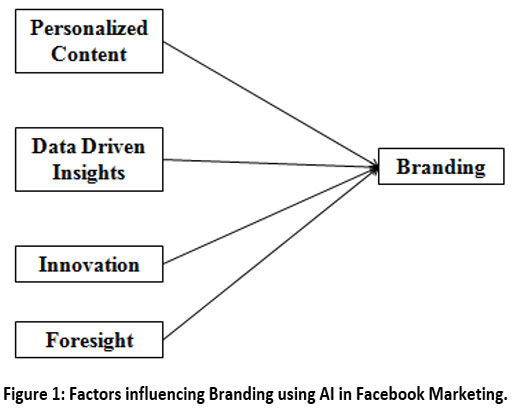 | Figure 1: Factors influencing Branding using AI in Facebook Marketing.
|
Independent Variables (IVs)
Personalized Content
Personalized content based on the individual's tastes and actions is what a company does to let customers have a totally new exciting and unforgettable experience.
Data-Driven Insights
Data-derived insights from the study of client databases in order to give a true perspective on like and dislike of the customers, help a company deliver the right products or services, and make it a brand more relevant.
Innovation
A company's capacity to employ state-of-art technologies, fresh techniques, and inventive ideas for leading the market and gaining substantial market share is known as innovation, which in its turn ensures the product's or the company's continuous relevance to the customer.
Foresight
The capability of the brand to anticipate marketing problems and change the marketing plan accordingly will be seen as the brand being proactive and forward-thinking.
Dependent Variable (DV)
Branding: The overall perception and positioning of a brand in the marketplace, shaped by customer experiences, loyalty, recognition, and trust.
Results
Demographic Analysis
Demographic analysis allows advertising strategists to know the profile of people they are targeting by accumulating and examining solid data elements that are connected with the main more general categories like age, income, sex, and occupation.
Table 1: Demography Details
Demography Factor | Highlighting Criteria | Percentage of response |
Age | 25-30 | 80% |
Gender | Male | 67% |
Occupation | Entrepreneur | 84% |
Annual Income | 10-15 Lpa | 77 % |
Demographic analysis, which can be defined as the process of segmenting and understanding the target audience by collecting and analyzing data related to key demographic factors, is absolutely necessary.For the AI-based marketing strategies of cloud restaurants, demographic analysis provides the insights that are most important. A large 80% of the surveyed people fall in the 25-30 years age group, thereby demonstrating young, tech-savvy people with high participation. This group is more likely to engage in personalized and innovative marketing campaigns, thus becoming targets for the AI-generated content that is oriented on attributes such as speed, customization, and convenience. The given results, which show that 67% of male participants responded positively to it, suggested that marketing efforts should target more male consumers, who might, in turn, be lured with product features if they offer something of value to them. Also, 84% of the surveyed people are entrepreneurs and the demographic is characterized by the attributes of valuing efficiency and being business-oriented. The use of AI-driven campaigns might be the magic that can bring about a new era for the business by the ideas of the campaign such as exclusive offers, timesaving aspects, and the potential to increase the business. So, they might be the first ones to sense this new wave of entertainment. The findings of the research are about the 77% of those who make 10-15LPA. It can be said that this particular segment is middle to upper-middle-class, which may likely involve itself in more appealing activities. Special campaigns, exclusive promotions, and high-end products suited perfectly for this income group could be the tools to boost brand attachment with the high-income audience.
Reliability Test of all the factors
Reliability Test is a statistical method used to assess the consistent standard of a measuring instrument or scale through time. The execution of the same instrument, like a survey, questionnaire, or test, and delivery of the same results under constant conditions is determined through this method.
Table 2: Reliability Test
Factors | Cronbach’s Alpha Value |
Personalized Content | 0.812 |
Data Driven Insights | 0.899 |
Innovation | 0.921 |
Foresight | 0.961 |
All of the factors in your study are very consistent, with the Cronbach's Alpha value of more than 0.7 (it is usually taken as an indicator of satisfactory reliability).This suggests that the instruments you use for Personalized Content, Data-Driven Insights, Innovation and Foresight are trustworthy, and you can go ahead with the statistical analyses.
Chi-Square Analysis to identify Relationships between the variables
Chi-Square Analysis (also known as the Chi-Square Test of Independence) is a statistical method used to determine if there is a significant association between two categorical variables. It compares the observed frequency distribution of categorical data to the expected frequency distribution, which assumes that the variables are independent.
Ho1: There is no significant relationship between Personalized Content and Branding.
Ho2: There is no significant relationship between Data Driven Insights and Branding.
Ho3: There is no significant relationship between Innovation and Branding.
Ho4: There is no significant Relationship between Foresight and Branding.
Table 3: Hypothesis Testing
Value | df | Asymptotic Significance (2-sided) | |
Pearson Chi-Square : Ho1 | 466.283a | 16 | 0.000 |
Pearson Chi- Square: Ho2 | 21.063a | 12 | 0.049 |
Pearson Chi- Square: Ho3 | 32.908a | 12 | 0.001 |
Pearson Chi-Square: Ho4 | 52.683a | 12 | 0.000 |
For all four hypotheses (Ho1, Ho2, Ho3, Ho4), the p-values are less than 0.05, which leads to the rejection of the null hypotheses in each case. This suggests that in each instance, there is a significant association between the variables, meaning they are not independent. Therefore, the factors being tested in each Chi-Square analysis have a meaningful relationship, which can be used to draw further insights into the data.
Model Fit Summary and Regression Analysis
The Model Fit Summary is meant for scepticism and doubt for now. It is a tool of evaluation for statistical models such as regression models and how data they have been built on, they fit. Thus it is the most important question - whether the model represents the relationships between the variables. It gives an overview of all different fit indices and also the statistics show how good the model is doing, both the whole fitness and the individual parameters of it.
Statistical approach used to check the connection between the dependent variable and the independent variables. It gives the insights of how the dependent variable responds in different settings of the independent variables, and it is mainly used for prediction, forecasting, and identifying trends. The objective is to identify the line that most accurately represents the data, generally expressed by the equation: Y= =a+bX+?.
Table 4: Model Fit Summary
Model Summaryb | |||||
Model | R | R Square | Adjusted R Square | Std. Error of the Estimate | Durbin-Watson |
1 | .815a | .664 | .640 | .895 | 1.749 |
The model is a good fit with an R² of 0.664, meaning the independent variables are responsible for around 66.4% of the variation in Branding. The Adjusted R², at 0.640, is evidence that the model is fairly well-specified. The Standard Error of the Estimate is a tool that helps to minimize prediction errors, and the Durbin-Watson value verifies that there is no substantial autocorrelation in the residuals, which is a confirmation that the model is valid. In sum, regression model is robust and is a good helper to predict Branding based on the chosen predictors.
Table 5: Anova
ANOVAa | ||||||
Model | Sum of Squares | df | Mean Square | F | Sig. | |
1 | Regression | 57.571 | 4 | 14.393 | 17.483 | 0.000b |
Residual | 45.279 | 55 | .823 | |||
Total | 102.850 | 59 | ||||
Given the p-value for F-test factors in at 0.000 (which is outside of the 0.05 significance level), it is time to give up the null hypothesis and claim that the independent variables in the regression model are statistically essential in explaining the variation in the dependent variable. Thus, this means that the model demonstrates a good fit to the data, and the connection between the predictors and the dependent variable is very important.
Table 6: Coefficients
Model | Unstandardized Coefficients | Standardized Coefficients | t | Sig. | ||
B | Std. Error | Beta | ||||
1 | (Constant) | 2.202 | .700 | 3.147 | 0.003 | |
Personalized Content | .487 | .126 | .495 | 3.855 | 0.000 | |
Data Driven Insights | .381 | .160 | .262 | 2.385 | 0.021 | |
Innovation | .284 | .139 | .260 | 2.048 | 0.045 | |
Foresight | .661 | .144 | .529 | 4.574 | 0.000 | |
a. Dependent Variable: Branding | ||||||
The coefficient of correlation of the metric with the Branding factor that researcher found in this study is very strong. Foresight appears to have the strongest relationship with the outcome of the regression analysis. Improving Branding may be achieved by applying Foresight or Personalized Content. Furthermore, the coefficients of all the predictors such as Foresight, Personalized Content, Innovation, and Data-Driven Insights are all significantly different from 0, and the corresponding p-values are all less than 0.05.
Discussions
Emphasizing Personalized Content: The high effect of Personalized Content on branding (with a Beta value of 0.495) thus obviously leads to the idea of AI-driven content being an integral part of the strategy to attract prospective buyers on Facebook. Analyzing customer data through AI tools and tuning advertisements to specific customer profiles, Cloud Restaurants could eventually serve personalized and more relevant content to the audience, resulting in stronger brand attachment and customer loyalty. This tactic enables the dining establishments to give custom-tailored experiences in order to raise customer participation as well as their perception of the brand. AI technology appears to be the cornerstone that has been embedded in cloud restaurants to craft unique, customer-centric branding strategies. AI tools collect massive amounts of data from customers regarding their purchase history, preferences, browsing behavior, and feedback, which are then translated into customized content tailored to individual customers. Such personalization is likely to bring in feelings of exclusivity and a connection with customers, thereby enhancing engagement and loyalty. For instance, AI-based recommendation systems will suggest dishes or promotions based on a customer's past orders, making the interaction more relevant and appealing. Additionally, AI's ability to segment audiences and deliver customized marketing messages ensures that content reaches the right customers at the right time, increasing the effectiveness of branding efforts. This targeted approach does not only improve brand perception but also increases the conversion rate because customers are more likely to accept any content that promotes their tastes and needs. Therefore, in essence, AI-enabled personalized content transforms how cloud restaurants connect with their customers because of brand positions as innovative, customer-centric, and emotionally focused.
Leveraging Data-Driven Insights for Strategy Optimization: The Data-Driven Insights feature (with a Beta value of 0.262) establishes the strength of using AI to evaluate a huge amount of consumer data. Through AI distribution of tools and customer interaction, preference, and behavior analysis enabled by the manufacturer, Cloud Restaurants should work in promoting utility-driven AI to make consumers more informed. These pieces of intelligence shall reflect the marketing strategy of the company and it is supposed to assist companies as they develop clear understandings of the customers' needs and improve the advertising campaigns for better conversion rates. Additionally, the application of data analytics will serve restaurant businesses in tracking customer sentiment, make adjustments drop/raise prices and alter marketing strategies in real-time accordingly.
Fostering Innovation in Digital Marketing: The considerable role of Innovation (with a Beta value of 0.260) conveys the message on the need for Cloud Restaurants to adopt unique AI techniques to get ahead of competition. The utilization of such AI-enabled features as predictive analytics, chatbots, and automation in Facebook campaigns is of great value to the marketing crew because it helps bring all processes under one virtual roof and also improved customer satisfaction. AI innovation will let out restaurants to outline inventive campaigns which will successfully bring out the brand's message among the target audience.
Innovations empowered with AI technology highly influence branding for cloud restaurants as they allow for individualized, efficient, and futuristic experiences toward customers. Predictive analytics in AI-driven innovation allows a cloud restaurant to forecast customer preferences for offering menu items that are closer to their taste, increasing satisfaction. For instance, tools such as chatbots and virtual assistants can help customers with responses to any query instantly, creating trust, hence building brand loyalty. Moreover, AI allows for the automation of marketing processes, ensuring that ads are delivered and content is created in a manner that is most effective for the targeted demographics. Advances in AI, such as natural language processing and sentiment analysis, allow cloud restaurants to understand customer feedback and adjust their strategies in real time. Through the integration of cutting-edge technologies, cloud restaurants can position themselves as forward-thinking and customer-centric, creating a distinct brand identity in a competitive market. It enables the sustenance of sustained brand relevance, enhances customer engagement, and secures long-term loyalty, as long as these innovations can be facilitated by AI in the changing digital food service landscape.
Emphasising Foresight for Strategic Longevity: The significant influence of Foresight, evidenced by a Beta value of 0.529, suggests that AI can be crucial in predicting trends, consumer behaviours, and market dynamics. By utilising AI to predict changes in consumer tastes and industry trends, Cloud Restaurants can proactively modify their branding initiatives. This progressive strategy allows them to outpace competition and establish themselves as market leaders, assuring long-term brand relevance. Foresight plays a pivotal role in influencing branding for cloud restaurants through the application of AI technology by enabling businesses to anticipate market trends, customer behaviors, and industry dynamics. AI-driven predictive analytics equips cloud restaurants with the ability to analyze vast datasets, uncover emerging patterns, and proactively adjust their marketing strategies. This forward-looking capability helps brands stay ahead of competitors by making the right offers that will fit into changing consumer preferences and market needs. For example, AI tools can track the shift in the way consumers eat at restaurants, like their desire for environmentally friendly packaging or tailored meals, which a restaurant can integrate into its branding strategy. Furthermore, it gives a perception of innovation and customer orientation that will improve trust and loyalty.
Conclusion
As explained above, it can be summarized that AI tactics are essential in improving branding strategies for Cloud Restaurants while employing Facebook marketing. The regression analysis demonstrates that key factors such as Personalized Content, Data-Driven Insights, Innovation, and Foresight significantly influence branding outcomes. These relationships between these factors and branding are strong affirming that AI tools that facilitate personalized approaches, customer data analytics, innovative practices, and prediction of trends can greatly enhance a Cloud Restaurant brand visibility and customer interaction. Regarding to Cloud Restaurants, this research indicates that AI has a really high value in improving the customer targeting process, marketing efficiency and long-term brand equity. Moreover, nurturing brand loyalty and setting apart amid competitive new age restaurants marketing, content personalization coupled with data analytics for effective campaigns targeted at meeting customer needs is important. Innovation and foresight also play a great role in understanding customer behavior and predicting the trends to guide the need for progressive strategies to promote brand growth.
Acknowledgement
The authors extend appreciation to the entire research team for their collaboration and meaningful contributions to various aspects of this research study. Their diverse perspectives and expertise enriched this study.
Funding Sources
The author received no financial support for the research, authorship, and/or publication of this article.
Conflict of Interest
The authors do not have any conflict of interest.
Data Availability Statement
Data may be provided based on reasonable request.
Ethics Statement
This research did not involve animal subjects, or any material that requires ethical approval.
Informed Consent Statement
This study mentioned informed consent and the privacy rights have been Protected.
Author Contributions
Surjadeep Dutta: Conceptualization, Data Collection, Data Analysis, Methodology.
Uma Padmini Ema: Project Review, Data collection, Strategy
Sarthak Sengupta: Literature Review, Discussions, Project Review.
Souvik Banerjee: Data collection, Editing, Literature Review.
References
- Balducci, B., & Marinova, D. (2018). Sentiment analysis in marketing: A review of the literature. Journal of Marketing Research, 55(3), 439-456. https://doi.org/10.1177/0022243718775267
- Chattaraman, V., Kwon, W. S., & Gilbert, J. E. (2019). Role of artificial intelligence in enhancing consumer engagement: AI-powered chatbots and virtual assistants. Journal of Retailing and Consumer Services, 50, 32-43. https://doi.org/10.1016/j.jretconser.2019.04.009
CrossRef - Gentsch, P. (2019). AI in marketing: A strategic guide to the future of marketing and business. Springer.
- Kaplan, A. M., & Haenlein, M. (2019). Siri, Siri, in my hand: Artificial intelligence in the marketing and business context. Business Horizons, 62(6), 757-764. https://doi.org/10.1016/j.bushor.2019.07.004
CrossRef - Huang, M.-H., & Rust, R. T. (2021). Artificial intelligence in service. Journal of Service Research, 24(1), 3-25. https://doi.org/10.1177/1094670520954193
- Rust, R. T., & Huang, M.-H. (2014). The service revolution and the transformation of marketing science. Marketing Science, 33(2), 206-221. https://doi.org/10.1287/mksc.2014.0865.
CrossRef

This work is licensed under a Creative Commons Attribution 4.0 International License.