User’s Perception about Orientation Program of Academic Library
Lucky T. Abdulsalalami1*  , O. Vincent Ekhaguosa1 and Rebecca Adeh2
1The University Library, Igbinedion University, Okada, Edo State, Nigeria .
2Nigeria Institute of Leather and Science Technology, Institute Library, Zaria. Kaduna, State, Nigeria .
lucky.abdulsalami@iuokada.edu.ng
http://dx.doi.org/10.12944/JBSFM.02.01-02.04
Copy the following to cite this article:
Abdulsalami L. T, Ekhaguosa O. V, Adeh R. (2021) "User’s Perception about Orientation Program of Academic Library". Journal of Business Strategy Finance and Management, 2(1,2). DOI:http://dx.doi.org/10.12944/JBSFM.02.01-02.04
Copy the following to cite this URL:
Abdulsalami L. T, Ekhaguosa O. V, Adeh R. (2021) "User’s Perception about Orientation Program of Academic Library". Journal of Business Strategy Finance and Management, 2(1,2). Available From: https://bit.ly/3irT6DA
Download article (pdf) Citation Manager Publish History



Introduction
Orientation is a program that is normally performed for fresh intake in an organization, in academic situation it's a ceremony for new one hundred level students or new postgraduate students educating and familiarizing them about the rules and regulations of such organization, introducing them to places of interest, such as the library, introducing them to users education, its objectives and helping the readers to familiarize them on the usage of the library. Fleming, (2000) posit orientation as a program of instruction in other words it's a program of instruction, education, and exploration provided by libraries to users to enable them to make more effective, efficient, and independent use of information sources and services to which the libraries provide access.
All performances in the field of education of the tertiary institution is to preparing student to get excellent practical and theoretical abilities needed in the labor force and develop skills in researches that would add value and formulate a solution to challenges hindering the growth and development of the country. To some extents, a university student's achievements is undoubtedly a result of what libraries are playing in tertiary institution of learning because any academic library starts with giving orientation, educating them about and use of the library.
Statement of Problem
Most of the students of Federal University Lafia, the undergraduates in particular come from different regions of Nigeria with a fresh mindset having little or no knowledge about library and their classification systems use in the classification of their resources. The orientation program gives ideas and knowledge of the resources, the University uses the library of congress classification scheme (LCCS) for proper organization of their information resources as an academic library, it is based on this that the library collections are divided into divisions which includes (A-H, J-P, Q-Z). The library has a central catalog cabinet which serves as a key to the library collections. The Federal University Library is responsible for conducting orientation programs annually when new students are admitted into the university. However, observation has shown that the majority of the undergraduate students take a long time not knowing the right place to ask and if they are directed, they would hardly go to the right place on shelves to get the particular object they want. Due to this, they come to the library with their notebooks to read without using the library information resources. This could be attributed to their limited knowledge of library services.
Objective of the Study
This study aims at examining the perception of users about the library orientation programs in the Federal University of Lafia. The specific objectives are:
- To know the perception of users about the library orientation programs.
- To find out how orientation programs are designed towards helping the need of students on proper information utilization.
- To find out how orientation program impacted to student's academic performances.
- To examined the challenges occurring in academic library orientation.
- To formulate solutions to challenges occurring in academic library orientation.
Research Questions
The following research questions were set out to generate data for the study:
- What are the perception of users about the library orientation programs?
- Is the orientation program in line with helping the need of the students?
- What are the impacts of orientation programs on student's academic performance?
- What are the challenges occurring in academic library orientation?
- What are the solutions to challenges occurring in academic library orientation?
Literature Review
People have different perceptions which undoubtedly signify that knowledge is dynamic. The more changes are witnessed in information and new knowledge is discovered, the more the complications are using the available resources and services in academic libraries. One of the important duties of academic libraries is to create awareness amongst users through giving library orientation and instruction on the current face of information coping with the needs of students, and at the same time aiming at fulfilling the objectives of their parent materials.
User education is one of the most important roles of the library's institution. To support this Canard (2002), stressed that "the library's second duty is to make students library literate so that they may understand the library as a whole". He considered libraries as essential resources for educating people, hence students must be made to understand this fact and the resources available will make them fully educated. This can only be achieved from an organized and purposeful instructional program. Viewing it from this point, one would say that academic libraries must look beyond their custodial duties and strive to attain the status of teaching to inculcate in their clients the skills needed to achieve the best result in information search.
Aguolu (2002) opines that the librarian must know the reader and understand the basic requirements of the library. If people do not know that books may interest them or can help them achieve their goals and aspirations in life, they are very unlikely to use libraries for such purposes. So there must be active and positive promotion of the desire for books. Many people are unaware of the value of the library collection, consequently do not avail them of the various service of the library. Therefore make it very imperative that libraries should and must encourage the use of libraries and educate readers in the use of library collection for academic growth, their intellectual pursuits, and for pleasure.
To complement the above Chopra (2001) stated that, perhaps for this and other reasons given by professional librarian in Nigeria, user orientation and instruction has become fashionable in nearly all the tertiary institution in the country. These reasons are:
- To join the rest of the world in providing this publicity activity.
- To assist patrons to know how to maximize the use of our libraries, hopefully, to become efficient; self-motivated and self–reliant clientele,
- To stimulate patrons' awareness of the potentials of the library and its personnel, stimulate and sustain the habit of an interest in using libraries and positively improve upon librarians' image
- To boost to the teaching colleagues the librarians' academic capability.
Ajibero (2002) declares that the orientation programs in our institutions of higher learning in form of librarian talk, guide tour of library, organized for students are grossly inadequate. Joseph (2005) opines that for user orientation to be meaningful and impact positively on students, it must be highly classroom course and assignments related with the full co-operation of faculty/institution academic staff. However, while it's been advocated that teaching should take place in the classroom, it must be emphasized that there is no adequate nor substitute for real practical teaching and assignment in the library if the best result is to be achieved.
Need for Orientation Program
The rationale behind library instruction in educating the user of the library should be that of assisting the user to manipulate library resources for whatever need to ultimately help develop reading habits in an academic institution Kannike-Martins (2001) stated that instructions on library use by readers involve imparting bibliographic knowledge to them, necessary for their effective use of library materials, gone are the days when libraries are regarded as mere repositories of printed knowledge where librarians are just expected to acquire, assemble and arrange such collections of material, books and non-books for posterity. Libraries nowadays are expected to participate actively in the overall education and intellectual buildup of an individual through the properly planned education programs for the users. The planning of such user education programs will, of course, involve various stages systematic and flexible enough to allow evaluation.
Zaki (2008) stressed that the exponential literature with rapid growth and wide application of new information technology, increasing emphasis as individual study, and the widespread adoption of the library of congress classification system required the library clients to have totally and unaware of the wealth of library materials which could be use that is of interest to them. The factors have rendered the traditional library orientation program inadequate and ineffective.
It is the contention of Nwalo (2002) that, the need for a systematic approach use is being increasingly appreciated the world over. The library is the organ that enriches the teaching, Study, and research activities of its parent organization especially the University. These University library collections are, of course, usually large and complex which needs an effective user education program to help patrons make proper use of them to maximize their benefits. Suffice it to remind ourselves that user education is designed primarily to promote the spirit of self-motivation and self-reliance in the search, acquisition utilization of information for life education in a world constantly bombarded by change.
Joseph (2005) revealed that user education can produce two ways advantages (that is to the user and the library). However, the most important advantage is assisting the user to become versed or independent in the use of the library, the librarian, in turn, will have more time for technical oriented and routine library work.
Some of the Benefits are as Identify Below:
- Creation of better interest for library clients
- Enhancement and effective library resource usage.
- Librarian and user's time are save
- Better understanding of the library rules and regulation
There is less friction between the user and the librarian that usually arises from communication breakdown. Above all, a lot of time on part of the librarian will be concentrated on technical services delivery. In a nutshell, user education is to serve as a pathfinder, the purpose of which is to prevent users from drowning in the unlimited information accessible to them.
Furthermore, the library according to Abdulsalami, is a place for independent work where user locate, assess, use, compare and contrast and at the same time evaluate information for academic inquiry, it is imperative then, that all necessary instruments stimulate interest and excitement in students that will encourage the use of the library, be put in place. As such, user education provides indecency and proficiency in information scorching and effective usage of library resources.
Challenges Against Positive Impact of Academic Library Orientation Program
User education, for all intent and purpose, is an important factor in ensuring library use, however, Chopra (2001), posit that many factors are impeding its full introduction and appreciation in Nigeria tertiary Institution. Chief amongst them are:
- There's the need for three (3) days orientation programs to fresher
- The use of the library curriculum needs to be properly reviewed in line with the technological age in Nigerian institutions.
- The methods and mode of instruction need to be restructured.
The mode of instruction to be used by librarians should be made simple and interesting while the technical aspect is taught by experience librarians. It is observed in some institutions that lecturers in social sciences, who are themselves not learned in the use of library, are made to teach user education as part of research method course and; Non-col1abortive attitude of some chief executives and faculty staffer to the introduction of user education as credit-earning course. In some cases, it is usually seen as necessary burdens on the students who are not going to become librarians be made to attend library orientation program. Some chief executives, on the other hand, will claim they never visited the library before they graduated.
Owusu-Ansah (2001) opine that the drawbacks of the academic librarian is due to the inability of the librarian to properly articulate the intellectual enterprise of academic institution. He stated that what seems to complicate the picture, in the traditional librarianship practice that make librarian a mere collection of books has been restructured in the age. Owusu-Ansah therefore, reasoned that the time has come "to recognize the new academic curriculum of librarianship in the digital age.
Solutions to the Problem
To resolve some of the problems bedeviling user education, libraries need thorough planning and execution by librarians and lecturers, in drawing up a suitable curriculum to embrace meaningful user education programs. Because of this, it is important to consider that Abdulsalami et al (2014) recommend the following solutions:
The library should be strengthened in terms of qualified personnel that can successfully take on the challenge of user education in our tertiary institutions.
Less reliance on crash program called library orientation. It must be understood that it is never a replacement for user education. Head librarians in our institutions of higher learning should work out an acceptable program that will convince supervisory bodies (for example, NUC, NBTE, NCCE) to fully support the introduction of user education as a credit-earning course to be offered by all students at least in the first semester in school.
Librarians, especially through the Nigerian Library Association must learn how to get involved in the politics of education in Nigeria. This is the only way most of the problems confronting the profession of librarianship can be effectively tackled. User education should form part of our library schools' curriculum. Finally, if user education is to achieve any form of permanence in the lives of students, concepts that are users' friendly, devoid of many technicalities should be put in place.
Methodology
The study adopted a survey research design and all new intake i.e. (undergraduate students of 100 levels students) of 2016/2017 academic section was studied by collecting and analyzing data collected. Aron and Bernard (2012) recommended that when a total number of population is within 001 to 1000 and above the researcher can use 20% of the population and if the population is up to 1001 to 10, 000 the researcher should use 5% of the population. Since the populations of the respondents have reached the size of 2781 in number, the 5% percent of 2781 is 139 which is the sample of the study population. This design is appropriate for this study which directly sought a target population of the new fresh intake seeking their opinion by using questionnaire to gather information on their perception about orientation program of academic library. The study was conducted in Nasarawa State of Nigeria. The population for the study was 2781 new undergraduate students. The sample size of this study is 139 drawn. The instrument for data collection for this study was a self-structured questionnaire with four and two responses mode (Useful; Very Useful; Not Very Useful; Not Useful), and Yes or No response. The instrument was subjected to face and content validation by three experts, from Library and Information Science, requesting to examine the clarity of expression used as well as the appropriateness of the language used in the instrument. Their comments and observations were therefore used to refine the instrument. In order to determine the reliability of the instrument, the researcher distributed twenty (20) copies of the instrument to twenty respondents of Nasarawa State University, Keffi for trial testing after approval of the instruments. Cronbach alpha method was used to determine internal consistency of the questionnaire items and a coefficient of 0.978 was obtained. With this reliability coefficient yielded, it was deem fit for the research to be conducted using the questionnaire designed for the data collection. The questionnaire were administered to the students by two (2) research assistance. The data collected was analyzed using SPSS, Percentage, Frequency Count, table and bar chat graph. The data for the study was distributed and collected by the researchers and research assistants through personal contact. All the respondents comprises of male and female undergraduate students of about 14 to 20 years of age, from different faculties and departments. The demographic variables of the respondents were not capture, the researchers were concern about the response of how the orientation is of benefit to them and how to provide solutions to problems militating against the smote conduct of orientation program of fresh students, 2016/2017 academic section of 2016/2017 academic section of Federal University of Lafia.
Response Rate
Table 1: One Hundred and Thirty-Nine (139) Research Instruments were Distributed Out of Which 132 Copies were Collected for Analysis.
|
Number of Questionnaire Administered |
Number of Questionnaire Returned |
Percentage of Questionnaire Returned |
|
139 |
132 |
95% |
A total of 139 copies of the questionnaire were distributed and 132 (95%) copies were returned. The response rate of (95%) is considered adequate for the study. This is because according to Dulle, Minish-Majanja and Cloete (2010) the standard and acceptable response rate for most studies is 60%.
Research Question 1: What is your Perception on the Orientation Program given to you by FUL Librarians?
The response rate can be seen in Fig. I and Tables 2 below.
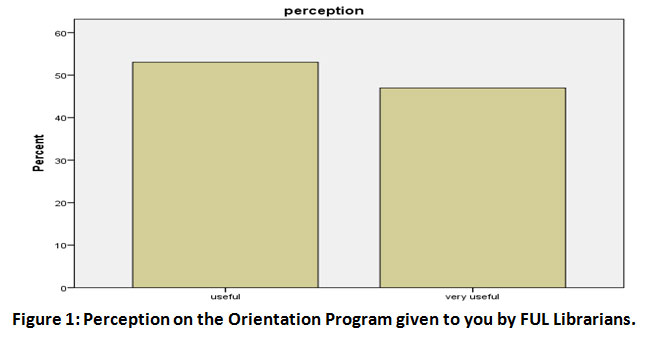 |
Figure 1: Perception on the Orientation Program given to you by FUL Librarians. Click here to view Figure |
Table 2: Perception on the Orientation Program given to you by FUL Librarians.
|
N/S. |
Perception |
Frequency |
Percentage |
|
1 |
Useful |
70 |
53.03 |
|
2 |
Very Useful |
62 |
46.96 |
|
3 |
Not Very Useful |
Nil |
Nil |
|
4 |
Not Useful |
Nil |
Nil |
|
|
Total |
132 |
100 |
Table 2 and figure I above shows the responses of students towards their perceptions of the impacts of the orientation program. The 70(53.03%) respondents agreed that the orientation program is useful, while 62(46.96%) respondents agreed that it is very useful. This means that the students believe that the orientation program if satisfactorily executed will add value to research and reading culture.
The response rate can be seen in Fig. II and Tables 3 below.
Research Question 2: How Orientation Program are Designed Towards Helping the Need of Students’ on Information Utilization?
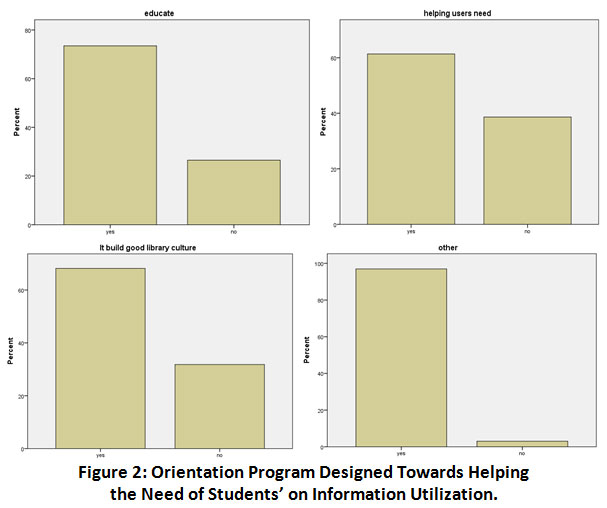 |
Figure 2: Orientation Program Designed Towards Helping the Need of Students’ on Information Utilization. Click here to view Figure |
Table 3: Orientation Program Designed Towards Helping the Need of Students’ on Information Utilization?
|
S/NO. |
Information Utilization Programs |
Frequency
Yes No |
Percentage
Yes No |
||
|
1 |
It educates and enlighten students |
97 |
35 |
73.5 |
26.5 |
|
2 |
Is designed towards helping the need of users |
81 |
51 |
61.4 |
38.6 |
|
3 |
It builds good library culture into the students |
90 |
42 |
68.2 |
31.8 |
|
4 |
Others. |
128 |
4 |
97 |
3 |
Table 3 and figure II above shows that, 97(73.5%) respondents were satisfied with the impact of library orientation because it educates and enlightens students and supports the reading and research needs of users which responses were 81(61.4%). It also opines that orientation imbibed good library culture in students with 90(68.2%).While 4(3.03%) respondents kept mute with no response. However, user's query decrease and have also increase user's confidence based on the utilization of library resources and services.
Based on the above analysis, it can be expatiated that library orientation impacted positively to students as majority of the respondents indicated the fact that it support reading and research need of user.
Research Question 3: What are the impact of orientation program on student’s academic performance?
The response rate can be seen in Fig. III and Tables 4 below.
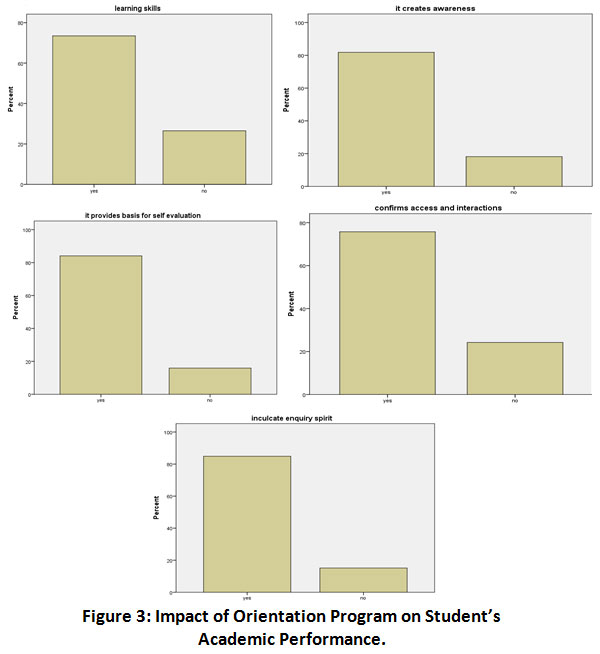 |
Figure 3: Impact of Orientation Program on Student’s Academic Performance. Click here to view Figure |
Table 4: Impact of Orientation Program on Student’s Academic Performance.
|
S/NO. |
Impacts to academic performance |
Frequency
Yes No |
Percentage
Yes No |
||
|
1 |
Improves student’s learning skills |
97 |
35 |
73.5 |
26.5 |
|
2 |
It creates awareness of how to use the library |
108 |
24 |
81.8 |
18.2 |
|
3 |
It provides basis for self-evaluation |
111 |
21 |
84.1 |
15.9 |
|
4 |
Orientation confirms students access to and interaction with library system |
100 |
32 |
75.8 |
24.2 |
|
5 |
It inculcates individual spirit of enquiry |
112 |
20 |
84.8 |
15.2 |
Table 4 and figure III above are the response of students towards improved academic performance derived from library orientation. Lots of roles had been played by topic of discussion to students. In the survey, 97(73.5%) respondent confirmed that orientation improves student's learning skills and guides to researches. 100(75.8%) respondent opine that Orientation confirms students access to and interaction with library system, while 108(81.8%) respondents posits that it creates awareness of how to use the library. In general, this is a solid observation that orientation programs have in many ways positive impacts on academic performance. 111(84.1%) respondents agreed that the orientation confirms that it provides the basis for self-evaluation, 112(84.8%) respondents confirmed that it inculcates the individual impact of orientation program on student's academic performance.
Summarily, well-tailor orientation confirms students' ability and knowledge to use and acquired knowledge of library usability as indicated by the popular response of the respondents. It also improves student's use of the library in pursuit of their studies.
Research Question 4: What are the challenges affecting the delivery of effective library orientation?
The response rate can be seen in Fig. IV and Tables 5 below.
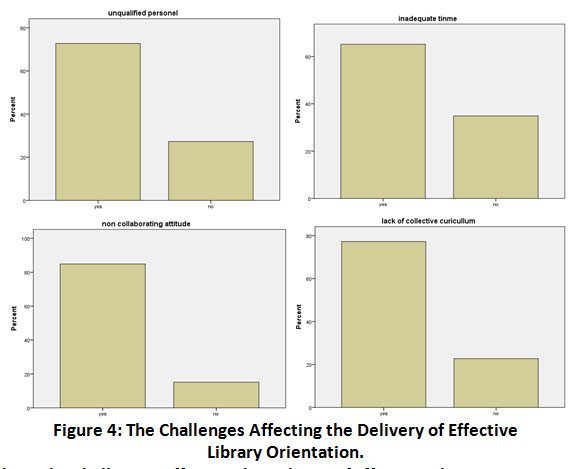 |
Figure 4: The Challenges Affecting the Delivery of Effective Library Orientation. Click here to view Figure |
Table 5: The Challenges Affecting the Delivery of Effective Library Orientation.
|
S/NO. |
Challenge |
Frequency
Yes No |
Percentage
Yes No |
||
|
1 |
Use of unqualified personnel |
96 |
36 |
72.7 |
27.3 |
|
2 |
Inadequate time to treat all program |
86 |
46 |
65.2 |
34.8 |
|
3 |
Non-collaborative attitudes of some staffs |
112 |
20 |
84.8 |
15.2 |
|
4 |
Lack of collective curriculum amongst tertiary institutions |
102 |
30 |
77.3 |
22.7 |
Table 5 and figure IV above, explains the challenges facing effective delivery of library orientation. Observations from the total 86(65.2%) respondents indicated that there was inadequate time to treat all programs. 96(72.7%) respondents considered the use of unqualified personnel as one of the challenges. 112(84.8%) respondents agreed that the non-collaborative attitudes of some staffs, 102(77.3%) opine that lack of collective curriculum amongst tertiary institutions is a serious challenge.
Going by the analysis above, it can be observed that the most vigorous challenge affecting the delivery of effective library orientation is the inadequate time to treat all programs. Library as an organization is made up of lots of activities which timer doesn't provide opportunity to cater for all that was needed to be treated in the program.
Research Question 6: What are the Solutions to the Problems?
The response rate can be seen in Fig. V and Tables 6 below.
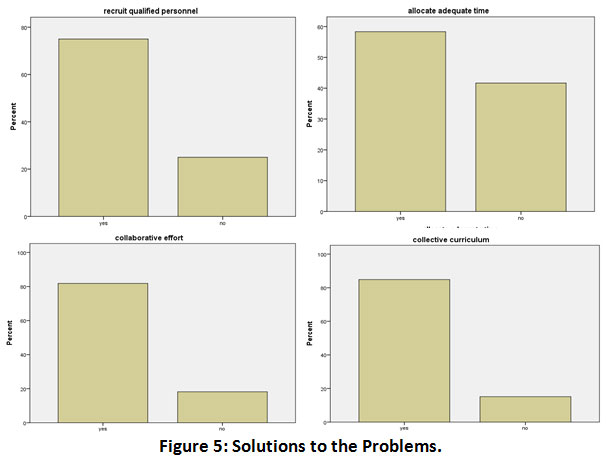 |
Figure 5: Solutions to the Problems. Click here to view Figure |
Table 6: Solutions to the Problems.
|
S/NO. |
Solutions To The Challenge |
Frequency
Yes No |
Percentage
Yes No |
||
|
1 |
Qualified personnel should be recruited |
99 |
33 |
75 |
25 |
|
2 |
Librarian should allocate adequate time for orientation program |
77 |
55 |
58.3 |
41.7 |
|
3 |
There is need to have staff collaborative efforts |
108 |
24 |
81.8 |
18.2 |
|
4 |
Collective curriculum should be put in place |
112 |
20 |
84.8 |
15.2 |
Table 6 and figure V above indicated the response of students’ regarding the solutions to the problems encountered by the delivery of library orientation, 77(58.3%) respondents suggested that Librarians should allocate adequate time for orientation program. Another 99(75%) respondents advised that qualified personnel should be recruited. 108(81.8%) respondents urge that there is a need to have staff collaborative efforts, while 112(84.8%) respondents said collective curriculum should be put in place.
Considering the total observations of the respondents as suggested in the analysis, librarians should allocate adequate convenient time for the program and qualified personnel should be fully provided. This will allow important aspects to be covered.
Findings
From the findings below observations were made:
Student's Perception of the Impact of Orientation: It is the finding of this research that, majority of the students are aware and do attend the program, and it had shown to be impactful to them in respect to their basic academic activities. It also showed that everything they do in the university goes with the library.
- Need for the Orientation: The need to have an orientation program is very important and commendable. Not only that, it should be primarily be designed based upon helping the students to independently utilize library resources and services. The data collected also showed that it should be in the way of teaching users how to solve their problem of information need. 97(73.5%) confirmed that orientation improves student's learning skills and guides to researches
- Impacts on Student's Academic Performance: The findings discovered that student's learning skills are improved, the right library usage is achieved or self-evaluation is enhanced and facilitated by the program. However, learning outcome which is the earning of upper grade of excellence is attained. 100(75.8%) opine that Orientation confirms students access, while 108(81.8%) respondents posits that it creates awareness of how to use the library
- Library use: It was clear from the findings that, orientation has helped students improved their use of the library in pursuit of their studies, beyond this it inculcates individual interest in reading habits to improve its day-to-day educational carrier. Its impact made satisfactory use of the library by students.
- Challenges Affecting User's Orientation: The majority of the challenge as agreed by the respondents are; Use of unqualified personnel, inadequate time to treat all programs, non-collaborative attitudes of some staff, lack of collective curriculum amongst tertiary institutions. These are some of the major problems militating against the delivery of effective orientation programs.
Conclusion
Libraries are considered as apex store source of information for continuous education in higher institutions most especially in universities. Following its strategic importance; probably, the tendency of not obtaining the right relevant information and right time is very high. Considering our era of information overload where information are been pushed to users unwantedly (push factor), if users would be allowed to access information unguardedly, then why the library and librarians.
The orientation reveals the need to have qualitative information. This is when the criteria are put into consideration in determining the authenticity of information to be scholarly standard by librarians.
Therefore, for all the goal and objectives of all types of libraries to be fully achieved user must be instructed in the proper use of the resource for maximum benefit and this will require well planned appropriate program of user education for different levels of the library clientele.
However, because of the noticeable problems of user orientation, it is appropriate to conclude that library literacy success in our tertiary institution depends on the efficient and effective skills personnel with good teaching orientation and methodology.
Recommendations
The following recommendations are made toward improving student's orientation in the Federal University of Lafia. (FUL)
The findings have made it necessary that, total of academic performance of students in the university; FUL should assume responsibility in maintaining impact pulished by its orientation to students in gaining excellent support of the library for all academic pre-requisites.
In any trial to organize orientation, it is strongly recommended that the library should carry out a survey or community analysis where the university communities are to be the audience in which data will be obtained. The survey is expected to be in the form that will involve finding student's prior level of information needs, current and future needs information-seeking behavior, and information-seeking strategy etc. Having done that, it is expected that the findings of the survey should guides to the determining, developing, and implementing the goal and objectives of the orientation.
Sequel to the above strategy recommended, emphasis should be laid on prioritizing, ensuring, and actualizing that orientation impact positively on improving student's academic performance, also right library use should be facilitated without which students cannot be on independent on their own because of the nature of the information organization within the system.
Orientation program should be simple and strategic to educating students. Using facilities or resources (e.g. teaching them how to consult catalog cards or OPAC) should be made easier and flexibility of use. This will ensure long-lasting and frequent use of the library with less boring and minimal barriers.
It is very inevitable and necessary to overcome or tackle the identified problem of effective user orientation. Human resource is a very critical factor that in many ways has implications on the success or otherwise of an organization. Good and effective managing of these personalities should be very coordinating and cooperating towards accomplishing a common goal, this will certainly help eradicate or minimize the menace to the library orientation.
Finally, the library should be strengthened in terms of qualified personnel that can successfully take up the challenge of user education in FUL, Lafia. If user orientation is to receive, any form of performance in the lives of students, concepts that are users' friendly, devoid of many technicalities should be put in place.
References
- Abdulsalami T. Lucky, Nwachukwu, V.N (Prof), Paulina F. Salami (2014) Availability, Accessibility and Use of Information Resources and Services among Information Seekers of Lafia Public Library in Nasarawa State. Information and Knowledge Management. IISTE, 4(10).
- Aguolu. C.C (2002). The Education of Library User in Nigerian University. Education Libraries Bulletin. Vol 25(3): Pp 20-29.
- Ajibero. M.I (2002) Effective Use of Polytechnic Library Resources. In Report of Proceedings of The First National Workshop on Effective Management of Polytechnic Resources for Polytechnic Libraries in Nigeria-Kaduna, NBTE: 13& 17 PP.
- Arom and Bernard (2012) Research Sampling Techniques in Education, Ibadan Heinemann Ibadan: Spectrum Books.
- Canard R (2002). Perspectives and User Satisfaction Surveys - Academic Libraries. Library Trends, spring.
- Chopra. H.R (2001) User Education Training the Librarian to Use New Technologies in the Developing Countries. Paper Presented at 67th IFLA Council General Conference. August 16-25: 1-5.
- Duelle, Mirosh-Majanja and Cloete (2010). "Orientation to College and Freshman Year Persistence/Withdrawal Decisions". The Journal of Higher Education. 57 (2): 155.
CrossRef - Fleming, P.A. in Popoola, S.O. (2000). Faculty awareness about library information products and services in Nigerian Universities. Gateway Library Journal, 4 (1&2):I-12.
- Joseph, M.B (2005) Encouraging User Education in Nigeria Academic Libraries: Towards Effective Use of Library Resources. International Journal of Research Education Vol. 2(1&2): pp 24-30
- Kannike, M., Phyllis A. (2001) Importance of Library User Education. Bendel Library Journal. Vol 4(1): pp 6-13 Nwolo, K.I.V (2002) User Education Reference Sources and Services and Services. Ibadan CES- University of Ibadan, 64-80pp
- Owusu-Ansah, E. (2001) The Academic Library In The Enterprise Of Colleges And Universities: Towards A New Paradigm Journal Of Academic Librarianship Vol. 27(4): pp 282-286.
CrossRef - Zaki (2008) User Education in Nigerian Universities: The Need For New Approaches. Library Focus Vol. 15 and 16 Pp 22-30

This work is licensed under a Creative Commons Attribution 4.0 International License.