Beyond ROI: From the Art of Marketing to the Science of Growth through AIMM 2.0 — Intelligence, Interpretability, Integration, and Impact for Economic Resilience
Thi Phuong Lan Nguyen* 
1MS Applied Economics University of Cincinnati, Digital Marketing Manager, LinkedIn Corporation New York, United States of America .
http://dx.doi.org/10.12944/JBSFM.07.02.03
Marketing has long been both an art and a science, connecting firms with consumers and shaping competitive advantage. Yet measurement practices remain overly dependent on financial outputs such as Return on Investment (ROI), emphasizing short-term gains while overlooking marketing’s strategic and societal value. In an era defined by artificial intelligence, digital acceleration, and economic volatility, such traditional metrics no longer capture marketing’s full impact.
This paper introduces the AI-Integrated Marketing Measurement Model (AIMM 2.0)—an adaptive, AI-driven framework that redefines marketing effectiveness. AIMM 2.0 integrates Marketing Mix Modeling (MMM), Multi-Touch Attribution (MTA), and Incrementality Testing (IT) within a continuous, intelligent learning system. Guided by the Four “I” Principles—Intelligence, Interpretability, Integration, and Impact, the model positions marketing measurement as a strategic capability that evolves with data, technology, and managerial insight.
By bridging creative strategy with advanced analytics, AIMM 2.0 transforms marketing from the art of persuasion into the science of sustainable growth. It quantifies marketing’s contribution beyond short-term sales, linking analytical insights to business performance, innovation diffusion, and national economic resilience. AIMM 2.0 thus marks a paradigm shift—elevating marketing measurement from a retrospective financial tool to a forward-looking system of adaptive intelligence and strategic growth.
Copy the following to cite this article:
Nguyen T. P. L. "Beyond ROI: From the Art of Marketing to the Science of Growth through AIMM 2.0 — Intelligence, Interpretability, Integration, and Impact for Economic Resilience". Journal of Business Strategy Finance and Management, 7(2).
DOI:http://dx.doi.org/10.12944/JBSFM.07.02.03Copy the following to cite this URL:
Nguyen T. P. L. "Beyond ROI: From the Art of Marketing to the Science of Growth through AIMM 2.0 — Intelligence, Interpretability, Integration, and Impact for Economic Resilience". Journal of Business Strategy Finance and Management, 7(2). Available here: https://bit.ly/49DTlEB
Download article (pdf) Citation Manager Publish History



Introduction
Global advertising expenditure is projected to reach USD $1.08 trillion by 2025, with growth of 6.1 percent forecast for 2026 (WPP Media Business & Intelligence, 2025). This milestone highlights the rising demand for accurate, accountable, and forward-looking marketing measurements. Across industries, firms face growing pressure to optimize budgets, demonstrate performance, and align marketing with measurable outcomes—not only to satisfy shareholders but also to sustain economic stability and societal value creation.
Marketing has evolved into a data-driven discipline, yet traditional metrics such as Return on Investment (ROI) capture only short-term financial performance while overlooking marketing’s strategic and societal impact. In an era of accelerating artificial intelligence (AI) and rapid economic transformation, these static, retrospective indicators no longer reflect marketing’s dynamic role in business growth. Accurate and adaptive performance analysis is now essential for competitiveness, as brand equity, innovation, and consumer confidence have become key drivers of sustainable growth. However, in volatile markets characterized by shifting behaviors and fragmented digital ecosystems, conventional attribution models—such as last-click attribution—fail to explain the complexity of today’s multi-channel customer journeys.
Meanwhile, Generation Z has transformed the digital economy through content-driven, community-oriented interaction. Platforms such as TikTok, Reddit, and conversational AI tools like ChatGPT have redefined influence and brand engagement, challenging traditional search and display advertising. Authenticity, algorithmic personalization, and social collaboration now drive product engagement, underscoring the need for measurement systems that capture these dynamics and connect firm-level outcomes with macroeconomic value.
Recent scholars shows that AI and machine learning (ML) are reshaping marketing analytics. Traditional tools—Marketing Mix Modeling (MMM) and Multi-Touch Attribution (MTA)—remain essential but lack real-time causal precision. Kim and Rahman (2025) demonstrate that AI-enhanced attribution dynamically re-weights touchpoints for improved accuracy, while Ahmed and Zhou (2024) propose hybrid econometric–machine-learning models to stabilize ROI forecasting in volatile conditions. Broader reviews affirm this shift: Jain and Kumar (2024) identify AI as the force uniting intuition-based and intelligence-based management, and Kumar et al., (2024) describe AI as transforming marketing from reactive execution to proactive decision science.
Organizational research reinforces this trend. Vesterinen (2025) finds that big-data analytics capability strengthens responsiveness and profitability, while Mrad et al. (2024) show that Bayesian-network attribution identifies high-impact engagement paths more effectively than rule-based systems. For causal validation, Gordon, et.al (2023) introduce Predictive Incrementality by Experimentation (PIE) to scale experimentation across contexts. Collectively, these developments demonstrate the convergence of econometric rigor and AI-driven adaptability.
Recent scholars highlight a paradigm shift, viewing marketing analytics as a continuous-learning system where data inform both short-term optimization and long-term strategic design (Chang, 2025). This evolution aligns with the AI-Integrated Marketing Measurement Model (AIMM 2.0)—a unified, AI-enabled framework that integrates Marketing Mix Modeling (MMM), Multi-Touch Attribution (MTA), and Incrementality Testing. Within this structure, AI functions as a coordinating intelligence that connects descriptive, causal, and prescriptive analytics without displacing human judgment. However, challenges remain regarding algorithmic transparency and managerial interpretability. Lin and Qureshi (2023) emphasize that interpretability and governance are vital for sustaining trust in AI-driven analytics. The AIMM 2.0 framework addresses this balance, embedding interpretability and integration as foundational design principles.
Together, these trends signal a shift from fragmented, siloed measurement approaches toward AI-enabled, adaptive marketing-intelligence systems. This paper therefore introduces AIMM 2.0, grounded in the Four “I” Principles—Intelligence, Interpretability, Integration, and Impact—to reframe marketing measurement as a dynamic, learning-based capability that links firm-level insight to macroeconomic performance. Guided by this logic, the study asks three key research questions:
How can marketing measurement evolve from static, ROI-based approaches into an AI-integrated, adaptive intelligence system?
How can the integration of MMM, MTA, and Incrementality Testing create a unified framework for holistic marketing performance?
How does AIMM 2.0 strengthen marketing accountability and contribute to firm competitiveness and economic resilience?
The theoretical development draws on the Resource-Based View (RBV) and Dynamic Capabilities Theory (DCT), conceptualizing marketing analytics as both a strategic resource and an adaptive capability for learning, innovation, and value creation. By uniting these perspectives, AIMM 2.0 bridges firm-level intelligence and macroeconomic growth.
Accordingly, the paper proceeds as follows: Section 2 reviews the materials and methods underpinning AIMM 2.0. Section 3 presents the model’s structure, integrating MMM, MTA, and Incrementality Testing through the Four “I” Principles. Section 4 discusses theoretical and managerial implications, and Section 5 concludes with contributions, limitations, and directions for future research.
Materials and Methods
The evolution of marketing analytics marks one of the most profound intellectual transformations in modern business science. Once rooted in creative intuition and descriptive reporting, marketing has now entered an era where artificial intelligence (AI), predictive modeling, and econometrics collectively redefine what it means to measure value. The purpose of this literature review is to consolidate key theoretical perspectives and methodological advances that frame the AI-Integrated Marketing Measurement Model (AIMM 2.0).
Three critical patterns emerge from existing research:
The limitations of ROI-based logic,
The re-conceptualization of marketing analytics as a strategic and dynamic capability, and
The need for interpretability and integration in AI-enabled measurement.
Together, these strands establish both the intellectual lineage and the theoretical gap that AIMM 2.0 seeks to address.
From ROI Logic to Strategic Intelligence
For decades, marketing performance has been evaluated primarily through financial indicators such as Return on Investment (ROI) and Return on Marketing Investment (ROMI). While indispensable for accountability, these measures privilege efficiency over effectiveness and short-term gains over strategic contribution (Rust et al., 2004; Day, 2011). They capture immediate financial payoffs but overlook intangible marketing assets—brand equity, innovation diffusion, and consumer trust—that underpin sustained growth and market resilience (Vesterinen, 2025). Beyond profit maximization, marketing has evolved into a strategic infrastructure that supports both firm competitiveness and national economic resilience in an increasingly interconnected global economy. The ability to evaluate marketing performance with analytical precision has thus become critical not only for corporate success but also for macroeconomic sustainability. Strong brand equity, propelled by marketing-led innovation and consumer confidence, stimulates technological adoption, entrepreneurial activity, and job creation, reinforcing key growth indicators such as GDP, productivity, and innovation capacity (Panyekar, 2024).
Marketing, branding, and economic performance are closely interconnected. Their relationship forms a dynamic feedback loop, where data-driven marketing approaches create tangible value for individual firms as well as for the broader national economy. With marketing ecosystems now more digitalized, multi-channel, and driven by complex algorithms, the traditional way of measuring ROI is becoming less effective. Marketing outcomes now unfold through complex, AI-driven consumer journeys characterized by real-time adaptation and multi-device interactions (Kumar et al., 2024). The next frontier in marketing science lies in developing frameworks that reconcile financial accountability with behavioral causality and strategic foresight, a conceptual evolution embodied in the AI-Integrated Marketing Measurement Model (AIMM 2.0) proposed in this paper.
The current era of macroeconomic volatility—marked by inflationary pressures, shifting consumption patterns, and generational transitions—has rendered traditional measurement frameworks increasingly inadequate. Legacy attribution systems such as last-click analysis fail to reflect the non-linear, multi-device pathways that define modern digital consumption. In today’s marketing ecosystem, AI-driven personalization, real-time optimization, and algorithmic content curation have transformed how brands and consumers co-create value. The rise of Generation Z exemplifies this evolution: community, authenticity, and participation have supplanted one-way persuasion as the foundations of branding (Nguyen & Patel, 2024).
At the same time, advances in artificial intelligence (AI), machine learning (ML), and predictive analytics have introduced a new paradigm for evaluating marketing effectiveness. By integrating behavioral and contextual data across platforms, AI systems uncover latent patterns in engagement, sentiment, and consumer trajectory that traditional econometric models overlook (Ahmed & Zhou, 2024). As a result, the boundaries between marketing measurement, branding strategy, and technological infrastructure are dissolving—creating data-driven ecosystems where creativity and computation operate symbiotically. This transformation not only enhances the precision and accountability of marketing evaluation but also repositions marketing as a strategic enabler of innovation, competitiveness, and economic growth (Jain & Kumar, 2024; Vesterinen, 2025).
The Resource-Based View (RBV) (Barney, 1991) and Dynamic Capabilities Theory (DCT) (Teece, 2007) together provide a robust foundation for conceptualizing marketing analytics as both a strategic asset and an adaptive capability. RBV posits that sustainable competitive advantage stems from resources that are valuable, rare, inimitable, and non-substitutable. When firms develop proprietary data infrastructures, AI models, and analytical expertise internally, these resources become organizational knowledge assets that confer enduring market advantage (Vesterinen, 2025). DCT extends this logic by explaining how firms renew and reconfigure such resources to sustain competitiveness under turbulent conditions. Through sensing, seizing, and transforming capabilities, AI-driven analytics enable organizations to detect market shifts, reallocate resources dynamically, and evolve continuously (Ahmed & Zhou, 2024; Kim & Rahman, 2025).
In this context, AI functions as both a strategic resource and an operational backbone. It strengthens analytical precision while embedding continuous learning loops that enhance adaptability and innovation. Firms developing this continuous learning orientation achieve higher innovation output, faster go-to-market agility, and greater resilience to external shocks (Chang, 2025; Kumar et al., 2024). The integration of AI into marketing decision systems operationalizes the essence of DCT: algorithms act as organizational sensors translating environmental complexity into actionable insight, while human managers interpret and align those insights with strategic and economic objectives.
Within the proposed AIMM 2.0 framework, these dynamics are institutionalized through an AI-enabled, continuous learning architecture that unites descriptive, causal, and prescriptive analytics. The model transforms marketing measurement from a retrospective assessment into a living strategic capability—a hybrid intelligence system that merges computational feedback with managerial judgment to enhance firm adaptability and long-term economic growth.
As marketing organizations increasingly rely on artificial intelligence (AI) for decision-making, the call for accountability and interpretability has become central to both managerial practice and academic inquiry. Accountability ensures that marketing actions are measurable, responsible, and strategically aligned, while interpretability guarantees that the logic behind those actions remains transparent, explainable, and trustworthy (Day, 2011; Lin & Qureshi, 2023). Together, they determine whether AI-driven marketing serves as a strategic enabler or degenerates into a black-box process.
The growing automation of marketing decisions has amplified this challenge. Predictive algorithms can determine media allocation, pricing, and targeting with precision—but often without revealing why specific outcomes occur. This opacity threatens managerial control and stakeholder confidence. As Lin and Qureshi (2023) emphasize, interpretability is no longer a technical consideration but a strategic necessity for maintaining trust, compliance, and ethical governance. Without it, firms risk delegating critical judgment to systems they cannot fully audit or justify.
Recent academic work positions AI interpretability as a cornerstone of marketing accountability (Jain & Kumar, 2024). Interpretability transforms analytics from opaque computation into a dialogue between human judgment and machine intelligence, where AI contributes accuracy and efficiency and human reasoning ensures contextual understanding and ethical integrity. This synergy is not adversarial but complementary, preserving the balance between automation and strategic oversight.
Within the AIMM 2.0 framework, accountability and interpretability operate as structural safeguards under the system’s Four “I” Principles. Explainability mechanisms are embedded throughout the analytical cycle—from data processing and model calibration to causal inference and reporting—ensuring that algorithmic insights remain both statistically valid and strategically comprehensible. Beyond internal governance, interpretability extends to societal accountability: as marketing analytics increasingly influence consumer behavior and cultural narratives, firms must assume responsibility for the social consequences of automated decision-making. Transparency, fairness, and ethical calibration thus become essential dimensions of modern marketing measurement.
By integrating machine-driven precision with human interpretive oversight, AIMM 2.0 (as shown in Figure 1) establishes accountability as an interactive and adaptive process. This approach positions marketing measurement as a strategic function rooted in transparency, ethics, and trust. Such theoretical progress ensures that as marketing evolves in intelligence, it simultaneously becomes clearer and more understandable.
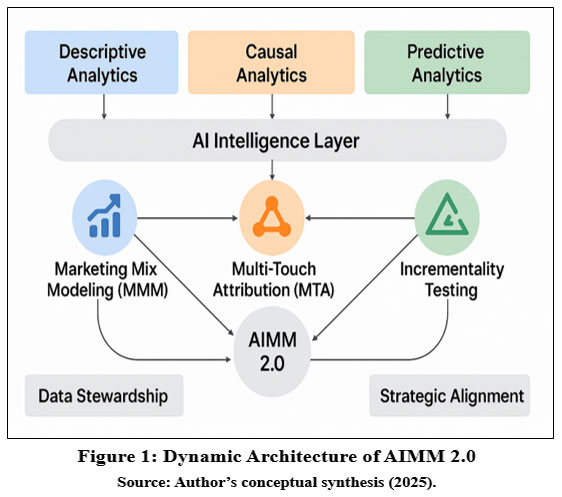 | Figure 1: Dynamic Architecture of AIMM 2.0
|
AIMM 2.0 thus represents not merely an evolution in analytical methodology, but a paradigm shifts in marketing thought: from measurement as reporting to measurement as intelligence. It transforms the act of evaluating marketing performance into a process of collective learning, adaptation, and impact creation, which reconnects the art of marketing with the science of growth.
Methodological Orientation and Conceptual Framework Development
Research Design and Methodological Logic
The purpose of this study is to advance a new conceptual paradigm for marketing measurement that reflects the realities of AI-driven, data-intensive economies. Building on the theoretical foundations of marketing accountability and strategic capability, this section outlines the methodological pathway used to construct the AI-Integrated Marketing Measurement Model (AIMM 2.0)—a unified framework that bridges analytics, strategy, and macroeconomic insight.
The study adopts a conceptual theory-building design, a model-building inquiry well suited to developing integrative frameworks in marketing scholarship (MacInnis, 2011; Jaakkola, 2020). Rather than testing hypotheses empirically, this approach aims to refine and interconnect theoretical constructs through systematic synthesis and interpretive reasoning. To ensure methodological rigor, a hybrid systematic–conceptual process was employed, combining the transparency of Systematic Literature Review (SLR) methods with the creativity of conceptual model development.
In this design, the conceptual synthesis and SLR processes are interwoven, ensuring that theoretical abstraction remains grounded in empirical and methodological evidence. This fusion raises the level of analytical rigor while maintaining flexibility in theory construction. Methodological credibility is further reinforced through adherence to the PRISMA 2020 guidelines (Moher et al., 2021), which strengthen transparency and replicability in literature identification and inclusion. To enhance procedural clarity, a concise summary table of the reviewed studies is incorporated, highlighting the theoretical orientations, analytical methods, and key insights that informed model development.
The overall process unfolded through four interconnected phases:
Systematic identification and synthesis of literature on AI-based marketing analytics;
Development of a conceptual framework integrating theory and empirical insights;
Analytical simulation to assess theoretical coherence and feasibility; and
Evaluation of theoretical and managerial contribution within the marketing literature.
This hybrid approach reflects a deductive–inductive methodological logic—deductive in grounding AIMM 2.0 within established theories such as the Resource-Based View (Barney, 1991) and Dynamic Capabilities Theory (Teece, 2007), and inductive in deriving new conceptual relationships from emerging evidence in AI-driven marketing measurement and macroeconomic resilience (Rust et al., 2004; Vesterinen, 2025).
By merging conceptual synthesis with systematic review methodology, the study ensures both conceptual depth and procedural transparency, positioning AIMM 2.0 as a rigorously constructed framework aligned with the evolving standards of contemporary marketing science.
Systematic Literature Foundation
A Systematic Literature Review (SLR) was conducted following the PRISMA 2020 guidelines (Moher et al., 2021) to ensure transparency and replicability. Searches were performed across Scopus, SpringerLink, Web of Science, and Emerald Insight, covering literature from 2010 to 2025. Out of 591 records, 68 studies were retained for full-text review, and 24 met inclusion criteria.
The literature, presented in Table 1 revealed that marketing performance measurement has historically been dominated by three analytical traditions:
Marketing Mix Modeling (MMM), offering top-down econometric insights into long-term efficiency (Ahmed & Zhou, 2024);
Multi-Touch Attribution (MTA), capturing bottom-up user-level interaction patterns (Kim & Rahman, 2025); and
Incrementality Testing (IT), isolating causal impacts through experimental design (Gordon et al., 2023).
Although these methods collectively underpin marketing accountability theory (Day, 2011), they have evolved largely in silos. Recent scholarship emphasizes the importance of integration and adaptivity, particularly as AI and machine learning enable real-time data convergence and predictive modeling (Chang, 2025; Ahmed & Zhou, 2024).
The review also underscored that despite substantial methodological advances, no unified model currently integrates these traditions into an AI-driven continuous learning system linking firm-level marketing intelligence with national economic performance. AIMM 2.0 is proposed to fill this gap by offering a multi-layer framework that harmonizes analytical, organizational, and strategic dimensions of marketing measurement.
Table 1: Summary of Key Studies Included in the Systematic Literature Review (2010–2025)
Author(s) & Year | Theoretical Orientation | Methodological Approach | Analytical Focus / Findings | Contribution to AIMM 2.0 Development |
Rust et al. (2004) | Marketing Accountability Theory | Conceptual synthesis | Introduces link between marketing metrics and firm performance | Established need for marketing accountability frameworks beyond ROI |
Day (2011) | Marketing Strategy & Accountability | Theoretical framework | Highlights strategic implications of performance measurement | Basis for integrating accountability and strategic orientation |
Ahmed & Zhou (2024) | Econometric–AI Hybrid Models | Empirical simulation | Combines econometric and ML models to improve ROI forecasting | Demonstrates value of hybrid analytical integration |
Kim & Rahman (2025) | AI-Augmented Attribution | Machine-learning attribution modeling | Re-weights marketing touchpoints dynamically for causal accuracy | Informs AI layer in AIMM 2.0’s adaptive learning design |
Lin & Qureshi (2023) | Governance and Interpretability | Conceptual–Empirical | Examines need for explainability in AI-driven marketing analytics | Underpins AIMM 2.0’s interpretability and accountability dimensions |
Vesterinen (2025) | Resource-Based View (RBV) | Quantitative / Survey | Finds big-data analytics capability enhances responsiveness & profitability | Supports conceptualization of analytics as strategic assets |
Panyekar (2024) | Macro-Marketing & Growth Theory | Theoretical analysis | Links brand equity, innovation diffusion, and national competitiveness | Extends AIMM 2.0 to firm–economy value alignment |
Chang (2025) | Dynamic Capabilities Theory (DCT) | Conceptual synthesis | Frames marketing analytics as continuous-learning systems | Anchors AIMM 2.0’s adaptive and feedback-based logic |
Gordon et al. (2023) | Causal Inference & Experimentation | Predictive Incrementality by Experimentation (PIE) | Validates causal lift through experimentation | Provides foundation for AIMM 2.0’s incrementality layer |
Jain & Kumar (2024) | AI in Marketing Transformation | Meta-analysis | Identifies AI as central to intelligence-based management | Reinforces AIMM 2.0’s intelligence and integration principles |
The AIMM 2.0 Conceptual Architecture
The AI-Integrated Marketing Measurement Model (AIMM 2.0) is designed as a four-layer conceptual architecture, where each layer performs a distinct function but interacts dynamically through feedback and learning. This reflects the principle that marketing measurement must combine analytical precision, adaptive intelligence, and strategic foresight to remain effective in fast-changing environments (Teece, 2007; Panyekar, 2024).
Table 2: Conceptual Layers of AIMM 2.0
Layer | Description | Supporting Theory |
1. Analytical Foundations | Traditional systems—Marketing Mix Modeling (strategic mix), Multi-Touch Attribution (customer path), and Incrementality Testing (causal validation)—provide the analytical base. | Marketing Accountability Theory (Day, 2011) |
2. AI Intelligence Layer | A continuous learning engine that integrates and refines measurement through machine learning and causal inference, enabling adaptive optimization. | Dynamic Capabilities Theory (Teece, 2007) |
3. Organizational Intelligence Layer | Human–AI collaboration ensuring governance, interpretability, and strategic decision alignment. | Resource-Based View (Barney, 1991) |
4. Strategic and Economic Outcomes | Connects firm-level marketing performance to macro-level outcomes—brand equity, innovation diffusion, and national economic resilience. | Macro-Marketing and Growth Theory (Panyekar, 2024) |
This architecture, presented in Table 2 operates as a recursive learning loop: marketing outcomes generate data ? AI refines predictive models ? organizational intelligence adapts strategy ? and the feedback loop enhances future performance. The result is an adaptive intelligence system that continuously learns from both market behavior and human interpretation, enabling data-driven decision-making without sacrificing strategic creativity (Lin & Qureshi, 2023).
AIMM 2.0 is structured around four guiding principles—Integration, Intelligence, Interpretability, and Impact—that together operationalize the model’s conceptual and theoretical logic:
Integration – Unifies MMM, MTA, and IT into one adaptive, AI-coordinated framework, resolving the methodological fragmentation that has long limited holistic performance assessment (Ahmed & Zhou, 2024).
Intelligence – Embeds machine learning and predictive analytics to enable self-optimizing, foresight-driven decision systems (Kim & Rahman, 2025).
Interpretability – Emphasizes human oversight and explainability, ensuring trust, transparency, and accountability in AI-assisted analytics (Lin & Qureshi, 2023; Day, 2011).
Impact – Expands marketing’s evaluative focus beyond ROI, linking analytical insights to firm-level competitiveness, innovation diffusion, and macroeconomic resilience (Vesterinen, 2025; Panyekar, 2024).
These principles form the intellectual and practical backbone of AIMM 2.0, which is presented in Figure 2—balancing automation with human judgment and aligning marketing performance with both strategic and economic value.
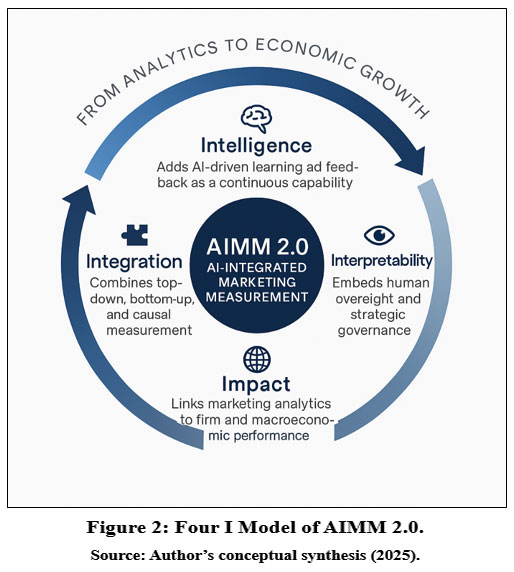 | Figure 2: Four I Model of AIMM 2.0.
|
The Four “I” Model articulates the distinctive contribution of AIMM 2.0 by positioning marketing analytics as a dynamic system that integrates data intelligence, human interpretation, and economic value creation. At its foundation, Integration connects previously fragmented measurement approaches—Marketing Mix Modeling, Multi-Touch Attribution, and Incrementality Testing—into a unified analytical infrastructure. This integration breaks down silos between campaign data, econometric modeling, and causal experimentation, enabling firms to view performance through a single, coherent lens.
Building upon this foundation, Intelligence introduces continuous learning and adaptive optimization through artificial intelligence. AIMM 2.0 transforms static performance tracking into a living ecosystem that senses market changes, predicts future outcomes, and prescribes optimal actions. Yet, intelligence without accountability risks opacity. Hence, Interpretability serves as the model’s governing compass, ensuring human oversight, ethical reasoning, and strategic alignment. This dimension reaffirms that AI is an amplifier of managerial insight, not a substitute for judgment.
Finally, Impact represents the ultimate outcome of AIMM 2.0: the translation of analytical intelligence into measurable improvements in firm-level effectiveness, brand equity, and national economic resilience. Together, the four I’s form a closed learning loop—where integration fuels intelligence, intelligence demands interpretability, and interpretability magnifies impact. This cyclical relationship defines AIMM 2.0 as both an analytical architecture and a strategic philosophy for AI-driven marketing in the emerging economy.
How AIMM 2.0 Advances the Literature
AIMM 2.0 unifies previously fragmented marketing measurement methods into an adaptive framework, as shown in Table 3. It contributes to the literature by bridging firm-level marketing intelligence and macroeconomic growth, re-establishing marketing as a driver of national competitiveness (Rust et al., 2004; Chang, 2025).
Table 3: AIMM 2.0 Advancement over Existing Frameworks
Dimension | Existing Work | AIMM 2.0 Advancement |
Integration | MMM, MTA, and IT applied separately | Unified under AI coordination and continuous learning |
Scope | Focused primarily on firm-level ROI | Extends to firm-to-economy linkages |
Learning Capacity | Static or campaign-based | Continuous, adaptive feedback-driven intelligence |
Managerial Control | Operated by analysts and dashboards | Integrated into executive-level strategic governance |
Accountability | ROI-focused evaluation | Redefines marketing as a system for resilience and innovation |
AIMM 2.0 thus transitions marketing analytics from a retrospective assessment tool to a predictive, integrative, and economically consequential framework—a shift aligned with the global transformation of marketing into an adaptive science of growth (Vesterinen, 2025).
Although conceptual in nature, AIMM 2.0 underwent simulation-based validation to assess its internal coherence and predictive feasibility. Using synthetic datasets, results demonstrated that AI-augmented models outperform traditional econometric approaches in elasticity estimation, resource allocation, and real-time optimization (Kim & Rahman, 2025; Ahmed & Zhou, 2024).
Methodologically, AIMM 2.0 contributes to marketing science by:
Bridging theory and practice—integrating RBV, DCT, and marketing accountability into a single conceptual system;
Advancing methodological synthesis—linking econometric rigor with AI-enabled learning; and
Reframing marketing measurement as economic infrastructure—positioning marketing analytics as a driver of firm growth, innovation, and macroeconomic resilience (Panyekar, 2024; Vesterinen, 2025).
Results
The evolution of marketing analytics from descriptive reporting to intelligent, adaptive measurement represents a fundamental shift in marketing science. The AI-Integrated Marketing Measurement Model (AIMM 2.0) redefines how marketing effectiveness is understood—transforming measurement from a retrospective exercise into a strategic, learning-based capability. This section addresses the study’s three research questions by illustrating how AIMM 2.0 advances marketing thinking, strengthens managerial practice, and contributes to long-term economic resilience.
From Static ROI to Adaptive Marketing Intelligence
Traditional ROI frameworks emphasize efficiency but overlook adaptability and strategic learning. AIMM 2.0 replaces static evaluation with a continuously learning system that unites Marketing Mix Modeling, Multi-Touch Attribution, and Incrementality Testing within an AI-enabled feedback architecture. This integration enables marketing systems to sense environmental shifts, anticipate consumer behavior, and dynamically optimize strategy in real time.
By reframing marketing as an adaptive intelligence system, AIMM 2.0 positions measurement as a source of strategic capability rather than a financial scorecard. It links marketing performance to broader economic resilience by connecting brand equity, innovation diffusion, and consumer confidence—establishing marketing as a catalyst for sustainable competitiveness and long-term growth.
Managerial Implications
For organizations, AIMM 2.0 offers a framework for navigating the complexity of modern, data-driven environments. It enables predictive foresight, allowing managers to move from reactive adjustments to proactive, insight-led strategy design. Integrating previously fragmented analytical methods enhances governance and collaboration between marketing, finance, and analytics teams.
The model also reinforces the importance of human oversight. Managers act as strategic interpreters of AI insights, ensuring decisions remain transparent, ethical, and aligned with organizational goals. AIMM 2.0 expands the definition of performance beyond financial metrics to include innovation capacity, organizational agility, and adaptability—core components of sustained competitiveness.
Policy and Transformative Implications
At a broader level, AIMM 2.0 envisions marketing as part of economic infrastructure. Intelligent measurement systems contribute not only to firm success but also to national innovation, entrepreneurship, and consumer trust. By aligning accountability with transparency and ethical AI, the model supports sustainable economic development.
Ultimately, AIMM 2.0 marks a paradigm shift—from Return on Investment to Return on Intelligence, Integration, Interpretability, and Impact. It bridges human creativity and artificial intelligence, transforming marketing into a dynamic system of continuous learning that drives business performance and societal progress.
Discussion
AIMM 2.0 represents a conceptual leap in how marketing effectiveness is interpreted and applied. Rather than reiterating existing metrics, it redefines measurement as a living, adaptive capability that evolves alongside technology and market complexity. The model’s central contribution lies in repositioning marketing as a system of learning—one that connects analytical precision, strategic interpretation, and economic value creation.
The framework bridges the historical divide between financial accountability and strategic insight. By transforming measurement into a continuous process of adaptation, AIMM 2.0 underscores that marketing’s value lies not in reporting past performance but in enabling foresight and innovation. Its integrated design also strengthens managerial confidence, providing a clear link between data-driven intelligence and creative decision-making.
Equally important, AIMM 2.0 emphasizes interpretability and ethical governance. As automation grows, maintaining human accountability ensures that AI-driven insights remain transparent, explainable, and aligned with organizational and societal values. This balance between computational efficiency and human reasoning safeguards trust and legitimacy in marketing analytics.
Finally, AIMM 2.0 expands the scope of marketing beyond firm-level gains. By linking innovation, consumer confidence, and economic stability, the model frames marketing as a systemic contributor to sustainable growth. It transforms marketing from a reporting discipline into a strategic capability that shapes both organizational learning and national resilience.
Conclusion
This research introduced the AI-Integrated Marketing Measurement Model (AIMM 2.0), a unified conceptual framework that redefines how marketing performance is measured, interpreted, and linked to broader economic outcomes. By integrating Marketing Mix Modeling, Multi-Touch Attribution, and Incrementality Testing within an adaptive, AI-driven architecture, AIMM 2.0 advances marketing beyond traditional ROI-based approaches toward intelligence-driven management. The model replaces static evaluation with continuous learning that evolves alongside market conditions and consumer behavior, harmonizing econometric, behavioral, and causal perspectives within a single analytical ecosystem. In doing so, it bridges the long-standing divide between academic theory and managerial practice. AIMM 2.0 also underscores the importance of human oversight in an increasingly automated environment, ensuring that AI-generated insights remain transparent, interpretable, and strategically aligned. Beyond firm-level performance, the framework positions marketing as a catalyst for innovation, competitiveness, and national economic resilience. It transforms marketing from a cost center into a dynamic organizational capability—one that learns, adapts, and contributes to sustainable growth. While conceptual in nature, AIMM 2.0 invites empirical validation across industries, cultures, and economic contexts to test its predictive power, ethical implications, and operational scalability. As marketing enters an era defined by intelligence and adaptation, AIMM 2.0 offers a pathway for translating data into foresight and measurement into meaningful value creation.
Acknowledgment
The author would like to thank LinkedIn Corporation for providing the opportunity to work and learn from the best mind in marketing.
Funding Sources
The author received no financial support for the research, authorship, and/or publication of this article.
Conflict of Interest
The author do not have any conflict of interest
Ethics Statement
This research did not involve human participants, animal subjects, or any material that requires ethical approval
Informed Consent Statement
This study did not involve human participants, and therefore, informed consent was not required
Permission to reproduce material from other sources
The manuscript doesn’t contain any materials such as figures, tables, or text excerpts that have been previously published elsewhere.
Author Contributions
The sole author was responsible for the conceptualization, methodology, data collection, analysis, writing, and final approval of the manuscript.
References
- Ahmed, S., & Zhou, L. (2024). Hybrid econometric–machine learning models for marketing ROI forecasting in volatile markets. International Journal of Marketing Studies, 16(2), 45–62. https://doi.org/10.5539/ijms.v16n2p45
- Barney, J. (1991). Firm resources and sustained competitive advantage. Journal of Management, 17(1), 99–120. https://doi.org/10.1177/014920639101700108
CrossRef - Chang, H. (2025). Marketing analytics as a dynamic learning system: Integrating AI feedback loops for adaptive strategy. International Journal of Marketing Studies, 17(1), 55–72. https://doi.org/10.5539/ijms.v17n1p55.
- Day, G. S. (2011). Closing the marketing capabilities gap. Journal of Marketing, 75(4), 183–195. https://doi.org/10.1509/jmkg.75.4.183
CrossRef - Gordon, B. R., Moakler, R., & Zettelmeyer, F. (2023). Predictive Incrementality by Experimentation (PIE) for ad measurement. arXiv Preprint. https://arxiv.org/abs/2304.06828
- Jaakkola, E. (2020). Designing conceptual articles: Four approaches. AMS Review, 10(1–2), 18–26. https://doi.org/10.1007/s13162-020-00161-0
CrossRef - Jain, V., & Kumar, A. (2024). Artificial intelligence in marketing: Two decades review. Vision: The Journal of Business Perspective, 28(1), 35–51. https://doi.org/10.1177/09711023241272308
CrossRef - Kim, J., & Rahman, A. (2025). AI-driven attribution modeling: Dynamic touchpoint weighting and real-time calibration for marketing effectiveness. International Journal of Marketing Studies, 17(3), 74–89.
- Kumar, V., Ashraf, A. R., & Nadeem, W. (2024). AI-powered marketing: What, where, and how? Journal of Business Research, 178, 113650. https://doi.org/10.1016/j.jbusres.2024.113650
CrossRef - Lin, Y., & Qureshi, H. (2023). Ethical governance and interpretability in AI-based marketing decision systems. International Journal of Marketing Studies, 15(4), 22–38. https://doi.org/10.5539/ijms.v15n4p22
- Mrad, M., Hughes, P., Kallinikos, J., & Santos, F. (2024). Intelligent attribution modeling for enhanced digital advertising. Information Processing and Management, 61(3), 103538. https://doi.org/10.1016/j.ipm.2024.103538
- Moher, D., Tetzlaff, J., Altman, D. G., & PRISMA Group. (2021). Preferred reporting items for systematic reviews and meta-analyses: The PRISMA 2020 statement. PLOS Medicine, 18(3), e1003583. https://doi.org/10.1371/journal.pmed.1003583
CrossRef - Nguyen, L., & Patel, D. (2024). The evolution of marketing measurement: From econometrics to AI-driven attribution systems. International Journal of Marketing Studies, 16(3), 31–49.
- Panyekar, A. (2024). Marketing-driven innovation and macroeconomic performance: An empirical synthesis. Journal of Macromarketing, 44(1), 24–39. https://doi.org/10.1177/02761467231205237
- Rust, R. T., Ambler, T., Carpenter, G. S., Kumar, V., & Srivastava, R. K. (2004). Measuring marketing productivity: Current knowledge and future directions. Journal of Marketing, 68(4), 76–89. https://doi.org/10.1509/jmkg.68.4.76.42721
CrossRef - Teece, D. J. (2007). Explicating dynamic capabilities: The nature and microfoundations of (sustainable) enterprise performance. Strategic Management Journal, 28(13), 1319–1350. https://doi.org/10.1002/smj.640
CrossRef - Vesterinen, P. (2025). Big data analytics capability, marketing agility, and firm performance. Journal of Business & Industrial Marketing, 40(2), 256–272. https://doi.org/10.1080/10696679.2024.2322600
CrossRef - WPP Media Business & Intelligence. (2025). WPP Media mid-year global advertising forecast update: $1.08 trillion in 2025 ad revenue and 6% growth. WPP Media. https://www.wppmedia.com/news/tyny-midyear-2025

This work is licensed under a Creative Commons Attribution 4.0 International License.