A Study on Assessment of Business Process Modeling Tool with the Application of the Grey Relational Analysis
Pallavi. D. R.* 
1Center for Management Studies, JAIN (Deemed-to-be University), Bangalore, Karnataka India .
http://dx.doi.org/10.12944/JBSFM.05.01.03
Copy the following to cite this article:
Pallavi D. R."A Study on Assessment of Business Process Modeling Tool with the Application of the Grey Relational Analysis". Journal of Business Strategy Finance and Management, 5(1).
DOI:http://dx.doi.org/10.12944/JBSFM.05.01.03Copy the following to cite this URL:
Pallavi D. R."A Study on Assessment of Business Process Modeling Tool with the Application of the Grey Relational Analysis". Journal of Business Strategy Finance and Management, 5(1). Available here: https://bit.ly/3DyoFF0
Download article (pdf) Citation Manager Publish History



A firm's present procedure is displayed through "Business Process Modelling". Tools for modelling corporate processes visually show a process's lifecycle. For an analytical depiction or representation of business operations to be effective, they are crucial. To create a thorough representation, one must first comprehend Business Process Modelling1. The approach of (BPM) increases efficiency while cutting expenses. It displays the performance of a business operation in the present or the prospective. "Steps, participants, and decision logic" are all included in BPM across the workflow. The steps of "process discovery, process mapping, process simulation, process analysis, and process improvement" are all combined in this method 2. Users can comprehend crucial business tasks with BPM. "Diagrams and flowcharts" are typically used to represent them additionally, these models offer crucial insights regarding the actions that make up a process 3. BPM includes both "folks (departments and groups) and IT (information technology) processes". Foreign company operations may engage in BPM if it is advantageous. Larger firms have BPMs that are more extensive due to volume and sophistication4. There are several modelling programs available, but deciding which one to employ might be difficult. The decision requires direction. Tools for BPM are visual representations of an application's timeline. For a workflow to be effectively represented analytically or shown, they are necessary. A thorough understanding of BPM helps in creating a thorough representation 5.
BPM is a very successful method that has several advantages for enterprises. BPM reveals areas that want work. The BPM is primarily used to give parties concerned a better knowledge of how a process functions intending to adopt enhancements6. In addition, the model entices integrity by outlining expected behavior for activities, assigns responsibility for them, and demonstrates how a process advances a company's goals. This plays a significant part in raising responsibility and levels of trust within a business8. BPM model enable agility and adaptability to change. As the business goals and tactics can shift quickly. With the use of business process modeling, stakeholders can quickly spot and carry out adjustments in line with new goals 9. The model supports uniformity between sectors. Many organizational procedures, especially those that are more complex, involve the same steps and activities. For instance, instead of at the company level, purchase requisition applications are frequently made at the cell level. Stakeholders can establish standards across units by employing process models to apply effective processes across the organization10.
The model employs the following.
Flowcharts
"A flowchart" is a visual representation that shows how a process works in business. To illustrate the steps, it employs basic forms and arrows. Forms denote actions and events, whereas arrows represent logical progressions. Various flowcharts can be produced using the software. They have to have a beginning and a finish. Typically, flowcharts come before more complicated modeling 11.
Gantt Charts
Process dynamics have long been represented visually using Gantt charts. They employ a bar format to represent a project timetable, including the length of activities and their component elements. Gantt charts are the perfect choice if you are working with schedules or operations that require a lot of time. Breaking the duties down into smaller activities helps to quickly determining whether the project is on time or late 12,13.
Control Flow Diagrams
Charts of management flows can depict typical flows with restrictions and limitations. These illustrations show how certain elements, such as extra data or other inputs, can affect how a procedure moves. A portion of the flow is represented by each component in a diagram. They are method diagrams 14.
Functional Flow Block Diagrams
Again, for modelling business processes, these charts are crucial. They entail a progressive arrangement of modules, where activities necessary for a result are referred to as blocks. "Equipment, software, and training" are identified in the operational circulation schematic. These diagrams are preferable to flowcharts when displaying hierarchical operations. They are purpose-oriented, in contrast to flowcharts 15.
Business Process Modelling Notation (BPMN)
"BPMN" is a diagram method that shows a process's stages from start to finish. It offers a thorough breakdown of business processes and flows. As a result, it serves as a crucial instrument in "business process modelling". This tool's purpose is to illustrate methods for increasing effectiveness and delineating brand-new circumstances. "The BPMN" model has been standardized, and using the standardized BPMN is advised. It can also be utilized with its graphic syntax and icons 16
Unified Modelling Language Diagrams (UML)
"UML diagrams" were created by software designers to depict the structure and interconnections of systems. This entity tool illustrates the interaction between organizations and individuals. Process documentation is made simpler and simpler to comprehend by using UML technology17.
The major goal of this strategy is to choose the best BPM solution for the business buying or implementing it, allowing for safer, quicker, more cost-effective, and more effective use of the BPM tool. Based on the primary goal, the corporate experts can choose the characteristics to be taken into account while choosing the BPM tool. Before assessing the options for BPM tools, it is vital to determine "the benefit and cost requirements" that will be used. Designers will also establish the relevant rank values for each of the criteria at this point. The weights for the benchmarks can then be determined using the GRA approach18. In the context of Multi-Criteria Decision-Making (MCDM), selecting the most suitable business activity modelling tool among the available options becomes imperative. The research proposes an approach based on the Grey Relational Analysis (GRA) method to assist businesses in making informed decisions and choosing the optimal business policy modelling technology. The objective is to enhance the effectiveness, affordability, and security of the business procedure modelling process.
Materials and Methods
Finding an acceptable answer from a limited number of possible alternatives that have been evaluated on a variety of qualities, both numerical and subjective, is called a "multiple attribute decision-making" (MADM) issue. Scholars from a variety of fields have paid a lot of emphasis to MADM recently19. One approach to studying ambiguity is called the grey system concept, which excels at mathematically analysing systems with dubious knowledge. As shown in the grey system idea, a white system is one where all of the data is available; a black system is one where all of the data is unclear 20. "A grey system" is one that only has the least part of recognized details. " Grey relational analysis (GRA), grey decision, grey programming, and grey control" are the five main components of the grey systems approach. GRA is part of the grey systems approach, which helps tackle challenges with intricate interconnections between various components and quantities 21. Therefore, the GRA technique has been extensively employed to address uncertainty issues arising from discontinuous data and partial knowledge. Additionally, the GRA approach is one of the most widely used techniques for examining numerous associations between discrete data collections and for making conclusions when dealing with several attributes. The main benefits of the GRA technique are that it is some of the best ways to make judgments in a corporate context, the computations are easy to understand, and the conclusions are dependent on the raw data22. Widespread use of "Deng's (1982) grey systems approach" in a variety of domains. It has been demonstrated to be practical for coping with inaccurate, insufficient, and ambiguous info. " Grey relational analysis (GRA)" is a branch of the grey systems approach, which can be used to solve issues involving complex interactions between several different elements and elements 23.
Numerous MADM issues, including "hiring decisions31, restoration planning for power distribution systems30, an inspection of integrated-circuit marking processes33, modelling of quality function deployment34, defect detection in silicon wafer slicing 32 have been effectively addressed by the use of GRA24. By incorporating all of the achievement similarity measures taken into account for each option into a fixed value, GRA can help address MADM troubles. As a result, the original issue is reduced to a judgement issue involving a single attribute. As a result, following the GRA procedure, solutions with numerous characteristics can be simply evaluated 25. Furthermore, a comparison sequence is created by converting the behaviour of each possibility into the primary step of GRA. The term "grey relational generating" refers to this phase. Based on those sequences, "a standard sequence (ideal target sequence)" is defined. Finally, the grey relational correlation between all similarity variants and the benchmark pattern is determined26. "The grey relational grade" between each comparable pattern and the benchmark pattern is then generated based on those "grey relational coefficients". The optimal variant will be the one whose converted comparable sequence has the greatest grey relational grade among "the reference sequence and itself" 27.
The objectives of the study include introducing BPM tools as effective solutions for facilitating the integration of modeling partners and BPM technologies. To propose an approach based on the Grey Relational Analysis (GRA) Method to assist businesses in making informed decisions and choosing the optimal business policy modeling technology. To conduct a comparative analysis of various BPM tools (GDToolkit, JPetriNet, ADONIS: CE, TimeNet, Jfern, and GreatSPN)using the GRA to rank the according to their suitability for business activity modeling. The study makes an attempt to enable businesses to make informed choices that lead to more effective, affordable and secure business process modeling which result in the enhancement of operational efficiency and competitiveness.
Step 1: Design of decision matrix and weight matrix
For an MCDM problem consisting of m alternatives and n criteria, let D = xij be a decision matrix, where xij ∈ R
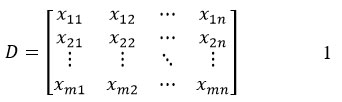
Step 2: Normalization of decision matrix
The normalization of two types of data i.e., better when the higher type or better when lower is evaluated using equations 2 or 3 respectively. After normalization, the data ranges from 0 to 1.
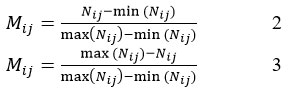
Where i,j=1,2,3,?,n
Step 3: Calculation of Gray relation coefficient

Step 4: Calculation of Gray relation grade

It represents the Gray Relation Coefficient on averages. After that, options are ordered using the "Gray Relation Coefficient's average" 28,29. The major goal of this strategy is to choose the best BPM solution for the business buying or implementing it, allowing for safer, quicker, more cost-effective, and more effective use of the BPM tool. Based on the primary goal, the corporate experts can choose the factors to be taken into account while choosing the BPM tool. Before assessing the alternatives to BPM tools, it is vital to determine "the benefit and cost standards" that will be used. We will also establish the corresponding rank values for each of the criteria at this point. Afterwards, we may utilise the GRA approach to specify "the weight for the standards". After the consideration, “Readability, Usability, Formality, Operating cost, Training cost, Application and Installment time” are to be used for BPM tool selection. In this example, we consider 6 candidates “BPM tools (JFern, JPetriNet, GreatSPN, GDToolkit, TimeNet and ADONIS: CE)”.
Analysis and Discussion
Table 1: Evaluation rank value for all the business process modelling tool selection criterions
|
BPM Tools |
Readability |
Usability |
Formality |
Operating cost |
Training cost |
Instalment time |
|
Jfern |
3 |
2 |
3 |
2 |
2 |
3 |
|
JPetriNet |
3 |
2 |
3 |
2 |
2 |
2 |
|
GreatSPN |
4 |
3 |
2 |
4 |
3 |
3 |
|
GDToolkit |
5 |
4 |
3 |
2 |
3 |
2 |
|
TimeNet |
2 |
3 |
4 |
3 |
2 |
4 |
|
ADONIS: CE |
2 |
1 |
2 |
1 |
1 |
5 |
Table 1 shows the initial decision matrix for the Evaluation rank value for all the business process modelling tool selection criteria. Here we consider 6 candidate BPM tools (JFern, JPetriNet, GreatSPN, GDToolkit, TimeNet and ADONIS: CE). After the consideration, “Readability, Usability, Formality, Operating cost, Training cost, Application and Installment time” are to be used as evaluation parameters for BPM tool selection. Here Readability, Usability, and Formality are beneficial criteria. Operating cost, Training cost, and Application and Installment time are taken as non-beneficial criteria.
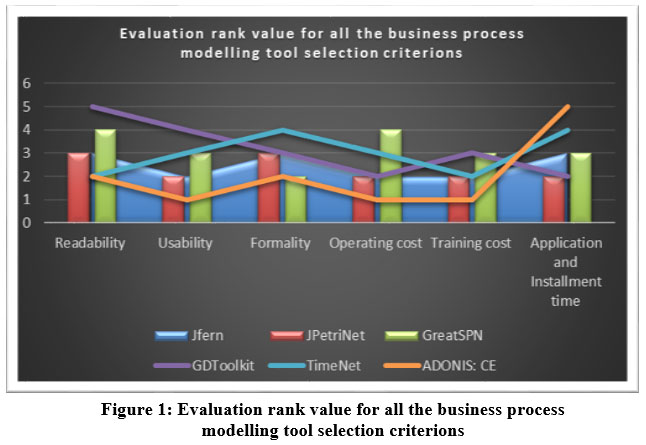 |
Figure 1. Evaluation rank value for all the business process modelling tool selection criterions Click here to view Figure |
Figure 1 illustrates the initial decision matrix for Evaluation rank value for all the business process modelling tool selection criteria. Here we consider 6 candidate BPM tools (JFern, JPetriNet, GreatSPN, GDToolkit, TimeNet and ADONIS: CE). After the consideration, “Readability, Usability, Formality, Operating cost, Training cost, Application and Installment time” are to be used as evaluation parameters for BPM tool selection.
Table 2: Normalized matrix.
|
0.3333 |
0.3333 |
0.5000 |
0.6667 |
0.5000 |
0.6667 |
|
0.3333 |
0.3333 |
0.5000 |
0.6667 |
0.5000 |
1.0000 |
|
0.6667 |
0.6667 |
0.0000 |
0.0000 |
0.0000 |
0.6667 |
|
1.0000 |
1.0000 |
0.5000 |
0.6667 |
0.0000 |
1.0000 |
|
0.0000 |
0.6667 |
1.0000 |
0.3333 |
0.5000 |
0.3333 |
|
0.0000 |
0.0000 |
0.0000 |
1.0000 |
1.0000 |
0.0000 |
Table 2 shows the normalized array for Evaluation rank value for all the business process modelling tool selection criteria. This is calculated using equation 2 for beneficial criteria (Readability, Usability, Formality) and equation 3 for non-beneficial criteria (Operating cost, Training cost, Application and Installment time).
Table 3: Deviation sequence.
|
0.6667 |
0.6667 |
0.5000 |
0.3333 |
0.5000 |
0.3333 |
|
0.6667 |
0.6667 |
0.5000 |
0.3333 |
0.5000 |
0.0000 |
|
0.3333 |
0.3333 |
1.0000 |
1.0000 |
1.0000 |
0.3333 |
|
0.0000 |
0.0000 |
0.5000 |
0.3333 |
1.0000 |
0.0000 |
|
1.0000 |
0.3333 |
0.0000 |
0.6667 |
0.5000 |
0.6667 |
|
1.0000 |
1.0000 |
1.0000 |
0.0000 |
0.0000 |
1.0000 |
Table 3 shows the Deviation sequence matrix for Evaluation rank value for all the business process modelling tool selection criteria. This value is calculated using equation 4, that is Maximum value of the column of normalized value is subtracted from the current value of the normalized matrix.
Table 4: Grey Relation Coefficient.
|
0.4286 |
0.4286 |
0.5000 |
0.6000 |
0.5000 |
0.6000 |
|
0.4286 |
0.4286 |
0.5000 |
0.6000 |
0.5000 |
1.0000 |
|
0.6000 |
0.6000 |
0.3333 |
0.3333 |
0.3333 |
0.6000 |
|
1.0000 |
1.0000 |
0.5000 |
0.6000 |
0.3333 |
1.0000 |
|
0.3333 |
0.6000 |
1.0000 |
0.4286 |
0.5000 |
0.4286 |
|
0.3333 |
0.3333 |
0.3333 |
1.0000 |
1.0000 |
0.3333 |
Table 4 shows the Grey Relation Coefficient matrix for Evaluation rank value for all the business process modelling tool selection criteria. This value is calculated using equation 5 and the zeta value is 0.5. Table 3 Deviation sequence matrix is for calculating Grey Relation Coefficient.
Table 5: Grey Relation Grade
|
BPM tools |
GRG |
|
Jfern |
0.5095 |
|
JPetriNet |
0.5762 |
|
GreatSPN |
0.4667 |
|
GDToolkit |
0.7389 |
|
TimeNet |
0.5484 |
|
ADONIS: CE |
0.5556 |
Table 5 shows the Grey Relation Grade value for alternate BPM tools taken for this paper. Its average values of the Grey Relation Coefficient using table 4. Here Grey Relation Grade value for Jfern is 0.5095, JPetriNet is 0.5762, GreatSPN is 0.4667, GDToolkit is 0.7389, TimeNet is 0.5484 and ADONIS: CE is 0.5556.
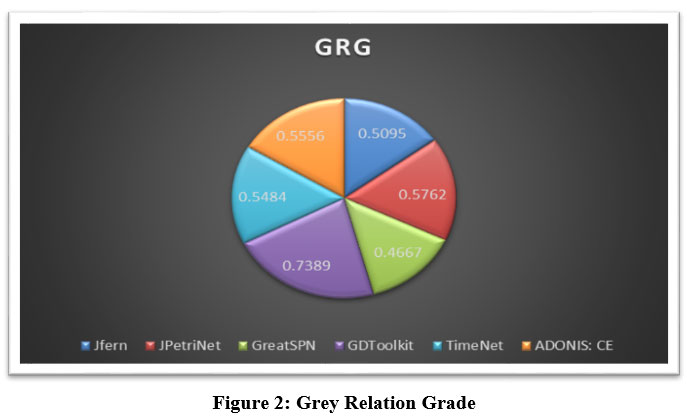 |
Figure 2: Grey Relation Grade Click here to view Figure |
Figure 2 shows the graphical representation of the Grey Relation Grade value for alternate BPM tools taken for this paper. Its average values of the Grey Relation Coefficient using table 4. Here Grey Relation Grade value for Jfern is 0.5095, JPetriNet is 0.5762, GreatSPN is 0.4667, GDToolkit is 0.7389, TimeNet is 0.5484 and ADONIS: CE is 0.5556.
Table 6: The rank of BPM tools.
|
BPM tools |
Rank |
|
Jfern |
5 |
|
JPetriNet |
2 |
|
GreatSPN |
6 |
|
GDToolkit |
1 |
|
TimeNet |
4 |
|
ADONIS: CE |
3 |
Table 5 shows the rank of the alternate BPM tools taken for this paper by ranking Grey Relation Grade values using table 5. Here rank for Jfern is fifth, JPetriNet is second, GreatSPN is sixth, GDToolkit is first, TimeNet is fourth and ADONIS: CE is third. The ranking order is “GDToolkit > JPetriNet > ADONIS: CE > TimeNet > Jfern > GreatSPN”.
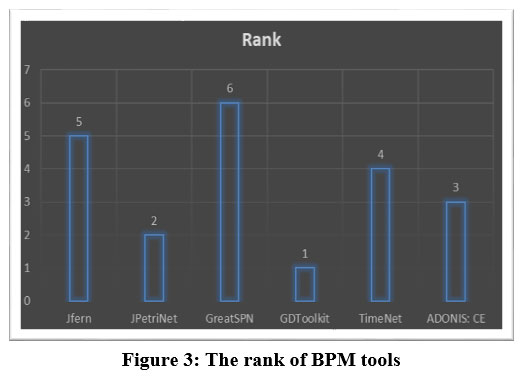 |
Figure 3: The Rank Of Bpm Tools. Click here to view Figure |
Figure 3 shows a graphical representation of the rank of the alternate BPM tools taken for this paper by ranking Grey Relation Grade values using table 5. Here rank for Jfern is fifth, JPetriNet is second, GreatSPN is sixth, GDToolkit is first, TimeNet is fourth and ADONIS: CE is third. The ranking order is “GDToolkit > JPetriNet > ADONIS: CE > TimeNet > Jfern > GreatSPN”. In this paper, the GRA analysis shows that the best preferred BPM tool is GDToolkit and the least preferred BPM tool is GreatSPN.
Conclusion
Industry professionals that have experience in the modelling area generally execute business process modelling (BPM), an efficient activity for expressing business operations for a corporation. BPM is a crucial component of businesses' efforts to optimize the efficiency of their information systems (IS). "Management and BPM" are increasingly important components of today's businesses. In the meantime, BPM "(Business Process Modeling) tools" are regarded as a great way to link modelling stakeholders and BPM cultures. The associated model can be shown to stakeholders using "BPM tools, and stakeholders" can also use these tools to manage and govern the model. For instance, BPM technologies can be used to create "business process models for the automobile manufacturing industry". Choosing the right BPM tool can be considered a crucial issue for a business because a bad choice can have a major and detrimental effect on the BPM modelling process, which will immediately damage the growth of business IS. Selecting an efficient BPM platform for the firm is a hard process, and numerous factors that influence BPM ought to be examined. This study applies a technique centred on "the Grey Relational Analysis (GRA) methodology" to assist businesses in choosing the best business process modelling technology, resulting in a more effective, affordable, and secure business process modelling approach. The rank for Jfern is fifth, JPetriNet is second, GreatSPN is sixth, GDToolkit is first, TimeNet is fourth and ADONIS: CE is third. The ranking order is “GDToolkit > JPetriNet > ADONIS: CE > TimeNet > Jfern > GreatSPN”. In this paper, the GRA analysis shows that the best preferred BPM tool is GDToolkit and the least preferred BPM tool is GreatSPN.
References
- Kopp, A. M., and D. L. Orlovskyi. "A Method for Business Process Model Analysis and Improvement." CEUR Workshop Proceedings, 2019.
- Augusto, Adriano, Raffaele Conforti, Marlon Dumas, Marcello La Rosa, and Artem Polyvyanyy. "Split miner: automated discovery of accurate and simple business process models from event logs."Knowledge and Information Systems 59 (2019): 251-284.
- Avila, Diego Toralles, Rubens Ideron dos Santos, Jan Mendling, and Lucineia Heloisa Thom. "A systematic literature review of process modeling guidelines and their empirical support." Business Process Management Journal 27, no. 1 (2020): 1-23.
- Pérez-Álvarez, José Miguel, María Teresa Gómez-López, Rik Eshuis, Marco Montali, and Rafael M. Gasca. "Verifying the manipulation of data objects according to business process and data models." Knowledge and Information Systems 62, no. 7 (2020): 2653-2683.
- Fischer, Marcus, Florian Imgrund, Christian Janiesch, and Axel Winkelmann. "Strategy archetypes for digital transformation: Defining meta objectives using business process management." Information & Management 57, no. 5 (2020): 103262.
- Dimitrijevi?, Dragan, Živoslav Adamovi?, Snežana Uroševi?, and Bratislav Prokopovi?. "The process of creating of the model of AME-participation and benefits of computing modeling (part 2)." Tekstilna industrija 67, no. 1 (2019): 39-50.
- Yang, Rebecca, Ron Wakefield, Sainan Lyu, Sajani Jayasuriya, Fengling Han, Xun Yi, Xuechao Yang, Gayashan Amarasinghe, and Shiping Chen. "Public and private blockchain in construction business process and information integration." Automation in construction 118 (2020): 103276.
- Baiyere, Abayomi, Hannu Salmela, and Tommi Tapanainen. "Digital transformation and the new logics of business process management." European Journal of Information Systems 29, no. 3 (2020): 238-259.
- López?Pintado, Orlenys, Luciano García?Bañuelos, Marlon Dumas, Ingo Weber, and Alexander Ponomarev. "Caterpillar: a business process execution engine on the Ethereum blockchain." Software: Practice and Experience 49, no. 7 (2019): 1162-1193.
- Wamba-Taguimdje, Serge-Lopez, Samuel Fosso Wamba, Jean Robert Kala Kamdjoug, and Chris Emmanuel Tchatchouang Wanko. "Influence of artificial intelligence (AI) on firm performance: the business value of AI-based transformation projects." Business Process Management Journal 26, no. 7 (2020): 1893-1924.
- Ritchi, Hamzah, Mieke Jans, Jan Mendling, and Hajo A. Reijers. "The influence of business process representation on performance of different task types." Journal of Information Systems 34, no. 1 (2020): 167-194.
- Lazaropoulos, Athanasios G. "Business Education and Training During the Enterprises' Digital Transformation: Notation Alignment and Equivalence Rules Among the Enterprises' Business Process Models." Regional Economic Development Research (2021): 51-70.
- Golosova, J?lija, Signe Remese, and Andrejs Rom?novs. "Development of the business processes modelling lab tools." In 2019 Open Conference of Electrical, Electronic and Information Sciences (eStream), pp. 1-6. IEEE, 2019.
- Wang, Wei, Hongwei Ding, Jin Dong, and Changrui Ren. "A comparison of business process modeling methods." In 2006 IEEE International Conference on Service Operations and Logistics, and Informatics, pp. 1136-1141. IEEE, 2006.
- Chand, Donald R., and Alina M. Chircu. "Business Process Modeling." In Business enterprise, process, and technology management: Models and applications, pp. 32-50. IGI Global, 2012.
- Ou-Yang, C., and Y. D. Lin. "BPMN-based business process model feasibility analysis: a petri net approach." International Journal of Production Research 46, no. 14 (2008): 3763-3781.
- Kumarapeli, Pushpa, Simon De Lusignan, Timothy Ellis, and Beryl Jones. "Using Unified Modelling Language (UML) as a process-modelling technique for clinical-research process improvement." Medical Informatics and the Internet in Medicine 32, no. 1 (2007): 51-64.
- Jin, Guangying, Guangzhe Jin, and Haibo Huo. "Selection of Business Process Modeling Tool with the Application of Fuzzy DEMATEL and TOPSIS Method." Axioms 11, no. 11 (2022): 601.
- Younas, Muhammad, Syed Husain Imran Jaffery, Mushtaq Khan, Muhammad Ali Khan, Riaz Ahmad, Aamir Mubashar, and Liaqat Ali. "Multi-objective optimization for sustainable turning Ti6Al4V alloy using grey relational analysis (GRA) based on analytic hierarchy process (AHP)." The International Journal of Advanced Manufacturing Technology 105 (2019): 1175-1188.
- Olabanji, Olayinka Mohammed, and Khumbulani Mpofu. "Appraisal of conceptual designs: Coalescing fuzzy analytic hierarchy process (F-AHP) and fuzzy grey relational analysis (F-GRA)." Results in Engineering 9 (2021): 100194
- Rani, Pratibha, Arunodaya Raj Mishra, Mohd Dilshad Ansari, and Jabir Ali. "Assessment of performance of telecom service providers using intuitionistic fuzzy grey relational analysis framework (IF-GRA)." Soft Computing 25 (2021): 1983-1993
- Wu, Lei, Jiao Liu, Jun Zhou, Qiuli Zhang, Yonghui Song, Shuai Du, and Wei Tian. "Evaluation of tar from the microwave co-pyrolysis of low-rank coal and corncob using orthogonal-test-based grey relational analysis (GRA)." Journal of Cleaner Production 337 (2022): 130362.
- Sindhu, Dinesh, Lalit Thakur, and Pankaj Chandna. "Multi-objective optimization of rotary ultrasonic machining parameters for quartz glass using Taguchi-Grey relational analysis (GRA)." Silicon 11 (2019): 2033-2044.
- Liang, Z. H. O. U., Tai-hua MU, Ruo-fang ZHANG, Qing-hua SUN, and Yan-wen XU. "Nutritional evaluation of different cultivars of potatoes (Solanum tuberosum L.) from China by grey relational analysis (GRA) and its application in potato steamed bread making." Journal of integrative agriculture 18, no. 1 (2019): 231-245.
- Suvvari, Anandarao, and Phanindra Goyari. "Financial performance assessment using Grey relational analysis (GRA): An application to life insurance companies in India." Grey Systems: Theory and Application (2019).
- Bhaumik, Munmun, and Kalipada Maity. "Multi-response optimization of EDM parameters using grey relational analysis (GRA) for Ti-5Al-2.5 Sn titanium alloy." World Journal of Engineering 18, no. 1 (2021): 50-57.
- Wang, Lihong, Kedong Yin, Yun Cao, and Xuemei Li. "A new grey relational analysis model based on the characteristic of inscribed core (IC-GRA) and its application on seven-pilot carbon trading markets of China." International journal of environmental research and public health 16, no. 1 (2019): 99.
- Javed, Saad Ahmed, Angappa Gunasekaran, and Amin Mahmoudi. "DGRA: Multi-sourcing and supplier classification through Dynamic Grey Relational Analysis method." Computers & Industrial Engineering 173 (2022): 108674.
- Li, Weichen, Xusheng Ren, Shimin Ding, and Lichun Dong. "A multi-criterion decision making for sustainability assessment of hydrogen production technologies based on objective grey relational analysis." International Journal of Hydrogen Energy 45, no. 59 (2020): 34385-34395.
- Chen, M. F., Tzeng, G. H., & Tang, T. I. (2005). Fuzzy MCDM approach for evaluation of expatriate assignments. International Journal of Information Technology & Decision Making, 4(02), 277-296.
- Wu, D., & Olson, D. L. (2006). A TOPSIS data mining demonstration and application to credit scoring. International Journal of Data Warehousing and Mining (IJDWM), 2(3), 16-26.
- Lin, Y. T., Lin, C. L., Yu, H. C., & Tzeng, G. H. (2010). A novel hybrid MCDM approach for outsourcing vendor selection: A case study for a semiconductor company in Taiwan. Expert systems with applications, 37(7), 4796-4804.
- Jiang, B. C., Tasi, S. L., & Wang, C. C. (2002). Machine vision-based gray relational theory applied to IC marking inspection. IEEE Transactions on Semiconductor Manufacturing, 15(4), 531-539.
- Wu, S. M., Liu, H. C., & Wang, L. E. (2017). Hesitant fuzzy integrated MCDM approach for quality function deployment: a case study in electric vehicle. International Journal of Production Research, 55(15), 4436-4449.

This work is licensed under a Creative Commons Attribution 4.0 International License.